Best Shade Grass Seed for Steep, Wooded Slopes

Seven shade-tolerant grass seeds ranked for steep, wooded slopes, with the deciding specs, honest trade-offs, and the one bag most homeowners should reach for first.

By Taylor MontgomeryUpdated 19 min read
On this page
- How I narrowed the shortlist to seven bags
- Best shade tolerant grass seed for steep hills at a glance
- The deciding spec most guides miss
- 1. Jonathan Green 40600 Dense Shade Grass Seed — Best overall
- 2. Jonathan Green Black Beauty Dense Shade Grass Seed — Runner-up
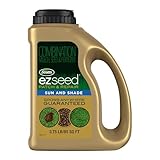
- 3. Scotts EZ Seed Patch & Repair for Sun and Shade — Best budget pick
- 4. Pennington Smart Patch Dense Shade Grass Seeds — Best for beginners
- 5. Scotts Turf Builder Thick'r Lawn Sun & Shade — Best for heavy use
- 6. Pennington Kentucky 31 Tall Fescue Grass Seed — Best for families
- 7. Majesty Green Power Shade Grass Seed — Best premium
- Does any of this seed actually hold a steep hill?
- How much seed does a slope really need?
- What the bag does not tell you about shade
- How to seed a wooded bank without losing it to the next storm
- The verdict
- FAQ
The best shade tolerant grass seed for steep hills is Jonathan Green 40600 Dense Shade Grass Seed, a 3 lb bag rated by the label for 1,800 sq ft of coverage, which is enough seed to actually finish a mid-sized bank in one pass. If your slope is small and sits under heavy tree cover, Jonathan Green Black Beauty Dense Shade is the tighter fit, with a 14 to 21 day germination window claimed on the bag and a four-grass mix built for low light.
How I narrowed the shortlist to seven bags
A quick word on the modifier before the picks. None of these bags is sold as a "steep slope" product with a published slope rating or a tackifier disclosure on the label. Scotts EZ Seed Patch & Repair is the only one whose listing explicitly claims it "is guaranteed to grow anywhere with proper care including in full sun, dense shade, high traffic areas and on slopes." Everything else in the set is a shade or sun-and-shade mix that homeowners commonly use on hillsides, but the slope call is yours to make from prep and coverage, not from a certification on the bag.
I worked from what the listings actually publish: bag size, coverage claim, grass species, germination window, and where in this seven-bag set each product sits on price and popularity. Anything I could not verify from the listing, I left out.
The criteria, in the order I weighted them:
- Shade tolerance stated on the bag. Dense-shade blends beat "sun and shade" blends for anything under real canopy.
- Coverage per bag against slope size. A slope you cannot finish in one bag is a slope with seams.
- Species mix. Fine fescues and turf-type tall fescue anchor better on banks than pure Kentucky bluegrass.
- Germination window. Faster establishment means less washout risk.
- Set position on price and popularity. Used to break ties, not to lead.
Two picks got cut in earlier rounds and are worth naming so you know what did not make it: pure Kentucky bluegrass monocultures, which are slow to establish and shallow-rooted on a bank, and any product whose listing said nothing about shade at all.
Best shade tolerant grass seed for steep hills at a glance
| Pick | Coverage claim | Shade rating | Price |
|---|---|---|---|
Best overall Jonathan Green 40600 Dense Shade |
1,800 sq ft | Dense shade | Check Price |
| 300 sq ft new 600 sq ft overseed |
Dense shade | Check Price | |
Best budget pick Scotts EZ Seed Patch & Repair |
85 sq ft | Sun and dense shade | Check Price |
Best for beginners Pennington Smart Patch Dense Shade |
Not listed | Dense shade | Check Price |
Best for heavy use Scotts Turf Builder Thick'r Lawn Sun & Shade |
1,000 sq ft | Sun and shade | Check Price |
Best for families Pennington Kentucky 31 Tall Fescue |
Not listed | Not shade-specific | Check Price |
Best premium Majesty Green Power Shade |
Not listed | Shade and low light | Check Price |




The deciding spec most guides miss
Most shade-seed comparisons stop at "tolerates shade" and move on. That is not what decides a bag for a steep, shady hill. The deciding spec is coverage per bag against the square footage of your slope.
Here is why. On a flat lawn, a thin second pass fixes a thin first pass. On a slope, every extra pass is another day of exposed soil and another storm's chance to move your seed downhill. You want one bag, one prep, one seed, one straw or tackifier cover. Miss on coverage and you get racing stripes of bare soil where the seed ran out.
The gap between the picks here is enormous. Jonathan Green 40600 is a 3 lb bag rated for 1,800 sq ft. Scotts EZ Seed at 3.75 lb is rated for 85 sq ft, because most of the jug is mulch and tackifier rather than seed. Scotts Thick'r Lawn covers 1,000 sq ft per 10 lb bag. Match the coverage figure to the slope you actually have before you match anything else.
1. Jonathan Green 40600 Dense Shade Grass Seed — Best overall
A 3 lb bag rated for 1,800 sq ft of dense-shade coverage, which is the best coverage-to-shade ratio in this shortlist.
Best for: wooded backyards with dappled shade and a 1,500 to 1,800 sq ft slope Skip it if: your bank is bare clay with no existing turf to knit into
Jonathan Green calls this a dense-shade seed and prints an 1,800 sq ft coverage claim on the label, which is the number that matters on a hillside. Three pounds is enough seed to finish a mid-sized bank in a single pass, and finishing in one pass is what keeps rain from carving channels between your seeded rows. The listing describes it as 100% grass seed, meaning it is not padded with mulch fillers the way a patch product is, so the coverage figure reflects actual seed on the ground.
Model JOG10600 sits at 7,843 in category sales rank within this set, which is a middle position: buyers are choosing it, but it is not the busiest listing on the shortlist. Within the seven bags here it lands mid-range on price, and for a dense-shade blend at 1,800 sq ft that is the trade-off working in your favour. Against Black Beauty it wins on coverage. Against the Scotts Thick'r Lawn it wins on shade specificity. Its trade-off is that the listing does not publish a full species breakdown, so you are buying on the coverage claim and the shade rating rather than a printed seed tag.
Pros:
- 1,800 sq ft claimed coverage from a 3 lb bag
- Dense-shade rating printed on the label
- Enough seed to finish a mid-sized slope in one pass
- 100% seed rather than seed-and-mulch mix
- Mid-range price position for the coverage delivered
Cons:
- Species breakdown not published on the listing
- No warranty text on the listing
- Slower-selling than Black Beauty within this set
2. Jonathan Green Black Beauty Dense Shade Grass Seed — Runner-up
A 1 lb dense-shade blend of four cool-season species, with a 14 to 21 day germination window claimed on the label.

Best for: small, dense-shade patches under mature trees Skip it if: you need to cover more than 600 sq ft in one go
Black Beauty is the shortlist's most transparent bag. Jonathan Green publishes the mix on the listing: turf-type tall fescue, Kentucky bluegrass, perennial rye, and fine fescues, which is the full cool-season toolkit for a low-light lawn. The listing states 14 to 21 days to germination and covers up to 300 sq ft as a new seeding or 600 sq ft as an overseed. That coverage is why it is the runner-up rather than the winner: on a real hillside, one bag rarely finishes the job.
Where it earns its place is species mix. Fine fescues are the shade specialists of the cool-season group and they anchor better on banks than bluegrass alone. If your slope is a shaded pocket rather than a whole yard, this is the tighter fit than the 40600. It sits second-cheapest in this set, and it is the second-fastest seller of the seven, so it is easy to add a second bag if you need one. The trade-off is straightforward: you are buying a smaller bag with a fuller spec sheet, which is a good deal on 300 sq ft and a poor one on 3,000.
Pros:
- Four cool-season species named on the listing
- 14 to 21 day germination window published
- Fine fescues in the mix for shade and slope
- Second-cheapest of the seven picks
- Second-fastest seller in this shortlist
Cons:
- Only 300 sq ft new-seeding coverage per bag
- Expensive per square foot on large slopes
- Smaller bag means more seams on a big project
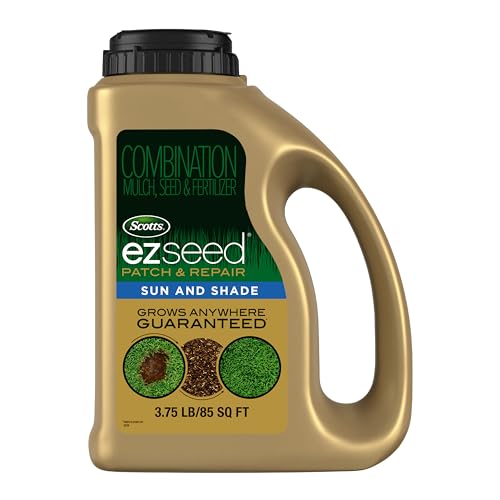
3. Scotts EZ Seed Patch & Repair for Sun and Shade — Best budget pick
A seed-mulch-fertilizer-tackifier combo whose listing explicitly names slopes as an intended use.
Best for: washed-out bare spots on a slope where seed keeps sliding Skip it if: the whole hillside is bare and you need real coverage
EZ Seed is the cheapest bag in this set and the fastest seller on the shortlist by a wide margin, ranking 41 in its category against 149,750 for the slowest pick here. It is the only product whose listing explicitly claims it is designed to grow on slopes, and it is the only one that ships with a built-in tackifier to hold seed against water movement. That is a genuine advantage on a steep site.
The catch is coverage. One 3.75 lb jug covers 85 sq ft, because the jug is mostly mulch, controlled-release fertilizer, and tackifier surrounding a smaller portion of Kentucky bluegrass, perennial ryegrass, and fine fescue. That is a patch product, not a hillside seeding. Use it exactly the way the label suggests: for the bare patches on a slope where the topsoil has already moved, where a plain seed will not stick and needs the mulch-and-tackifier system to anchor it. Scotts says germination is best when daytime temperatures sit between 60°F and 80°F with no frost risk, so time it to spring or early fall.
Pros:
- Cheapest pick in the shortlist
- The only listing that names slopes as an intended use
- Built-in tackifier holds seed on a bank
- Mulch and fertilizer combined in one product
- Fastest-selling product in this set
Cons:
- Only 85 sq ft coverage per jug
- Expensive per square foot for whole-slope seeding
- Mixed sun-and-shade rating rather than dense-shade
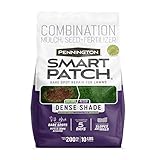
4. Pennington Smart Patch Dense Shade Grass Seeds — Best for beginners
A 10 lb dense-shade patch product sold with a written money-back guarantee printed on the listing.

Best for: first-time seeders who want a bag with a written money-back promise Skip it if: you already know how to prep and time an overseed
Pennington's Smart Patch is the only bag in this shortlist whose listing carries a full money-back warranty, with a mailing address and a phone number for returns. For a first-time seeder that is genuine value: you can try it, and if the slope does not take, you have a written path to a refund. The listing describes it as seed and fertilizer in one, with added microbials that Pennington says prevent disease and improve overall lawn health. It is aimed at lawns receiving little to no sunlight, which is the right rating for a shaded bank.
Its weakness is that the listing does not publish a coverage figure, which is exactly the number the deciding-spec section says you need. Ten pounds of a patch-and-fertilizer mix is not the same as ten pounds of straight seed, and without a stated square footage you are guessing how far it goes. It sits fifth in price rank of the seven and lands in the premium band, so you are paying for the guarantee and the fertilizer more than for raw coverage. Against the 40600, it loses on stated coverage and wins on written warranty.
Pros:
- Money-back guarantee published on the listing
- Dense-shade rating for low-light lawns
- Seed and fertilizer combined in one bag
- Microbial additive named by the manufacturer
- 10 lb bag suits medium-sized projects
Cons:
- No coverage figure listed on the bag
- Premium price position within this set
- Slower germination not published on the listing
5. Scotts Turf Builder Thick'r Lawn Sun & Shade — Best for heavy use
A 10 lb, 1,000 sq ft three-in-one product built to thicken an existing thin lawn on a slope.

Best for: thickening a thin, part-shade slope that kids and dogs still cross Skip it if: the slope has almost no living grass left to thicken
Thick'r Lawn is a three-in-one: grass seed, fertilizer, and soil improver. Scotts claims up to a 50% thicker lawn subject to proper care, and rates one 10 lb bag for 1,000 sq ft of application. That coverage figure is the second-largest in this shortlist, behind only the 40600, and it is why this bag earns its slot for a busy household. The soil improver is the specific advantage on a slope, because a shaded bank is usually compacted and low in organic matter.
Scotts recommends applying once in late spring and once in late summer or early fall, which fits the two seeding windows for cool-season grass. It is rated sun-and-shade rather than dense-shade, so it is the wrong pick under a heavy canopy but the right pick for a slope that gets three to five hours of filtered light. It is the most expensive bag in this set, and the listing does not name the specific grass species, which is the trade-off you are making for the coverage and the soil improver. Against the 40600, it loses on shade specificity and wins on soil improvement.
Pros:
- 1,000 sq ft coverage per 10 lb bag
- Seed, fertilizer and soil improver in one product
- Two-application-a-year schedule published
- Up to 50% thicker lawn claim from Scotts
- Big enough bag for medium slopes in one pass
Cons:
- Sun-and-shade rating rather than dense-shade
- Most expensive bag in this set
- Species mix not published on the listing
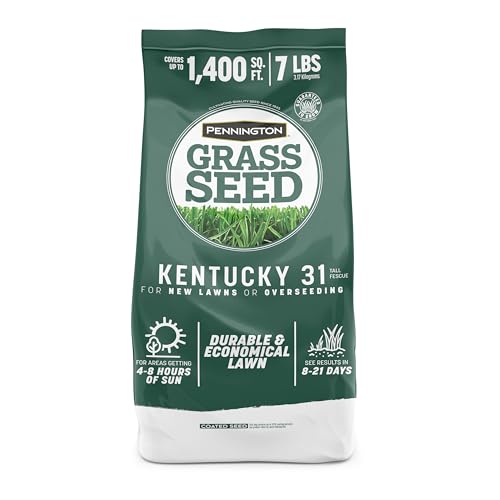
6. Pennington Kentucky 31 Tall Fescue Grass Seed — Best for families
A 7 lb bag of drought-resistant Kentucky 31 tall fescue with an 8 to 21 day germination window.
Best for: high-traffic banks in the transition zone with only light shade Skip it if: the slope is under dense tree canopy most of the day
Kentucky 31 is the traffic answer in this shortlist. Pennington describes it as growing thick blades that stand up to hot summers and heavy rains, and says the lawn seed holds up well under foot traffic. That matters on a family slope where the bank is also a shortcut to the trampoline. Tall fescue also puts down deeper roots than bluegrass, and deeper roots are what hold a hillside together in a hard rain. Germination lands in an 8 to 21 day window.
Read the shade rating honestly. Kentucky 31 is a tall fescue, and tall fescue is the most shade-tolerant of the true sun grasses, but it is not a dense-shade blend. If the slope gets four hours of filtered sun a day, this bag is a very good choice, and it will out-wear the dense-shade mixes on traffic. If the slope is under mature oaks with two hours of light, pick the 40600 or Black Beauty instead. It sits third-cheapest in this set and third in category popularity of the seven, so it is a well-supported listing. Its trade-off is real: traffic tolerance in return for less deep-shade performance.
Pros:
- Traffic-tolerant tall fescue
- 8 to 21 day germination range
- Deep roots that hold soil on a bank
- Third-cheapest bag in the shortlist
- Drought-resistant claim from Pennington
Cons:
- Not a dense-shade blend
- Single-species rather than a mix
- No published coverage figure
7. Majesty Green Power Shade Grass Seed — Best premium
A shade-and-low-light blend with a 7 to 14 day germination claim and a moisture-resistance callout.

Best for: damp, low-light corners where moisture rots most mixes out Skip it if: you want a published coverage figure before you buy
Majesty Green Power Shade is the only bag in this shortlist whose listing explicitly flags moisture resistance, saying it is crafted to flourish in areas with high moisture and frequent rainfall. On a north-facing wooded slope that stays damp for days after a storm, that is a genuinely useful callout, because moisture is what kills most shade seedings before they establish. The listing also claims 7 to 14 day germination under optimal conditions, which is the fastest window named in this set.
It is the slowest seller here by a wide margin, ranking 149,750 in the category, and the most expensive bag in the shortlist. The listing does not publish a coverage figure, so you cannot match this bag to a square footage the way you can with the 40600 or Thick'r Lawn. Nor does the listing publish a species breakdown. You are buying on the shade-and-moisture positioning and on the germination claim, and the trade-off against the winner is straightforward: you get a more specific climate story, but you give up the coverage arithmetic that makes the 40600 the safer default.
Pros:
- 7 to 14 day germination claim
- Moisture-resistance flagged on the listing
- Rated for shade and low light explicitly
- 3 lb bag suits smaller projects
Cons:
- Most expensive bag in this shortlist
- No coverage figure published on the listing
- Slowest seller of the seven
- Species breakdown not stated on the listing
Does any of this seed actually hold a steep hill?
Honest answer: seed alone does not hold a steep hill. Every bag in this shortlist is a shade or shade-tolerant lawn seed, not a slope stabilisation product with a certified erosion rating. Scotts EZ Seed is the only listing that names slopes explicitly and the only one built around a tackifier that grips soil. Everything else relies on you to solve the anchoring problem separately.
What actually holds seed on a bank is a system: a firm, raked seedbed, a light straw or biodegradable erosion blanket pinned over the seed, and enough coverage from the bag to fill the slope in one pass. Do those three things and any of these seeds will establish. Skip them and none of them will, no matter how the label reads. The winner earns its slot because it delivers the coverage you need to finish in one pass. The tackifier is your job.
How much seed does a slope really need?
Coverage is the number you match to the slope, not the bag weight. Measure the bank first, then buy.
- Pace the length of the slope in feet.
- Pace the height of the slope, straight up, in feet.
- Multiply the two. That is the square footage of the face.
- Add 20% for overlap and edges.
- Match that number to the bag's coverage claim, not to its weight.
A quick worked example. A 40 ft wide bank that runs 25 ft from top to bottom is 1,000 sq ft of face, or 1,200 sq ft with the overlap allowance. One 3 lb Jonathan Green 40600 covers 1,800 sq ft, so it finishes the job in one bag with margin. Two Black Beauty bags cover 600 sq ft of new seeding between them, which is not enough. Fourteen jugs of EZ Seed would be needed to cover the same face, which is why patch products belong on patches.
Common coverage mistakes on a slope:
- Buying by weight instead of by stated coverage
- Ignoring the 20% overlap allowance
- Assuming a patch product is a hillside product
- Forgetting that overseeding rates are half of new-seeding rates
What the bag does not tell you about shade
Shade is not one thing, and the label almost never distinguishes. Two hours of morning sun with dry afternoon shade is a completely different growing condition from six hours of damp, filtered shade under a maple canopy. Every seed bag here treats "shade" as a single rating.
Read your slope before you read the bag. Time how many hours of any direct sun the bank gets in mid-summer, not spring, because trees leaf out. Note whether the shade is dry (from a wall or a fence) or damp (from a tree canopy that also drops leaves). Dense-shade blends like the 40600 and Black Beauty are built for the low-light, damp case. Sun-and-shade blends like Thick'r Lawn and EZ Seed are built for the part-sun case. Kentucky 31 is a full-sun grass that tolerates some shade, not a shade grass that tolerates some sun.
The other thing the bag rarely says is what falls on the slope in autumn. A shaded bank under deciduous trees is buried in leaves for six weeks a year. Any seeding done in early fall has to survive that. Aim for late-summer seeding on a leafy site, so the grass is up before the leaves come down.
How to seed a wooded bank without losing it to the next storm
The order matters more than the seed. Here is the sequence that keeps seed on the slope:
- Rake first. Break the surface crust down to loose soil, at least a half inch deep. Seed on a hard surface washes off.
- Amend if needed. If the bank is compacted clay, top-dress with a half-inch of compost before you seed.
- Sow at the rate on the bag. New-seeding rates, not overseeding rates, on a bare or thin slope.
- Firm the seed in. Walk the slope with a rake laid flat, or press it in with the back of a shovel. Contact matters.
- Cover. Straw at a light rate, or a biodegradable erosion blanket pinned with landscape staples on the steepest sections.
- Water lightly and often. Two or three short waterings a day for the first two weeks, not one long soak.
- Time it to the temperature. For the cool-season mixes here, aim for late-summer or early-fall seeding when daytime temperatures sit between 60°F and 80°F.
Skip any of those steps and the seed becomes a downhill statement about erosion. Do them all and the winner in this shortlist will fill a 1,800 sq ft bank in one bag.
The verdict
For most people asking about the best shade tolerant grass seed for steep hills, Jonathan Green 40600 Dense Shade is the pick. It is a dense-shade blend, it publishes 1,800 sq ft of coverage per 3 lb bag, and that is enough seed to finish a mid-sized wooded slope in one pass. Finishing in one pass is the single biggest thing you can do to keep a hillside seeding from washing out.
If your slope is smaller and sits under real canopy, take Jonathan Green Black Beauty Dense Shade instead. It publishes its four-species mix on the listing, states a 14 to 21 day germination window, and covers 300 sq ft as a new seeding. It is the tighter tool for a smaller job. The cutoff between the two is roughly 500 sq ft: below that, Black Beauty; above it, the 40600.
Two situational picks are worth naming. If the slope is bare, washed and steep, use Scotts EZ Seed for the patches where nothing else will grip, because it is the only listing here with a built-in tackifier and a slope callout. If the slope gets three to five hours of filtered sun and takes real foot traffic, use Scotts Thick'r Lawn for the soil improver and the 1,000 sq ft coverage.
FAQ
Is shade tolerant grass seed worth it for a slope that only gets morning sun?
Shade tolerant grass seed is worth it whenever a slope drops below about four hours of direct sun a day, and morning-only sites usually do. A dense-shade blend like the Jonathan Green 40600 will establish where a sun mix thins out. If your bank gets four to six hours of filtered sun, a sun-and-shade blend like Scotts Thick'r Lawn is the better middle-ground pick.
How does Jonathan Green 40600 compare to Black Beauty Dense Shade?
Jonathan Green 40600 covers 1,800 sq ft per 3 lb bag and is built for whole-slope seeding. Black Beauty covers 300 sq ft of new seeding per 1 lb bag but publishes its four-species mix on the listing, including fine fescues that anchor well on banks. Pick the 40600 for slopes over 500 sq ft; pick Black Beauty for smaller pockets under mature trees.
Can Scotts EZ Seed really hold on a steep hill?
Scotts EZ Seed can hold on a steep hill in patch-sized doses, because its listing explicitly names slopes and it includes a tackifier that grips soil. One 3.75 lb jug only covers 85 sq ft, though, so it is a patch product, not a hillside seeding. Use it for washed-out bare spots on a bank and pair it with a broader-coverage seed for the rest of the slope.
What germination window should I expect on a shaded slope?
Germination on a shaded slope tracks the label. Jonathan Green Black Beauty lists 14 to 21 days, Pennington Kentucky 31 lists 8 to 21 days, and Majesty Green Power Shade claims 7 to 14 days under optimal conditions. Cool, damp shade slows every one of those windows by three to five days in practice, so plan on the longer end of the range and keep watering through it.
What is the most common mistake on a shaded, sloped seeding?
The most common mistake on a shaded, sloped seeding is buying a patch product for a whole-slope job. Patch products like Scotts EZ Seed at 85 sq ft per jug and Pennington Smart Patch are built for small bare spots. On a 1,000 sq ft bank you need a bag rated for full-area coverage, like Jonathan Green 40600 at 1,800 sq ft or Scotts Thick'r Lawn at 1,000 sq ft.
Measure the face of your slope this weekend, add a 20% overlap allowance, and match that number to the coverage figure on the bag rather than the weight. For most homeowners with a shaded, wooded bank in the 500 to 1,800 sq ft range, that arithmetic points to Jonathan Green 40600 as the safe default: one bag, one prep, one pass, and enough dense-shade seed to actually finish the job before the next storm arrives. Pair it with a light straw cover or a pinned erosion blanket on the steepest sections, and time the seeding to a late-summer or early-fall window with daytime temperatures between 60°F and 80°F.