Best Shade Grass Seed for Large Yards: Pennington Wins
Six shade-tolerant grass seed mixes ranked for large yards, with the bag size, coverage claims and light thresholds that actually decide the buy.

By Taylor MontgomeryUpdated 15 min read
On this page
- Best shade tolerant grass seed for large yards at a glance
- How I narrowed six bags down for a big yard
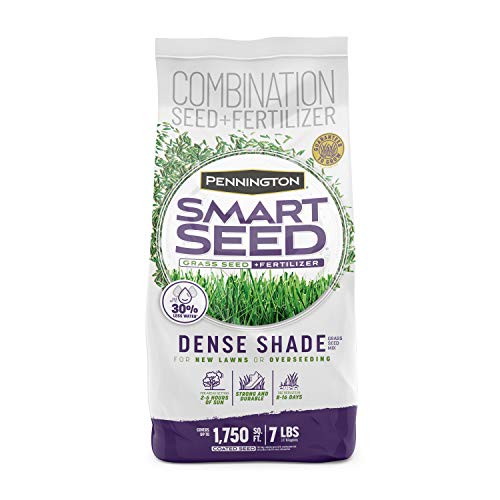
- 1. Pennington Smart Seed Dense Shade Mix Grass Seeds for Lawn — Best overall
- 2. Pennington Kentucky 31 Tall Fescue Grass Seed — Runner-up
- 3. Scotts Turf Builder Grass Seed Sun & Shade Mix — Best premium
- 4. Scotts EZ Seed Patch & Repair for Sun and Shade — Best budget pick
- 5. Jonathan Green 40600 Dense Shade Grass Seed — Best for beginners
- 6. Jonathan Green Black Beauty Heat & Drought Resistant Grass — Best for small spaces
- How much ground does one bag really cover?
- Cool-season blends versus patch products
- What large-yard buyers keep getting wrong
- How to read a shade rating on a seed bag
- The verdict
- FAQ
The best shade tolerant grass seed for large yards is Pennington Smart Seed Dense Shade Mix, a 7 lb bag of ryegrass, Kentucky bluegrass and tall fescue that Pennington says will grow on just 2 to 6 hours of sunlight. Most shoppers compare bag weight and price. What actually decides a large-yard buy is claimed square footage per bag against the light your worst zone gets. Go with Scotts Turf Builder Sun & Shade if you are seeding a new lawn from scratch and want the biggest published coverage figure per bag.
Best shade tolerant grass seed for large yards at a glance
| Pick | Bag size | Shade claim | Price |
|---|---|---|---|
Best overall Pennington Smart Seed Dense Shade |
7 lb | Grows on 2 to 6 hours of sun | Check Price |
Runner-up Pennington Kentucky 31 Tall Fescue |
7 lb | Tall fescue, sun to light shade | Check Price |
Best premium Scotts Turf Builder Sun & Shade |
5.6 lb | Full sun to moderate shade | Check Price |
Best budget pick Scotts EZ Seed Patch & Repair |
3.75 lb | Sun to dense shade (patch) | Check Price |
Best for beginners Jonathan Green Dense Shade |
3 lb | Dense shade blend | Check Price |
Best for small spaces Jonathan Green Black Beauty |
3 lb | Full sun to light shade | Check Price |




How I narrowed six bags down for a big yard
Three reasons cut most of the bags I looked at. First, a shade claim without a stated light threshold. A label that says "sun and shade" without a number tells you nothing about a yard where half the grass sits under oaks. Second, a bag under 3 lb, which forces a large-yard buyer to stack four or five orders to cover a single side lawn. Third, no cool-season grasses listed in the mix, because warm-season blends fail the shade test whatever the front of the bag promises.
The six that survived are the ones where the listing publishes either a light threshold, a coverage figure in square feet, or a named blend with a fescue or bluegrass component. Two of the six are Pennington, two are Scotts, two are Jonathan Green. Bag sizes run 3 lb to 7 lb. Only one, Pennington Smart Seed Dense Shade Mix, states a specific light range in the product feature bullets. That number is why it leads.
The keyword modifier here is large yards, and Amazon's search treats that as a soft filter. Read the coverage claim before you buy, not the bag weight.
1. Pennington Smart Seed Dense Shade Mix Grass Seeds for Lawn — Best overall
A 7 lb bag with a published low-light threshold makes this the safest default for a shaded large yard.
Best for: large shaded lawns getting 2 to 6 hours of sun Skip it if: you only need to patch a few bare spots
Pennington says this mix combines perennial ryegrass, Kentucky bluegrass and tall fescue, and requires only 2 to 6 hours of sunlight. That light number is the single most useful figure in this whole set: no other listing here quotes a comparable range. The bag runs 7 lb at 16.5 x 3.55 x 7.5 in, tying the Kentucky 31 bag for the largest volume in this roundup. Pennington calls the blend disease and traffic resistant, and includes fertilizer with the seed. The listing does not print a square footage figure, which is the one thing I wish it did for a shade tolerant grass seed for large yards. That aside, the shade claim is more specific than anything else here, and the bag is one of the two heaviest in the set. It also carries the most detailed satisfaction guarantee in this roundup, with a mailing address, a phone number and a stated refund process.
Pros:
- Only pick here quoting a 2 to 6 hour light range
- 7 lb bag, tied for largest in this set
- Ryegrass, bluegrass and fescue blend covers cool-season shade
- Fertilizer included per the listing
- Detailed money-back guarantee published
Cons:
- No published square footage figure
- Premium price position in this set
- Only two sellers listed
2. Pennington Kentucky 31 Tall Fescue Grass Seed — Runner-up
A 7 lb bag of pure tall fescue for sunny yards with scattered shade and traffic.
Best for: big sunny yards with scattered shade and foot traffic Skip it if: your yard is mostly deep shade
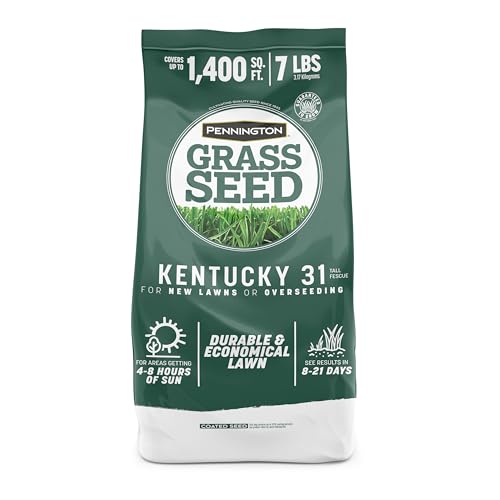
Kentucky 31 is a single-species tall fescue seed, not a shade blend, and that changes what it does well. Pennington calls it drought-resistant, holds up to foot traffic, and says you should see results in 8 to 21 days. The bag matches the Smart Seed at 7 lb and 16.5 x 3.55 x 7.5 in, so coverage per order is on the same scale. Tall fescue tolerates light shade but does not compete with a bluegrass or fine fescue in dense shade under a canopy. That is why it sits behind the Smart Seed for the target reader here. Where it wins is a yard that is mostly sunny with a shaded strip or two, and gets walked on. Kentucky 31 also sells faster in the set than any pick except the EZ Seed patch product. Two of the six picks are Pennington, and if you have a mixed yard you could reasonably buy both.
Pros:
- 7 lb bag, tied largest in this roundup
- Single-species tall fescue, no filler mystery
- Traffic and drought claims from Pennington
- Second-cheapest of the six
- 8 to 21 day germination window quoted
Cons:
- Not a dense-shade blend
- No light-hour threshold published
- No stated warranty on this listing
3. Scotts Turf Builder Grass Seed Sun & Shade Mix — Best premium
The largest published coverage figure in this set: 2,240 sq ft when overseeding.

Best for: seeding a new lawn with mixed sun and moderate shade Skip it if: you already have grass and just want to overseed cheaply
Scotts Turf Builder Sun & Shade is a 5.6 lb bag at 14.5 x 3 x 8.75 in, and Scotts publishes two coverage figures for it: 745 sq ft as a new lawn and 2,240 sq ft when overseeding. That overseeding number is the largest quoted for any bag in this roundup, which is why it earns the premium slot for a big yard. Scotts describes the product as combined seed, fertilizer and soil improver, designed for full sun and moderate shade, with medium drought resistance and medium to high durability. Note the word moderate. This is not the pick for the deepest zone under a mature maple. It is the pick for the four-thousand-square-foot side lawn that is mostly open with two shaded corners. The listing recommends seeding at soil temperatures between 55°F and 70°F. The trade-off against the Pennington leader is a smaller bag and a shade claim that stops at moderate.
Pros:
- Largest coverage claim here at 2,240 sq ft overseed
- Combined seed, fertilizer and soil improver
- Two published coverage figures, new and overseed
- Medium to high durability per the listing
Cons:
- Most expensive pick here
- Shade claim stops at moderate, not dense
- Warranty listed as n.a
- 5.6 lb bag, smaller than the two Pennington bags
4. Scotts EZ Seed Patch & Repair for Sun and Shade — Best budget pick
The cheapest of the six, and the only one built as a patch product rather than a fresh-seeding bag.
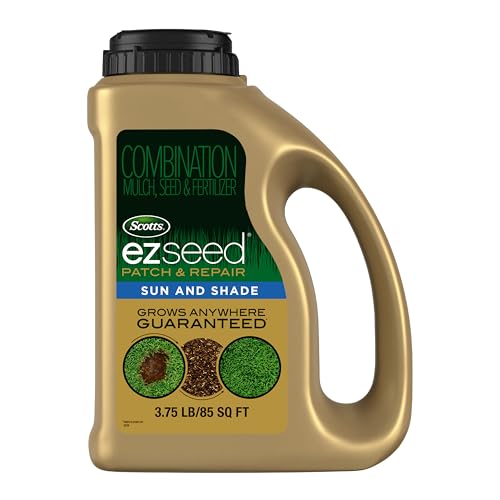
Best for: filling bare spots and repairing patchy shade Skip it if: you need to seed thousands of square feet at once
EZ Seed is a different product to the others. Scotts calls it a mix of Kentucky bluegrass, perennial ryegrass and fine fescue with mulch that expands around the seed, controlled release fertilizer, and a tackifier that helps hold seed on slopes. Coverage is stated as up to 85 sq ft for the 3.75 lb jug. That is the smallest coverage figure in this roundup by a wide margin, and it is the reason this is a patch pick, not a full-yard pick. For a large yard buyer, the sensible use is fixing the shaded spots along a fence line or under a tree where full seeding has failed. Scotts says germination is best between 60°F and 80°F with no frost risk. The listing claims the mix will grow in dense shade with proper care, which matters here. It sells far faster than anything else in this set, and it is the cheapest.
Pros:
- Cheapest of the six
- Tackifier helps hold seed on slopes
- Mulch expands to protect seed
- Sells faster than the rest of this set
- Fine fescue in the blend for shade
Cons:
- 85 sq ft coverage is far too small for a full yard
- Smallest weight of seed per bag here at 3.75 lb
- Only two sellers listed
- Not designed for open-lawn seeding
5. Jonathan Green 40600 Dense Shade Grass Seed — Best for beginners
1,800 sq ft coverage claim from a small 3 lb bag makes the math easy for a first attempt.

Best for: first-time seeders working under trees Skip it if: you want to cover more than 1,800 square feet per bag
Jonathan Green publishes a straight 1,800 sq ft coverage number and calls this 100% superior grass seed. The listing is thin on detail, which cuts both ways. There is no light-hour threshold, no named grass species in the feature bullets, and no warranty printed. What you do get is a shade-specific label from a brand that has sold to sod farms for decades, and a simple coverage claim you can divide into your yard. For a beginner, that arithmetic matters more than a marketing paragraph. The 3 lb bag at 3 x 14 x 9 in is the same physical size as the Black Beauty option below, and both are compact enough to keep in a garage without a shelf reshuffle. Against the leader, the trade-off is obvious: fewer published specifications, no stated blend, and the slowest sales rank of the six. It is the least-documented option in the set, so buy on the coverage figure alone.
Pros:
- Clear 1,800 sq ft coverage figure
- Purpose-built dense shade product
- Compact 3 lb bag, easy to store
- Second-lowest weight but sensible coverage math
Cons:
- No grass species listed in feature bullets
- No light-hour threshold
- No warranty published
- The slowest seller of the six
6. Jonathan Green Black Beauty Heat & Drought Resistant Grass — Best for small spaces
A tall fescue and Texas bluegrass blend for lightly shaded sections that also take afternoon sun.

Best for: lightly shaded sections that also bake in afternoon sun Skip it if: the area sits under heavy tree canopy all day
Black Beauty is the outlier in this shade roundup because Jonathan Green positions it as heat and drought resistant first, shade-capable second. The blend is tall fescue and Texas bluegrass. Jonathan Green says the leaf has a waxy coating that limits evaporation, and that roots can reach up to 4 feet deep. Coverage is 750 sq ft new or 1,500 sq ft overseeding for the 3 lb bag, and the recommended seeding windows are mid-August to mid-October or mid-March through mid-May. The listing describes it as best in full sun to lightly shaded conditions, which is why this is the small-space, mixed-light pick rather than a dense-shade one. If a section of a big yard sits in dappled light and gets full afternoon sun in July, this is the closer fit. Under a solid canopy, the Pennington leader is the better call.
Pros:
- Named blend: tall fescue and Texas bluegrass
- 750 sq ft new, 1,500 sq ft overseed coverage stated
- Deep-root claim from Jonathan Green
- Two published seeding windows
- Waxy leaf coating claim for drought
Cons:
- Best in full sun to light shade only
- 3 lb bag is small for a big yard
- No warranty on the listing
- Not designed for dense shade
How much ground does one bag really cover?
Coverage is the number you should be doing arithmetic on for a large yard, not the price. Only four of the six listings publish a square footage figure. Here they are, side by side:
- Scotts Turf Builder Sun & Shade, 5.6 lb: 745 sq ft new, 2,240 sq ft overseeding.
- Jonathan Green Dense Shade, 3 lb: 1,800 sq ft.
- Jonathan Green Black Beauty, 3 lb: 750 sq ft new, 1,500 sq ft overseeding.
- Scotts EZ Seed Patch, 3.75 lb: 85 sq ft.
The two Pennington bags do not publish a coverage figure in the listing data, which is the single biggest gap in the Smart Seed leader. If you have a measured yard, calculate bags from the published number, then add a bag. Nothing kills a new lawn like running out of seed in the last strip and watching weeds fill the gap. For a quarter-acre shaded lot, expect to buy two Scotts Turf Builder bags to overseed, or seven EZ Seed jugs to spot-fix, if you were foolish enough to try.
Cool-season blends versus patch products
Two products in this set are patch and repair, and four are full seeding bags. That distinction matters more than any price gap. A patch product like EZ Seed is engineered around mulch and tackifier, not around blade density. The seed-to-filler ratio is deliberately low, because the point is to hold moisture on a bare 6-inch scar in the lawn. Try to seed a whole side yard with it and you will spend more per square foot than any bag here, and end up with sparse coverage.
A blend bag is the opposite. Pennington Smart Seed Dense Shade is almost pure seed with a fertilizer coating. It is priced to spread across hundreds of square feet, and the coverage math only works if you use it that way.
- Use a patch product for repair jobs under 100 sq ft.
- Use a blend bag for anything larger.
- Never buy a patch product for a whole-lawn seeding.
What large-yard buyers keep getting wrong
Three mistakes come up repeatedly, and each of them costs money.
- Buying by bag weight, not coverage. A 7 lb bag with no published coverage figure is a guess. A 5.6 lb Scotts bag with 2,240 sq ft printed is a plan. Pick the one you can calculate.
- Ignoring the light threshold. The Pennington Smart Seed listing is the only one in this set that quotes a specific range, 2 to 6 hours. If your worst zone gets 90 minutes of dappled sun, no seed on this page is guaranteed to fill it. Consider ground cover instead.
- Assuming shade blend equals dense shade blend. Scotts Turf Builder Sun & Shade calls itself moderate shade. Jonathan Green Dense Shade labels itself dense shade. Those are different products for different zones.
The buyer who reads the shade word on the front and ignores the qualifier is the buyer who reseeds in the fall.
How to read a shade rating on a seed bag
Shade language on grass seed bags is not standardised. It is the manufacturer's word, and every bag here uses it slightly differently. Read the specifications, not the marketing panel.
Pennington gives you an hour count. Two to six hours of sun is a real number you can check with a phone camera and a timer on a Saturday. That is why the Smart Seed leads: the shade claim is the only one you can verify against your yard before you buy. Scotts uses "moderate" and "dense" as separate categories, and the EZ Seed jug is the one that says dense. Jonathan Green splits the difference: the 40600 bag is labelled dense shade, and Black Beauty is labelled for full sun to light shade.
A safe rule: if the bag does not quote hours, treat "sun and shade" as at least half-day sun, and treat "dense shade" as needing morning sun plus dappled light through the afternoon. Grass will not grow under a solid evergreen canopy no matter what the label says.
The verdict
Pennington Smart Seed Dense Shade Mix is the winner because it is the only bag here that quotes an actual light threshold, 2 to 6 hours, alongside a 7 lb bag size that suits a large yard buyer. If your shaded zones fall inside that range, buy this and stop reading.
Two conditions flip the pick. If you are seeding a new lawn with mostly open ground and only patches of shade, buy Scotts Turf Builder Sun & Shade instead, because its 2,240 sq ft overseeding figure is the largest published coverage claim in this set. If you are patching bare spots along a fence line or under a tree, buy Scotts EZ Seed Patch & Repair, which is the cheapest option here and the only one engineered around a tackifier and mulch for spot repairs.
Pennington Kentucky 31 sits third as the traffic and drought pick for sunny yards, and the two Jonathan Green bags cover the compact-storage case. All six are useful, but only one solves the specific problem of a large yard with real shade, and that is the Pennington Smart Seed Dense Shade Mix.
FAQ
Is shade tolerant grass seed worth it over a standard mix?
Shade tolerant grass seed is worth it any time part of your lawn gets under six hours of direct sun. Standard mixes are heavy on ryegrass and Kentucky bluegrass, which thin out under trees. A dense shade blend adds fine fescues and adjusts the ratios so the sward survives on less light. For a large yard with mixed conditions, a shade blend for the tough zones and a standard mix for the open ground is the cleanest approach.
How much shade tolerant grass seed for large yards do I need per 1,000 sq ft?
Shade tolerant grass seed for large yards needs to be calculated from the coverage number on the bag, not from a generic rate. Scotts Turf Builder Sun & Shade quotes 745 sq ft new or 2,240 sq ft overseeding for 5.6 lb. Jonathan Green Dense Shade lists 1,800 sq ft for 3 lb. Divide your measured shaded area by the coverage figure, then add one extra bag for edges and thin spots.
Pennington Smart Seed or Scotts Turf Builder, which is better for a shaded lawn?
Pennington Smart Seed is the better choice for a shaded lawn because it is the only bag here that publishes a specific light range, 2 to 6 hours of sun. Scotts Turf Builder Sun & Shade is designed for full sun and moderate shade, per the Scotts listing, and its bigger 2,240 sq ft overseeding coverage suits mostly-open lawns. Deep shade under trees: Pennington. Mixed sun and moderate shade: Scotts.
Can I use Scotts EZ Seed Patch & Repair for a whole lawn?
Scotts EZ Seed Patch & Repair is not intended for a whole lawn. The 3.75 lb jug covers up to 85 sq ft, per the Scotts listing, which is a spot-repair figure, not a seeding rate. Using it across a large yard means dozens of jugs and a per-square-foot cost that no full-bag blend comes close to. Use it for bare patches under 100 sq ft and buy a blend bag for the rest.
When is the best time to seed a shaded lawn?
The best time to seed a shaded lawn is early fall, when soil temperatures fall between the numbers the listings quote. Scotts Turf Builder recommends 55°F to 70°F soil, and Scotts EZ Seed germinates best between 60°F and 80°F daytime air. Jonathan Green Black Beauty targets mid-August to mid-October or mid-March through mid-May. Fall seeding beats spring because weed pressure is lower and cool-season grasses build roots before summer heat.
For a large shaded yard, the cleanest move is to measure the worst zone first, count the hours of direct sun it gets on a clear day, and buy the Pennington Smart Seed Dense Shade Mix if that number falls between two and six. It is the only bag in this roundup that lets you match a seed to a measured condition instead of a marketing label. Add a bag of Scotts Turf Builder Sun & Shade for the open ground, keep a small EZ Seed jug in the garage for the inevitable patches, and you have a three-product plan that covers most large-yard shade problems without overbuying. Start with the winner and expand from there.