Best Shade Grass Seed: Pennington Smart Seed Wins
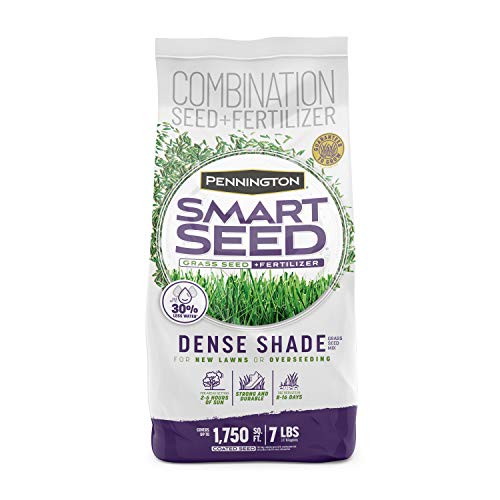
Five shade mixes, ranked by what the bag actually tells you: seed weight, coverage claims, germination windows and how much ground each one covers before you need a second bag.

By Taylor MontgomeryUpdated 16 min read
On this page
- Best shade tolerant grass seed for homeowners at a glance
- How I screened these five bags
- How much sun does a shade mix really need?
- 1. Pennington Smart Seed Dense Shade Mix — Best overall
- 2. Scotts Turf Builder Grass Seed Sun & Shade Mix — Best premium
- 3. Jonathan Green Black Beauty Dense Shade Grass Seed — Best minimal setup
- 4. Jonathan Green 40600 Dense Shade Grass Seed — Best upgrade
- 5. Scotts EZ Seed Patch & Repair for Sun and Shade — Best budget pick
- Coverage per bag: the number that decides your order
- What more money buys in a shade mix
- Pennington vs Scotts Turf Builder: which shade tolerant grass seed for a full lawn?
- Mistakes that kill shade seed before it sprouts
- The verdict
- FAQ
The best shade tolerant grass seed for homeowners is Pennington Smart Seed Dense Shade Mix, a 7 lb bag blending perennial ryegrass, Kentucky bluegrass and tall fescue that Pennington says needs only 2 to 6 hours of sunlight. If you're patching bare spots rather than seeding a lawn, Scotts EZ Seed Patch & Repair is the smarter buy at 3.75 lb covering a claimed 85 sq ft. Price tiers here split cleanly: the entry bags are small and job-specific, the mid bag is bulk seed with almost nothing else in it, and the premium bags bundle fertilizer and soil improver into the same jug.
Best shade tolerant grass seed for homeowners at a glance
| Pick | Bag weight | Claimed coverage | Price |
|---|---|---|---|
Best overall Pennington Smart Seed Dense Shade Mix |
7 lb | Seed plus fertilizer in one bag | Check Price |
Best premium Scotts Turf Builder Sun & Shade Mix |
5.6 lb | 745 sq ft new 2,240 sq ft overseed |
Check Price |
Best minimal setup Jonathan Green Black Beauty Dense Shade |
1 lb | 300 sq ft new 600 sq ft overseed |
Check Price |
Best upgrade Jonathan Green 40600 Dense Shade |
3 lb | 1,800 sq ft claim | Check Price |
Best budget pick Scotts EZ Seed Patch & Repair |
3.75 lb | 85 sq ft claim | Check Price |


How I screened these five bags
I set three criteria before looking at any bag, and I weighted them in this order.
- Named shade genetics, weighted heaviest. A bag that lists which grasses are inside tells you what you're planting. Two of these five name all four cool-season families. Two more name three grasses each. One names none at all.
- Published coverage, weighted second. Square footage is the only number that turns a bag weight into a shopping decision. Four of the five publish it.
- Extras that reduce steps, weighted third. Fertilizer, mulch, tackifier and soil improver in the same jug mean fewer trips to the garden centre.
Why that order? Because shade is a genetics problem first. Fine fescue and turf-type tall fescue hold up in low light in ways that a sun-bred blend never will, so what's in the bag matters more than what's mixed with it. Coverage comes second because buying too little seed is the most common way this purchase goes wrong. Extras come last: useful, but they don't grow grass on their own.
Every pick here sits in Amazon's Plants, Seeds & Bulbs grasses category and has two sellers listing it, so nothing on this shortlist is a single-source oddity.
How much sun does a shade mix really need?
Shade is not a yes or no. It's hours per day, and it's the number that decides whether any shade tolerant grass seed for homeowners has a chance.
Pennington puts a figure on it. Its bag says the mix requires only 2 to 6 hours of sunlight. That's the clearest threshold published across these five, and it's a genuinely useful cutoff. Measure your worst spot on a bright day. Note when the sun first touches the grass and when it leaves. If the answer is under two hours, no bag on this page will give you a thick stand there.
Scotts Turf Builder describes its territory differently: full sun and moderate shade. That wording matters. Moderate shade is not dense shade, so a north-facing strip behind a garage is asking more of it than the listing promises.
Three bags use "dense shade" in their names. Both Jonathan Green mixes and the Pennington do. Scotts EZ Seed says it's guaranteed to grow anywhere with proper care, dense shade included, which is a claim about the mulch-and-tackifier system as much as the seed.
Here's the trick with hours. Deciduous shade in April is not deciduous shade in July. Seed in spring under an oak and the seedlings get real light for weeks before the canopy closes.
1. Pennington Smart Seed Dense Shade Mix — Best overall
The most complete shade bag here: three named grasses, fertilizer already mixed in, and a published sunlight threshold you can actually measure against.
Best for: a whole shady lawn under 2 to 6 hours of sun Skip it if: you only have a few bare patches to fix
At 7 lb, this is the heaviest bag of the five, and that weight is the practical case for it. Seeding a back yard with a 1 lb or 3 lb bag means either buying two or three of them or spreading too thin. Pennington gives you one bag and one pass.
The blend is perennial ryegrass, Kentucky bluegrass and tall fescue, which is a sensible trio for low light. Ryegrass establishes fast, bluegrass fills in by spreading, tall fescue takes the traffic. Pennington says fertilizer is included in the right amount for the seed, so you're not buying a starter feed separately. It also describes the seed as disease and traffic resistant, which is the manufacturer's claim rather than a measured figure.
The bag measures 16.5 x 3.55 x 7.5 in, so it stores flat on a shelf. Pennington publishes a satisfaction guarantee with a mailing address and a phone line, and it's the only pick here with a stated refund process, which is worth something if germination disappoints.
The trade-off: it sells at a premium position and Pennington doesn't publish a square-foot number, so you're sizing by weight rather than by area. It's also overkill for a 20 sq ft bare patch.
Pros:
- Heaviest bag here at 7 lb
- Three named grasses for low-light performance
- Fertilizer already blended into the bag
- Published sunlight range of 2 to 6 hours
- Only pick with a stated refund process
Cons:
- No published square-foot coverage figure
- Premium price position among these five
- Wasteful for small patch jobs
- Only two sellers stock it
2. Scotts Turf Builder Grass Seed Sun & Shade Mix — Best premium
The clearest coverage math of the five, with 745 sq ft for a new lawn and 2,240 sq ft for overseeding printed right on the bag.

Best for: mixed lawns with sun in front and shade behind Skip it if: your yard is dense shade all day
This is the bag to buy when your yard isn't uniformly shady. Scotts positions it for full sun and moderate shade, and that dual range means one bag handles the sunny front strip and the partly shaded side yard without you buying two products.
The coverage numbers are the standout. A 5.6 lb bag covers 745 sq ft as a new lawn and 2,240 sq ft when overseeding. That four-to-one ratio is a useful reminder: overseeding an existing thin lawn stretches a bag a long way. Scotts also names a soil temperature window rather than an air temperature one, calling for daily average soil temperatures consistently between 55°F and 70°F. Soil temperature lags air temperature by weeks in spring, so that's a more honest instruction than most.
Scotts describes Root-Building Nutrition in the mix, plus grass fertilizer and soil improver, and rates the blend as medium drought resistance with medium to high durability. Those are the company's own ratings.
The catch is the word moderate. This is the one pick here that doesn't claim dense shade, so under a mature maple it's the wrong bag. It also carries the highest price position of the five and lists its warranty as not applicable.
Pros:
- Publishes both new-lawn and overseeding coverage
- Soil temperature window given, 55°F to 70°F
- Handles sun and shade from one bag
- Fertilizer and soil improver included
Cons:
- Rated for moderate shade, not dense shade
- Highest price position in this set
- No stated warranty
- Doesn't name which grass varieties are inside
3. Jonathan Green Black Beauty Dense Shade Grass Seed — Best minimal setup
The only bag here that names all four cool-season grass families and puts a germination window on the label.

Best for: one shady strip of 300 sq ft or less Skip it if: you need to cover a whole back yard
One pound. That's the whole appeal. If you have a single shady strip along a fence or beside a shed, this is the smallest sensible quantity, and you're not storing four pounds of leftover seed in a garage over winter.
The label detail is the best of the five. Jonathan Green names turf-type tall fescue, Kentucky bluegrass, perennial rye and fine fescues, which is all four cool-season families in one bag. Fine fescue is the genuine low-light specialist among them, and it's the ingredient most missing from generic sun-and-shade blends. The company also states a germination time of 14 to 21 days and says the varieties carry beneficial endophytes. Coverage is 300 sq ft for a new lawn, 600 sq ft for overseeding.
That germination window is worth planning around. Three weeks of keeping seed damp is a real commitment, and knowing it upfront beats guessing.
The trade-off against the bigger bags is simple arithmetic. To match the Pennington's 7 lb you'd buy seven of these, and the second-cheapest position here is per bag, not per square foot. There's no fertilizer, no mulch, no tackifier, so a starter feed is a separate purchase.
Pros:
- All four cool-season grass families named
- Germination window stated, 14 to 21 days
- Smallest bag here at 1 lb, minimal leftovers
- Coverage published for new lawns and overseeding
Cons:
- Only 300 sq ft of new-lawn coverage
- No fertilizer, mulch or tackifier included
- Poor value per square foot at scale
- No published warranty
4. Jonathan Green 40600 Dense Shade Grass Seed — Best upgrade
Claims 1,800 sq ft of coverage from a 3 lb bag, which is the widest reach per pound of anything on this list.

Best for: overseeding a large thin shady area cheaply per square foot Skip it if: you want a published germination window before buying
This is the value play if you're covering ground. Jonathan Green claims 1,800 sq ft from 3 lb, and describes the contents as 100% superior grass seed. At 600 sq ft per pound that's the most area per pound published in this set, well ahead of the Black Beauty bag's 300 sq ft per pound for new lawns.
Read that ratio carefully, though. It's a single figure with no split between new-lawn and overseeding rates, and 600 sq ft per pound reads much closer to an overseeding rate than a bare-soil rate. Treat it as a bag for thickening an existing thin lawn under trees, not for starting from dirt.
Where it falls short is the label. Jonathan Green publishes just two feature claims on this listing, and neither names a grass variety, a germination window or a sunlight requirement. The Black Beauty bag from the same brand tells you all three. So you're buying on the brand's dense-shade positioning and the coverage number rather than on stated genetics.
It's also the slowest seller of the five by a wide margin, sitting in the mid price tier. The bag measures 3 x 14 x 9 in and comes with no stated warranty.
Pros:
- Widest published coverage per pound, 1,800 sq ft from 3 lb
- Mid price tier, not the most expensive here
- Named for dense shade specifically
- Sensible 3 lb size for medium yards
Cons:
- No grass varieties named on the listing
- No germination window or sunlight range published
- Single coverage figure with no overseeding split
- Slowest seller of these five
- No fertilizer or mulch included
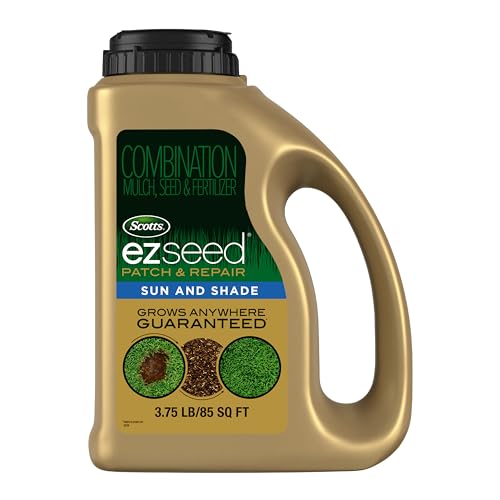
5. Scotts EZ Seed Patch & Repair for Sun and Shade — Best budget pick
A four-part patch system in a jug: seed, expanding mulch, controlled-release fertilizer and tackifier, sized for 85 sq ft of damage.
Best for: bare spots under trees and along fence lines Skip it if: you're seeding more than about 85 sq ft
This isn't a lawn seed. It's a repair product that happens to contain seed, and judging it as anything else gets you the wrong answer.
The 3.75 lb jug covers up to 85 sq ft, which is a fraction of what the other bags claim, because most of the weight isn't seed. Scotts includes mulch that expands to surround the seed, a controlled-release fertilizer, and a tackifier meant to stop seed washing away. That last ingredient is the one that earns its place on a slope or in a spot where the downspout dumps. The seed itself is Kentucky bluegrass, perennial ryegrass and fine fescue, and Scotts says the mix germinates best when daytime temperatures sit between 60°F and 80°F with no frost risk.
The three-step instruction is genuinely simple: prep the area, apply evenly, water until no more is absorbed. Scotts says it's guaranteed to grow anywhere with proper care, including full sun, dense shade, high-traffic areas and slopes.
It's the cheapest of the five and the one buyers choose most often here. But the coverage ceiling is real. At 85 sq ft per jug, patching a whole shady back yard would mean stacking up jugs and paying far more per square foot than any bag on this page.
Pros:
- Cheapest of the five
- Four-part system: seed, mulch, fertilizer, tackifier
- Tackifier helps on slopes and washout spots
- Three named grasses including fine fescue
- The one buyers choose most often here
Cons:
- Only 85 sq ft of coverage per jug
- Poor economics beyond small patches
- Most of the weight isn't seed
- Narrow 60°F to 80°F application window
Coverage per bag: the number that decides your order
Bag weight is what you see on the shelf. Square footage is what you actually need, and the gap between the two is where most shade-seed orders go wrong.
Line up the published figures:
- Jonathan Green 40600: 1,800 sq ft from 3 lb
- Scotts Turf Builder: 745 sq ft new lawn, 2,240 sq ft overseeding, from 5.6 lb
- Jonathan Green Black Beauty: 300 sq ft new, 600 sq ft overseeding, from 1 lb
- Scotts EZ Seed: 85 sq ft from 3.75 lb
- Pennington: coverage not published
Notice how badly weight predicts area. The 3.75 lb EZ Seed jug covers less than a third of what the 1 lb Black Beauty bag does, because the jug is mostly mulch and fertilizer by weight. Meanwhile the 3 lb Jonathan Green bag claims more than double the new-lawn area of the 5.6 lb Scotts.
Measure before you buy. Pace the shady area, multiply length by width, then match it against the new-lawn figure, not the overseeding figure, unless there's already grass there. Most shoppers miss that the two numbers can differ by a factor of four on the same bag.
What more money buys in a shade mix
The three price tiers here buy three different things, and none of them is simply more seed.
Entry tier. The two cheapest picks are the smallest and most specialised: a 1 lb bag for one strip, and a patch jug for 85 sq ft of damage. Both do their job well. Neither scales.
Mid tier. The Jonathan Green 40600 sits between them and spends your money on raw coverage: 1,800 sq ft from 3 lb, with no fertilizer, no mulch, no published germination window. Bulk seed, thin label.
Premium tier. The two most expensive picks bundle in the extras. Pennington blends fertilizer straight into its 7 lb bag. Scotts Turf Builder adds fertilizer, soil improver and what it calls Root-Building Nutrition to its 5.6 lb. You're paying for fewer separate purchases and, in Pennington's case, a stated sunlight threshold and a refund process.
So the premium here isn't better seed. It's a shorter shopping list and better documentation.
Pennington vs Scotts Turf Builder: which shade tolerant grass seed for a full lawn?
Both premium bags are sized for a real lawn rather than a patch, so this is the comparison most people actually need to resolve when choosing shade tolerant grass seed for homeowners with a whole yard to fix.
Pennington wins on shade depth. Its bag is built for dense shade and names 2 to 6 hours of sunlight as the requirement. Scotts describes its territory as full sun and moderate shade, which is a narrower promise. Under a mature canopy, that difference decides it.
Scotts wins on planning. It publishes 745 sq ft new-lawn coverage and 2,240 sq ft overseeding coverage, plus a 55°F to 70°F soil temperature window. Pennington publishes neither, so you're guessing at how far 7 lb goes.
Scotts also wins on mixed yards. One bag over a sunny front and a shaded side beats buying two products.
The cutoff is your sunniest measurement. If any part of the target area gets solid afternoon sun, Scotts covers both zones. If the whole area is under trees, Pennington is the bag built for it.
Mistakes that kill shade seed before it sprouts
Shade seed fails more often than sun seed, and rarely because the seed was wrong.
- Seeding too late in spring. Scotts EZ Seed asks for daytime temperatures of 60°F to 80°F. Turf Builder asks for soil at 55°F to 70°F. Miss the window and you're germinating into summer heat with tree roots drinking every drop.
- Watering by the calendar. Black Beauty states 14 to 21 days to germinate. That's up to three weeks of keeping the surface damp, not three days.
- Buying by bag weight. As the coverage figures show, 3.75 lb can mean 85 sq ft. Buy by square footage.
- Expecting a shade mix to beat zero light. Two hours is the lowest threshold published across these five. Below that, consider mulch or a shade-tolerant groundcover instead of grass.
- Ignoring what's competing. Tree roots take water and nutrients before your seedlings see any. That's why the fertilizer already blended into the Pennington and Scotts Turf Builder bags matters more here than in an open lawn.
The verdict
If you're seeding or overseeding a whole area that sits under trees most of the day, buy the Pennington Smart Seed Dense Shade Mix. It's the biggest bag here at 7 lb, its perennial ryegrass, Kentucky bluegrass and tall fescue blend is built for low light, the fertilizer is already in the bag, and it's the only pick that tells you plainly it needs 2 to 6 hours of sun. Pennington also publishes a refund process, which no other pick here does.
If your yard is a mix of sun and shade rather than uniformly dark, buy the Scotts Turf Builder Sun & Shade Mix instead. Its exact advantage is documentation and range: 745 sq ft of new-lawn coverage, 2,240 sq ft of overseeding coverage, and a 55°F to 70°F soil temperature window, all printed for you before you spread a single seed.
The cutoff is hours of direct sun on the worst part of the area. Under two hours and neither bag will thrive, so rethink the planting. Two to six hours, take the Pennington. Six hours or more in some spots and shade in others, take the Scotts. For bare patches under 85 sq ft, neither of those bags is right and the EZ Seed jug is.
FAQ
Is shade tolerant grass seed for homeowners worth the extra cost?
Shade tolerant grass seed for homeowners is worth it when your problem area genuinely gets limited light. These mixes lean on fine fescue and turf-type tall fescue, which handle low light better than sun-bred blends. Jonathan Green's Black Beauty names all four cool-season families for exactly that reason. In full sun, a general-purpose mix does the same job for less.
How much shade tolerant grass seed for homeowners do I need per square foot?
How much you need per square foot depends on whether you're starting bare or thickening existing turf. Jonathan Green's Black Beauty covers 300 sq ft new and 600 sq ft overseeding from 1 lb. Scotts Turf Builder covers 745 sq ft new and 2,240 sq ft overseeding from 5.6 lb. Measure your area, then use the new-lawn figure unless grass is already growing there.
Which grasses actually tolerate shade?
Which grasses tolerate shade comes down to the cool-season families. Fine fescues handle the least light, turf-type tall fescue adds durability, Kentucky bluegrass spreads to fill gaps, and perennial ryegrass germinates fast. Jonathan Green's Black Beauty bag lists all four. Pennington names three of them: perennial ryegrass, Kentucky bluegrass and tall fescue. Bags that name none leave you guessing.
Pennington Smart Seed or Scotts EZ Seed for a shady lawn?
Pennington Smart Seed or Scotts EZ Seed depends entirely on area. Pennington's 7 lb bag is for seeding a whole shaded lawn and names a 2 to 6 hour sunlight requirement. Scotts EZ Seed covers just 85 sq ft per 3.75 lb jug because most of that weight is mulch, fertilizer and tackifier. Patches take the jug, lawns take the bag.
What's the most common shade seeding mistake?
The most common shade seeding mistake is stopping the watering too early. Jonathan Green states a germination time of 14 to 21 days, so the surface needs to stay damp for up to three weeks. Tree roots pull moisture away faster than open ground does. The second mistake is buying by bag weight instead of by published square footage.
Start with a tape measure and a watch, not a shopping cart. Pace out the shady area, then sit outside on a clear day and time how long direct sun actually reaches it. Those two numbers, square feet and hours, pick your bag for you. If the answer lands between 2 and 6 hours over an area bigger than a patio, the Pennington 7 lb bag is the safe default: enough seed for one pass, three named grasses bred for low light, fertilizer already mixed in, and a company that publishes an address to write to if it disappoints you.