Best Fast Growing Grass Seed for Thick Grass
A ranked pick of five cool-season lawn seed mixes, with the winner named, the trade-offs spelled out, and the deciding coverage numbers on the table.

By Taylor MontgomeryUpdated 16 min read
On this page
- Best fast growing grass seed for thick grass at a glance
- How I screened these five seed mixes
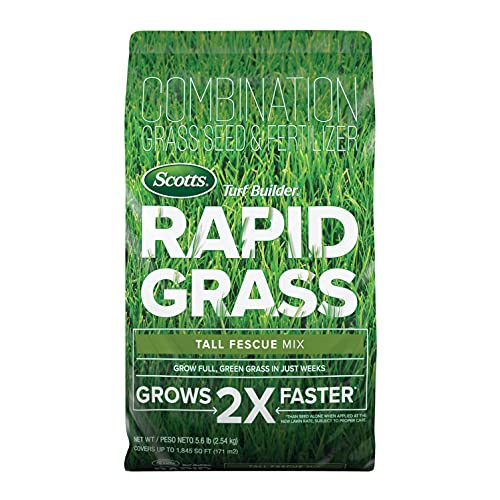
- 1. Scotts Turf Builder Rapid Grass Tall Fescue Mix — Best overall
- 2. Scotts EZ Seed Patch & Repair for Sun and Shade — Best for families
- 3. Pennington Contractors Central Grass Seed Mix — Most versatile
- 4. Jonathan Green Fast Grow Grass Seed — Best upgrade
- 5. Pennington Kentucky 31 Tall Fescue Grass Seed — Best budget pick
- What the word thick actually means on a seed bag
- How much ground does one bag really cover?
- When should you put grass seed down?
- What the listings do not tell you about germination
- The verdict
- FAQ
The best fast growing grass seed for thick grass is Scotts Turf Builder Rapid Grass Tall Fescue Mix, a 5.6 lb bag that overseeds up to 1,845 sq. ft. and bundles seed with lawn food in one pass. If you only need to close small patches in a family yard, Scotts EZ Seed Patch & Repair wins on 85 sq. ft. of dense coverage with mulch, tackifier and starter fertiliser already blended in.
The 30-second shortlist: Scotts Rapid Grass for the whole lawn, EZ Seed for spots, Pennington Contractors Central for the biggest yard on a budget.
Best fast growing grass seed for thick grass at a glance
| Pick | New-lawn coverage | Blend | Price |
|---|---|---|---|
Best overall Scotts Turf Builder Rapid Grass Tall Fescue Mix |
615 sq. ft. (5.6 lb) | Tall fescue mix with lawn food | Check Price |
Best for families Scotts EZ Seed Patch & Repair |
85 sq. ft. (3.75 lb) | Kentucky bluegrass, ryegrass, fine fescue | Check Price |
Most versatile Pennington Contractors Central |
4,000 sq. ft. (7 lb, all-purpose figure) | All-purpose regional mix | Check Price |
Best upgrade Jonathan Green Fast Grow |
1,750 sq. ft. (7 lb) | Annual rye, tall fescue, fine fescue | Check Price |
Best budget pick Pennington Kentucky 31 Tall Fescue |
4,000 sq. ft. (3 lb, listing figure) | Kentucky 31 tall fescue | Check Price |


The keyword phrase "thick grass" carries a promise no seed bag can fully deliver on its own. Density comes from mowing height, watering depth, soil contact and a second pass of seed four to six weeks after the first. The picks below are the ones most likely to get you there fast; the sections after them explain how to lock the thickness in.
How I screened these five seed mixes
I started with cool-season mixes marketed for speed, then cut by three named reasons: bags with no published coverage figure, mixes with no stated blend of species, and listings that leaked into warm-season territory where the growing rules change. What survived is five cool-season products from three brands, spanning a 3 lb pouch to a 7 lb bag.
From there I ranked on four criteria, in this order:
- Coverage per bag, because a fast lawn needs enough seed to hit the ground at the right rate. Under-seeding is the single most common reason a "fast" seed looks slow.
- Blend quality, meaning whether the bag names the grass species inside it and whether that mix supports both sun and light shade.
- Included extras, like starter fertiliser, mulch or tackifier that keeps seed from washing off a slope.
- Set position, which is where the price bands and sales figures come in. When two mixes tied on the first three, I went with the one buyers here choose more often.
That order matters. A bag with a dense, named blend beats a bag that just says "grass seed", even if the second one is cheaper by weight. And a mix with tackifier beats one without it, because seed on a slope with no glue is seed you will be raking out of the driveway.
1. Scotts Turf Builder Rapid Grass Tall Fescue Mix — Best overall
Scotts Rapid Grass is the winner because it ties a named tall fescue blend to combined seed-and-food and the most usable overseeding coverage in the set.
Best for: large bare patches or a full new lawn in cool-season regions Skip it if: you only need to patch a small spot near a walkway
Scotts says this mix grows grass 2X faster than seed alone at the new-lawn rate, with proper care. That's the manufacturer's claim, not a measurement, but the structure of the bag backs the intent: seed and fertiliser blended in one pass, sized at 5.6 lb, in a 15 x 4.5 x 9.5 in box. Coverage is 615 sq. ft. for a new lawn and 1,845 sq. ft. for overseeding, which is the strongest overseed figure of any pick here that names both numbers separately.
The application window Scotts prints on the bag is 60°F to 80°F daytime temperatures, spring or fall. That is standard for cool-season tall fescue and it matches what the other tall fescue picks in this set expect. It sits at the top of the price positions here, and it is the second-fastest seller of the five. That combination is what pushes it into the overall slot: it is the pick most of these buyers are already choosing, and the specifications on the bag explain why.
The trade-off is size. If your problem area is 40 sq. ft. of dirt by the front step, this bag is overkill and the EZ Seed pouch below is the smarter buy. And the bag is heavier and bulkier than the Pennington entry-level option, so storage matters.
Pros:
- Overseeding coverage of 1,845 sq. ft. from one 5.6 lb bag
- Seed and lawn food already combined
- Named tall fescue mix suited to cool-season regions
- Clear 60°F to 80°F application window on the bag
- Second-strongest seller of the five picks here
Cons:
- Highest price position in this set
- Overkill for small patch jobs
- No shade-tolerant species named in the blend
2. Scotts EZ Seed Patch & Repair for Sun and Shade — Best for families
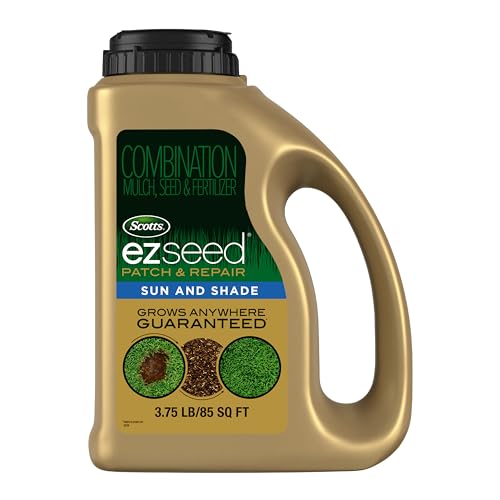
EZ Seed wins the patch job because it wraps Kentucky bluegrass, ryegrass and fine fescue in mulch, tackifier and starter fertiliser, and asks the reader to do three steps and nothing else.
Best for: small bare spots in yards with kids, pets and mixed sun Skip it if: you have more than 100 sq. ft. of open ground to seed
This is the fastest seller in the set by a wide margin. The 3.75 lb jug covers 85 sq. ft., which sounds small next to the 4,000 sq. ft. figures further down the table, but the seed here is diluted into a growing medium: mulch that expands around the seed, controlled-release fertiliser, tackifier to hold it in place on slopes, and a moisture-locking coat. You are not buying seed by the pound. You are buying a self-contained patch kit.
Scotts names the blend on the listing: Kentucky bluegrass, perennial ryegrass and fine fescue. That is a genuine sun-and-shade combination, and the listing says it will grow in full sun, dense shade, high-traffic areas and on slopes, given proper care. Attribute that claim rather than assume it, and the pick still holds. The three-step routine on the jug, prep, apply, water until no more is absorbed, is the reason this shows up in family yards: it is hard to get wrong.
The trade-off is scale. At 85 sq. ft. per jug, a whole new lawn from this product would cost far more than the Rapid Grass bag above it and take longer to apply.
Pros:
- Named blend of Kentucky bluegrass, ryegrass and fine fescue
- Mulch and tackifier included for slope holding
- Controlled-release starter fertiliser in the mix
- Simple three-step application on the jug
- The pick buyers here choose most often
Cons:
- Only 85 sq. ft. per 3.75 lb jug
- Not economical for whole-lawn seeding
- Not designed for a permanent stand of a single species
3. Pennington Contractors Central Grass Seed Mix — Most versatile
Pennington Contractors Central is the middle-ground pick because one 7 lb bag is marketed to cover a very large area and the mix is tailored to the region it ships to.

Best for: medium to large lawns where you want one bag to do everything Skip it if: you need a dark-green colour or a shade-tolerant blend
Pennington positions this as an all-purpose lawn grass seed mix formulated and mixed specifically for the region where it is sold. That is the listing's language, and it is worth attributing rather than assuming: what ships to a buyer in the upper Midwest is not what ships to a buyer in the mid-Atlantic. The bag is 7 lb, 16.5 x 3.55 x 7.5 in, and the listing says one bag covers up to 4,000 sq. ft.
Treat that 4,000 sq. ft. figure as the manufacturer's number for maintenance and overseeding rates rather than new-lawn establishment. For a full new lawn you almost always double the rate on the bag, which is true across the category and not specific to this mix. Contractors Central sits in the middle price band of the five picks, and the listing pitches it for new lawns, overseeding and lawn repair, so it is the closest thing here to a one-bag answer.
Its weakness is that the listing does not name the grass species in the blend, only that it is regionally formulated. If you want to know exactly what will grow, the tall fescue and blended picks above and below tell you more.
Pros:
- 7 lb bag with a large listed coverage
- Regionally formulated for the shipping address
- Positioned for new lawns, overseeding and repair
- Mid-range price position in this set
Cons:
- Blend species not named on the listing
- The 4,000 sq. ft. figure needs derating for new lawns
- Slowest seller of the three cool-season all-purpose picks here
4. Jonathan Green Fast Grow Grass Seed — Best upgrade
Jonathan Green Fast Grow is the upgrade because it names annual ryegrasses, tall fescues and fine fescues on the bag and is written as a fast temporary cover to overseed later.

Best for: problem areas you want green fast, then plan to overseed later Skip it if: you want a permanent stand from a single application
This is the pick for a reader who reads bag labels. Jonathan Green publishes the mix on the listing: annual ryegrasses, tall fescues, fine fescues. That is a genuine sun-to-medium-shade blend, and the listing is unusually honest about what the product is: a temporary grass seed solution that lasts throughout one season, meant to be overseeded with a Black Beauty product afterwards for a lasting thick lawn. That is the manufacturer's phrasing, and it is a rare piece of clarity in this category.
The 7 lb bag covers 1,750 sq. ft. for new lawns and 3,500 sq. ft. for overseeding. Compared with the Rapid Grass winner, that is more square footage per bag on the new-lawn figure, but you are buying seed without the built-in fertiliser Scotts includes. The application window is mid-August to mid-October or mid-March through mid-May, which is a shorter fall shoulder than the temperature-based window on the Scotts bag but easier to plan against.
The catch is in the plan itself. Annual ryegrass is not a long-lived species. If you seed with this and skip the follow-up overseeding, you get a strong first season and a thinner second one.
Pros:
- Named blend on the listing, all three species
- 1,750 sq. ft. new-lawn coverage from a 7 lb bag
- Listed for full sun to medium shade
- Clear application windows in spring and fall
- Explicit plan for overseeding afterwards
Cons:
- Contains annual ryegrass, one-season by design
- No starter fertiliser included
- Weakest sales position of the five picks here
5. Pennington Kentucky 31 Tall Fescue Grass Seed — Best budget pick
Kentucky 31 is the budget answer because it is the cheapest bag in the set, a single-species tall fescue, and Pennington backs it with a stated money-back guarantee.

Best for: large, drought-prone yards where cost per square foot decides Skip it if: you want a soft, fine-bladed lawn under bare feet
Kentucky 31 is one of the oldest tall fescue selections still sold at scale. It is coarse-bladed, deep-rooted and drought-resistant, which is what the listing calls out first. Pennington sells it here as a 3 lb bag with a listed coverage of up to 4,000 sq. ft., positioned for full sun to medium-shaded areas. The bag is small, 11 x 3 x 7.5 in, and it is the cheapest pick of the six by a clear margin.
Read the 4,000 sq. ft. figure as an overseeding rate. For a new lawn from bare soil, you will need more than one bag on a yard that large, and that is normal for tall fescue at establishment rates. What Kentucky 31 gives you at this price is a hardy, drought-tolerant base grass that can carry a full lawn on its own once it fills in. Pennington also publishes a money-back guarantee on the listing, which is unusual in this set.
The trade-off is texture and colour. Kentucky 31 is not the softest tall fescue on the market and it is a lighter, more olive green than the darker turf-type fescues in the Rapid Grass blend.
Pros:
- Cheapest pick of the five, by clear margin
- Drought-resistant single-species tall fescue
- Listed for full sun to medium shade
- Written money-back guarantee on the listing
- Small, easy-to-store 3 lb bag
Cons:
- Coarser blade than turf-type tall fescues
- Lighter green colour than the Scotts blends
- Small bag means multiple purchases for a full lawn
What the word thick actually means on a seed bag
Thick grass is not a species. It is a density: how many grass plants per square inch of soil. That density comes from four things, and only one is on the bag.
- Seeding rate. Enough seed on the ground at the right spacing.
- Soil contact. Seed pressed lightly into loose soil, not sitting on thatch.
- Moisture. Steady damp, not a flood then a drought.
- Mowing height. Cool-season lawns mowed at 3 to 4 inches shade out weeds and thicken naturally.
A bag labelled fast growing tells you the species inside will germinate quickly. That is a real advantage, and every pick in this roundup delivers it. What the bag cannot control is whether you seed at the right rate or water through week two. This is why the keyword promises more than any single product can, and it is why the picks above are ranked on coverage and blend rather than on the word "fast" alone.
If you want a lawn dense enough to crowd out crabgrass by next summer, plan on two passes of seed, four to six weeks apart, at the rate printed on the bag both times.
How much ground does one bag really cover?
Coverage figures on grass seed bags come in two shapes: a new-lawn number and an overseeding number. The overseeding number is roughly two to three times the new-lawn number, because you are dropping seed into an existing lawn rather than starting from soil. Here is how the five picks compare on both figures, from what the listings publish:
- Scotts Rapid Grass, 5.6 lb. New lawn 615 sq. ft., overseeding 1,845 sq. ft.
- Scotts EZ Seed, 3.75 lb. 85 sq. ft. total; not intended for whole-lawn seeding.
- Pennington Contractors Central, 7 lb. Up to 4,000 sq. ft.; the listing does not split the two figures.
- Jonathan Green Fast Grow, 7 lb. New lawn 1,750 sq. ft., overseeding 3,500 sq. ft.
- Pennington Kentucky 31, 3 lb. Up to 4,000 sq. ft. on the listing; treat as an overseed figure.
Two takeaways matter. First, when a listing gives one big number and no split, assume that number is the overseeding rate and cut it by a factor of two for a new lawn. Second, coverage per pound is not the same as coverage per dollar, and the two picks that name both figures separately are the ones easiest to plan against.
When should you put grass seed down?
The best fast growing grass seed for thick grass still needs the right temperature to germinate. Scotts prints 60°F to 80°F on the Rapid Grass bag, which is the daytime range where cool-season species do their work. Jonathan Green gives the same window as calendar dates: mid-August to mid-October, or mid-March through mid-May, depending on where you live.
- Early fall is the strongest window for cool-season seed. Soil is warm, air is cooling, and weed pressure drops.
- Late spring is the second window, but you are racing summer heat.
- Summer is the worst time. Seed germinates then dies in the first heat wave.
- Winter is dormant seeding, which is a different technique and not what these bags are written for.
If your soil thermometer reads below 55°F for a week, hold the seed. Frost after germination is the fastest way to lose a new stand of grass.
What the listings do not tell you about germination
Listings tell you the species, the coverage and the application window. They do not tell you what most first-time seeders get wrong. Three items worth knowing before the bag opens:
- Water depth beats water frequency. New seed wants the top inch of soil damp, not the top eighth. Two short mistings a day is worse than one long one that soaks in.
- Straw is optional if you use a mulched product. EZ Seed and any mix with tackifier hold themselves in place. Bare seed on bare soil is where straw or a light mulch matters.
- The first mow decides the shape. Wait until the new grass is 3 inches tall and the soil is dry enough to walk on, then mow it back to 2 inches. Mowing too early rips seedlings out of the ground.
None of this is on the bag, and none of it changes with brand. It is the difference between a bag that grew and a lawn that thickened.
The verdict
Two profiles cover most of this category. If you have a whole lawn or a large problem area to seed, Scotts Turf Builder Rapid Grass Tall Fescue Mix is the right default. The named tall fescue blend, the built-in fertiliser and the 615 sq. ft. new-lawn coverage from a single 5.6 lb bag make it the pick most likely to give you a thick stand on the first pass. It also gives you the strongest overseeding figure in the set, at 1,845 sq. ft., which matters because thick grass comes from that second pass more than the first.
If you have small bare patches and a family yard that gets used, Scotts EZ Seed Patch & Repair is the better buy. It costs less than Rapid Grass, the three-step routine is hard to get wrong, and the pre-blended mulch and tackifier hold the seed in place through the first week of watering.
The cutoff is roughly 100 sq. ft. of bare ground: below it, EZ Seed; above it, Rapid Grass. Buyers on a strict budget should consider Kentucky 31 as a large-area fallback, and buyers who want to read every species on the bag should upgrade to Jonathan Green Fast Grow with a follow-up overseeding plan.
FAQ
What is the best fast growing grass seed for thick grass in a sunny yard?
The best fast growing grass seed for thick grass in a sunny yard, in this set, is Scotts Turf Builder Rapid Grass Tall Fescue Mix. Tall fescue handles full sun, the bag combines seed and fertiliser, and the 615 sq. ft. new-lawn coverage gives enough seed density for a thick first stand. Pennington Kentucky 31 is the budget alternative for the same conditions.
Is fast growing grass seed worth it over regular seed?
Fast growing grass seed is worth it when you need cover in weeks rather than months, such as a bare patch before a family event or a bare slope before a rainy fall. It is less worth it if you want a long-lived permanent lawn from one bag, because some fast mixes lean on annual ryegrass. Read the species list on the listing before you decide.
How much coverage does a 7 lb bag of grass seed give?
How much coverage a 7 lb bag gives depends on the species and the rate. Jonathan Green Fast Grow lists 1,750 sq. ft. for a new lawn and 3,500 sq. ft. for overseeding. Pennington Contractors Central lists up to 4,000 sq. ft., which reads as a maintenance figure. As a rule, halve any single big number on a bag to get a realistic new-lawn rate.
Should I pick Scotts Rapid Grass or Scotts EZ Seed?
Choose Scotts Rapid Grass or Scotts EZ Seed by the size of the job. Rapid Grass is for whole lawns and large problem areas, with 615 sq. ft. new-lawn coverage per 5.6 lb bag and starter fertiliser built in. EZ Seed is for patches under 85 sq. ft., with mulch and tackifier pre-blended. The cutoff sits at roughly 100 sq. ft. of bare ground.
What is the biggest mistake when seeding for thick grass?
The biggest mistake when seeding for thick grass is skipping the second pass. Density comes from overseeding four to six weeks after the first application, at the rate printed on the bag. Watering too shallow is the second mistake: aim for the top inch of soil damp for the first two weeks. Mowing too early is the third.
There is no single bag on this list that produces a thick lawn on its own. What Rapid Grass gets you is a strong first stand at the right seed density, in a species blend that suits cool-season regions, with fertiliser already in the mix. Put it down inside the 60°F to 80°F window on the bag, water the top inch of soil daily until germination, wait the four to six weeks the roots need to settle, then overseed with the same product at the overseeding rate. That second pass is the one that closes the canopy and starves the weeds. Everything else, mowing height, watering depth, timing, follows from there.