Best Self Propelled Pruning Shears for Weak Grip

Six pruners compared on the things that actually matter for tired hands: lever action, ratchet mode, motor assist, and weight. One clear winner, plus the three conditions that change the answer.

By Taylor MontgomeryUpdated 17 min read
On this page
- Best self propelled pruning shears for seniors at a glance
- What "self propelled" actually means on a pruner listing
- How I screened these six and what the criteria weigh
- 1. DECERK® 8.5" Professional Pruning Shears — Best overall
- 2. Gerossi Ratchet Pruning Shears Heavy Duty — Runner-up
- 3. SEESII Electric Pruning Shears — Best for beginners
- 4. ANTTCTIG Electric Pruning Shears — Best premium
- 5. Fiskars Bypass Pruning Shears — Best for heavy use
- 6. Kynup Pruning Shears — Best budget pick
- Which cutting mechanism suits a tired hand best?
- How thick a branch do you really need to cut?
- What the listings do not tell you about weight and reach
- When a different pick wins
- The verdict
- FAQ
The best self propelled pruning shears for seniors are the DECERK 8.5" Professional Pruning Shears, because the lever geometry does the squeezing your hand can't, at 0.55 lb total. If your hands can't close a lever at all, the SEESII Electric Pruning Shears takes over with a brushless motor and a 1.4 in cut. Getting this wrong hurts. A pruner that needs more force than you have turns into a two-handed wrestling match, and that's how thumbs get sprained and stems get crushed instead of cut.
Best self propelled pruning shears for seniors at a glance
| Pick | Cut capacity | Assistance type | Price |
|---|---|---|---|
Best overall DECERK® 8.5" Professional Pruning Shears |
3/4 in claim | 4X lever claim | Check Price |
| 3/4 in claim | Ratchet, 3X claim | Check Price | |
Best for beginners SEESII Electric Pruning Shears |
1.4 in | Brushless motor | Check Price |
Best premium ANTTCTIG Electric Pruning Shears |
2.56 in opening | Brushless motor | Check Price |
Best for heavy use Fiskars Bypass Pruning Shears |
5/8 in | None, plain bypass | Check Price |
Best budget pick Kynup Pruning Shears |
1 in claim | None, cushioned grip | Check Price |



What "self propelled" actually means on a pruner listing
Here's the honest answer up front. Not one of these six listings uses the phrase "self propelled". Amazon's search returned them anyway, because the phrase gets used loosely to mean any pruner that supplies force you don't have to.
So treat the term as a family of three mechanisms, not a specification you can look up:
- Lever multiplication. A pivot geometry that trades handle travel for cutting force. The DECERK listing claims 4X.
- Ratchet action. The blade holds its position between squeezes, so you take a thick stem in three or four bites. Gerossi claims 3X hand power.
- Motor assist. A battery and a brushless motor close the blade. SEESII and ANTTCTIG both work this way.
Nothing here is genuinely self-propelled in the sense of moving itself down a branch. That product doesn't exist at this size. What exists is force assistance, and the three types feel completely different in the hand. So when you shop for the best self propelled pruning shears for seniors, you're really choosing between lever, ratchet and motor, and the choice depends far more on your hands than on your hedge.
Two of the six picks here offer no assistance at all. I kept them, because a cushioned bypass pruner with a genuinely sharp blade beats a heavy assisted one on soft green growth, and pretending otherwise would be dishonest.
How I screened these six and what the criteria weigh
I compared the published listings side by side and weighted four criteria, in this order.
- Force per cut, 40%. The mechanism claim, taken as a claim. A lever or ratchet listing scores over a plain bypass listing.
- Weight, 30%. Published weight in ounces or pounds. Anything you hold above shoulder height gets punished fast by mass.
- Cut capacity, 20%. Stated diameter. Beyond a point this stops mattering, and I'll explain why below.
- Published specifications, 10%. A listing that publishes a warranty and full dimensions is a listing you can plan around.
Why that weighting? Because grip strength is the thing that actually fails, and it fails before capacity does. A pruner rated for 1 in wood is useless if you can't close it on a 3/8 in rose cane. That's why force assistance carries twice the weight of cut capacity here.
Cuts I made: anything with no published weight got marked down but not eliminated, which is why ANTTCTIG sits fourth rather than first despite the widest opening. Anything sold only as a multi-pack was out, since every pick here is a single tool. Two picks are held back by their price position rather than their design.
1. DECERK® 8.5" Professional Pruning Shears — Best overall
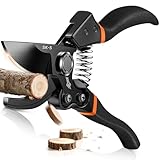
A 0.55 lb manual pruner with lever geometry that does most of the squeezing for you, and it's the only pick in this set that names arthritis in its own listing.
Best for: gardeners with stiff hands who still want a manual tool Skip it if: you need to cut past 3/4 in regularly
This is the lightest assisted pruner here at 0.55 lb, and that number matters more than the blade spec. Weight is what turns a twenty-minute session into a five-minute one. At 8.5 in long and 2.2 in wide, it's a compact tool that sits inside a jacket pocket.
Decerk says the optimized lever design multiplies cutting force up to 4X, and claims the pruner handles 3/4 in branches. The blade is described as a three-layer titanium-coated Japanese SK5 bypass edge, tested through 5,000 cuts. Those are the manufacturer's figures, not measured ones. What I can confirm from the listing is the construction described: anodised aluminium handles and high-hardness screws.
The safety lock is the detail worth noting. Decerk says it opens and closes with one hand, which sounds minor until you've fumbled a two-handed lock with a full bucket in the other arm.
The trade-off against the electric picks is real. You still squeeze. A 4X lever reduces effort, it doesn't remove it, and on genuinely dead wood you'll feel that. Against the Fiskars, you give up a published lifetime warranty for the lever action.
Pros:
- Lightest assisted pick here at 0.55 lb
- 4X lever multiplication claim
- Compact 8.5 x 2.2 in body
- One-handed safety lock
- Sells faster than every other pick in this set
Cons:
- Still requires a squeeze, unlike the two electric picks
- No published warranty
- Only two sellers list it
- 3/4 in claim is well below the ANTTCTIG opening
2. Gerossi Ratchet Pruning Shears Heavy Duty — Runner-up
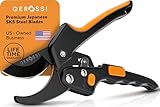
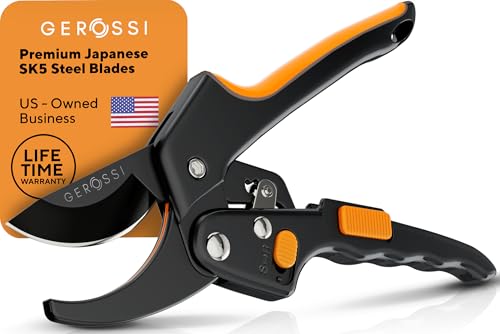
The only ratchet mechanism in this set, which means you can take a thick stem in stages instead of one hard squeeze.
Best for: dry, woody stems that jam a normal pruner Skip it if: you want one squeeze per cut every time
Ratchet action is the single most underrated answer for weak hands, and this is the only pick here that offers it. The idea is simple: squeeze, the blade advances and locks, release, squeeze again. Three or four gentle pulls replace one that your hand can't manage.
At 7.83 oz it's the lightest pruner in this comparison, lighter even than the DECERK. Overall size is 8.1 in long by 2.7 in wide, so it's slightly stubbier and slightly broader than the winner.
Gerossi describes a two-mode design: a traditional single-cut for everyday stems and a ratchet mode the brand says multiplies hand power threefold. The listing claims 3/4 in capacity and describes a high carbon SK-5 steel blade with a corrosion-resistant coating. Note the anvil blade design, which crushes slightly more than a bypass and suits dry wood better than soft green stems.
The honest weakness is speed. Ratcheting is slower per cut, and switching modes is one more thing to remember. It also sells far less briskly than the DECERK or the Fiskars, and only one seller lists it, which narrows your options if it goes quiet.
Pros:
- Lightest pick in the set at 7.83 oz
- Only ratchet mechanism here
- Two selectable cutting modes
- 3X hand power claim
Cons:
- Ratcheting takes multiple squeezes per cut
- Anvil blade crushes soft green stems more than a bypass
- No published warranty
- Only one seller lists it
3. SEESII Electric Pruning Shears — Best for beginners
Two batteries and a brushless motor mean your hand only presses a trigger, which is the right answer when squeezing is off the table.

Best for: hands that can't squeeze a lever at all Skip it if: you prune for a few minutes at a time
This is where the category stops being about grip and starts being about a trigger finger. SEESII rates the cut at 1.4 in, which is nearly double the DECERK claim, and the motor does all of it.
The tool weighs 2 lb, roughly four times the DECERK. That sounds bad and often isn't, because the weight sits low in your palm rather than at the end of a lever you're fighting. Overall length is 12.6 in with a 3.15 in width, so it's a noticeably bigger object than any manual pick here.
SEESII says the package includes two 2000mAh batteries delivering 2000+ cuts per charge, and describes two cutting modes with an adjustable range from 0.8 in up to the full 1.4 in. The narrower setting is the one to use on roses, since a shorter blade travel means faster cycling. The brand describes the motor as brushless, which it links to smoother, more consistent performance.
Two lb is the sticking point. Hold it overhead for a hedge line and your shoulder will complain long before your fingers do. It's also the cheaper of the two electric picks but firmly the most expensive tier here alongside ANTTCTIG.
Pros:
- Motor removes grip effort entirely
- 1.4 in cut capacity, adjustable down to 0.8 in
- Two 2000mAh batteries included
- Two selectable cutting modes
Cons:
- 2 lb, roughly four times the winner's weight
- 12.6 in length makes it awkward inside dense shrubs
- Batteries are one more thing to charge and eventually replace
- No published warranty
- Only one seller lists it
4. ANTTCTIG Electric Pruning Shears — Best premium
A 2.56 in maximum opening, the widest here by a large margin, with spare blades and a second battery in the box.

Best for: thick fruit tree wood up to 2.56 in Skip it if: you want a published weight before buying
The 2.56 in opening is the headline, and it's genuine daylight over the rest of this set. The next-widest is the SEESII at 1.4 in. If you're taking apple or plum wood down, that difference is the difference between a pruner and a saw.
ANTTCTIG describes two selectable opening sizes, 1.97 in and 2.56 in, so you can shorten the blade travel for lighter work. The brand says the blade is SK7 steel, which it positions as harder and sharper than the SK5 used in the DECERK, Gerossi and Kynup listings. The listing also describes a brushless motor with lower noise and reduced heat, and a soft silicone-wrapped handle intended to cut vibration.
Where it falls short is the listing itself. There's no published weight and no published overall dimensions, which for a tool this size is the one number I most wanted. An electric pruner with a wider jaw is almost certainly heavier than the 2 lb SEESII, and you can't verify that before it arrives.
It's also the most expensive pick here and the slowest seller of the six. That combination asks you to pay the most for the least corroboration.
Pros:
- Widest opening in the set at 2.56 in
- Two selectable opening sizes
- Spare blades and a second battery included
- SK7 blade steel claim, a step up from the SK5 picks
Cons:
- No published weight or overall dimensions
- Most expensive pick here
- Slowest seller of the six
- Wide-jaw electrics are bulky inside dense growth
- Only one seller lists it
5. Fiskars Bypass Pruning Shears — Best for heavy use
The only pick in this set with a published lifetime warranty, and the one I'd hand someone who prunes soft green growth every single day.
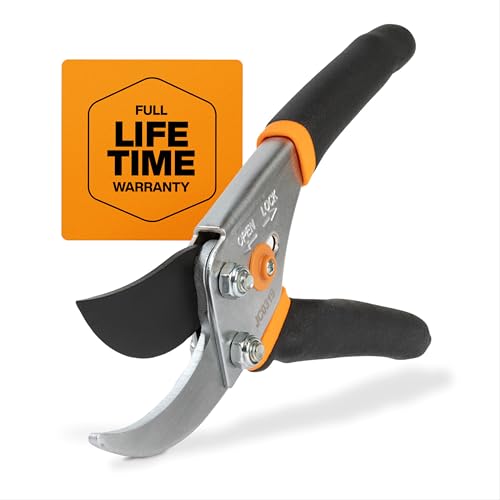
Best for: long sessions on soft green growth Skip it if: your grip gives out on woody stems
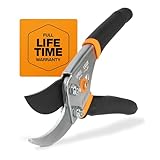
The warranty is the story. Of six listings, this is the single one publishing a lifetime warranty, and that shifts the maths on a tool you'll own for a decade. It's also the second-cheapest pick here, which makes the pairing unusual.
Stated cut capacity is 5/8 in, the smallest number in this set. That's a deliberate design choice rather than a flaw: Fiskars describes the bypass blade as built for delicate flower stems and green growth, reducing crushing and plant damage. On roses and perennials that's exactly what you want.
Weight is 0.65 lb across a 9.07 in body, so it's marginally heavier and longer than the DECERK. Fiskars says the precision-ground steel blades stay sharp through heavy use, and describes a blade coating that reduces friction, limits sap gumming and resists rust, plus a sap groove. There's an easy-open safety lock for storage.
Here's the catch, and it's the reason this sits fifth rather than first. There is no lever multiplication, no ratchet and no motor. Fiskars offers an ergonomic non-slip handle and nothing more. If your hand strength is the constraint, cushioning alone won't solve it.
Pros:
- Only published lifetime warranty in this set
- Second-cheapest pick here
- Bypass blade suited to delicate green stems
- Sap groove and anti-friction coating
- Sells briskly in its category
Cons:
- No force assistance of any kind
- 5/8 in capacity is the smallest here
- Heavier than the winner at 0.65 lb
- Only one seller lists it
6. Kynup Pruning Shears — Best budget pick
The cheapest of the six, and the only one whose listing specifically states it works properly in a left hand.

Best for: left-handed gardeners on a tight budget Skip it if: you need mechanical assistance, not just cushioning
Left-handedness is the quiet problem in this category. Most pruners are built around a right-handed squeeze, and in the wrong hand the blades splay and mash the stem instead of slicing it. Kynup says its balanced body works flawlessly either way. That's a claim, but it's a claim nobody else here makes.
At 0.53 lb it's the lightest of the four manual picks, on a 3.2 in by 8.6 in frame. Kynup states a 1 in cut capacity, higher than the DECERK's 3/4 in claim and well past the Fiskars 5/8 in. The blade is described as SK5 stainless steel. The listing calls out arthritis and weak hands directly, describing a non-slip SoftGrip handle with cushioning that absorbs pressure, plus a safety lock.
Read the mechanism claim carefully, though. Cushioning spreads load across your palm. It doesn't multiply force. That's the honest gap between this and the DECERK, and it's why this pick sits last despite the higher stated capacity.
It's also worth noting this one is listed under bonsai cutters rather than general pruning shears, which hints at a tool tuned for precision more than brute leverage.
Pros:
- Cheapest of the six
- Lightest manual pick at 0.53 lb
- 1 in cut capacity claim
- Explicitly left-hand friendly
- Safety lock included
Cons:
- Cushioning only, no lever or ratchet multiplication
- No published warranty
- Listed under bonsai tools, not general pruners
- Only one seller lists it
Which cutting mechanism suits a tired hand best?
The obvious specification is blade steel. Four of these six listings name SK5 or SK7, and gardeners compare those numbers endlessly. That's not what decides it.
Mechanism decides it. Here's how the three types actually behave:
- Lever multiplication keeps the tool light and fast. One squeeze, one cut. Best when your grip is reduced but functional. The DECERK sits here.
- Ratchet trades speed for the lowest peak force of any manual design. Best when a single hard squeeze is genuinely impossible. Only the Gerossi offers it.
- Motor assist removes squeeze force entirely and replaces it with weight. Best when arthritis or a hand injury has taken squeezing off the table. SEESII and ANTTCTIG sit here.
Then there's the fourth group, which is what most shoppers accidentally buy. Cushioned grips with no multiplication at all. Both the Fiskars and the Kynup live here, and both are good tools. Neither reduces the force your hand has to generate.
That distinction is the whole game when you're comparing the best self propelled pruning shears for seniors. A soft handle feels better in the shop. A lever feels better on the twentieth cut.
How thick a branch do you really need to cut?
Capacity inflation drives a lot of overbuying in this category. The range across these six picks runs from 5/8 in on the Fiskars up to a 2.56 in opening on the ANTTCTIG, a fourfold spread.
Most home pruning happens under 1/2 in. Rose canes, perennial stems, fruit tree water shoots, hedge regrowth. All of that sits comfortably inside every pick here.
So work through this in order:
- Walk the garden and find the thickest thing you cut more than twice a year.
- Measure it. Actual inches, not eyeballed.
- Add a quarter inch of margin.
- Anything above 1 in belongs to a lopper or a pruning saw, not a hand pruner.
That last step is where the money leaks. Buying a 2.56 in electric to handle two branches a season means carrying a heavy tool through a hundred small cuts you'd have made faster with the 0.55 lb DECERK.
The exception is fruit trees. If you're renovating an old apple or plum, wood between 1 in and 2.5 in genuinely comes up, and the ANTTCTIG is the only pick here rated for it.
What the listings do not tell you about weight and reach
Five of these six publish a weight. ANTTCTIG doesn't, and for the widest-jaw electric in the set that's the gap I'd most like closed.
Reach is the second blind spot. Every pick here is a hand pruner, and hand pruners need you close enough to touch the branch. None of these listings describes a pole extension or a telescoping shaft. For anyone who'd rather not climb a stepladder, that's a real limit, and no amount of cutting force fixes it.
Overall length gives you a clue about manoeuvrability inside dense growth:
- Kynup: 10.6 in overall
- Fiskars: 9.07 in overall
- DECERK: 8.5 in
- Gerossi: 8.1 in
- SEESII: 12.6 in
The two shortest bodies are the two assisted manual picks, which is convenient. The SEESII is 4.5 in longer than the Gerossi, and inside a mature hedge you feel every one of those inches.
Blade replacement is the third unknown. Only the ANTTCTIG listing mentions spare blades in the box. Nobody publishes a sharpening spec. Plan on treating the manual picks as sharpen-yourself tools.
When a different pick wins
Three specific conditions flip the recommendation away from the DECERK.
If you cannot close a lever at all, the DECERK is the wrong tool no matter how light it is. Go to the SEESII. A 2 lb tool you can operate beats a 0.55 lb tool you can't, and the trigger-plus-motor combination asks nothing of your grip.
If your regular thickest cut is above 1 in, the DECERK's 3/4 in claim runs out. The ANTTCTIG's 2.56 in opening is the only pick in this set that answers, and the two-stage adjustment means you can shorten travel for lighter work in the same session.
If you prune soft green growth for an hour at a stretch, the Fiskars wins on the warranty and the bypass geometry. Lifetime coverage on a tool you'll use daily for years is worth more than a lever you don't need at 3/8 in.
And a fourth, narrower flip. If you're left-handed and buying cheap, the Kynup is the only listing here that claims proper left-hand function, at the lowest price position of the six.
The verdict
The DECERK 8.5" Professional Pruning Shears is the pick I'd put in most hands. It's the lightest assisted tool here at 0.55 lb, the only manual pick whose listing names arthritis directly, and it sells faster than anything else in this comparison. The 4X lever claim plus a one-handed safety lock covers the two things that actually go wrong: force you don't have, and fiddly hardware you can't work with one occupied hand.
Two conditions flip it. If squeezing a lever is genuinely beyond you, the SEESII Electric Pruning Shears takes over, cutting 1.4 in on motor power with two 2000mAh batteries included, at the cost of 2 lb in your palm. If your regular cuts run past 1 in, the ANTTCTIG's 2.56 in opening is the only answer in this set.
The Gerossi's exact advantage over the DECERK is peak force. Ratchet mode splits a hard cut into three easy ones, and at 7.83 oz it's the lightest pruner here. If one squeeze is the problem, that's the fix. If speed matters more, stay with the winner.
FAQ
Are self propelled pruning shears worth the extra money?
Self propelled pruning shears are worth it when grip strength, not blade sharpness, is what stops you. A lever or ratchet pruner sits in the middle of this set on price, and the mechanism is what you're paying for. Motor-driven picks cost the most here and only pay off if squeezing is genuinely painful. Cushioned handles alone don't reduce force, whatever they cost.
Which pruner gives the most cutting power for the least hand effort?
The most cutting power for the least effort comes from the two electric picks, since a brushless motor removes squeeze force entirely. Among manual tools, the Gerossi's ratchet mode has the lowest peak force because it splits one hard squeeze into three gentle ones. The DECERK's 4X lever claim sits between the two: less effort than a plain bypass, faster than a ratchet.
What cut capacity should seniors look for in pruning shears?
The cut capacity seniors should look for is usually 5/8 in to 1 in, which covers rose canes, perennial stems and hedge regrowth. The Fiskars stops at 5/8 in, the DECERK claims 3/4 in, the Kynup claims 1 in. Anything thicker belongs to a lopper. Buying a 2.56 in electric for two seasonal branches means carrying extra weight through every small cut.
DECERK or SEESII: which should I actually buy?
DECERK or SEESII comes down to one question: can you still squeeze? If yes, take the DECERK at 0.55 lb, because it's a quarter of the SEESII's 2 lb and needs no charging. If squeezing hurts or fails, the SEESII cuts 1.4 in on motor power with two batteries in the box. Weight versus grip effort is the whole trade.
What mistake do most people make buying pruners for weak hands?
The mistake most people make is buying a soft cushioned grip and assuming it reduces cutting force. It doesn't. Cushioning spreads pressure across your palm, which helps blisters, not strength. Both the Fiskars and the Kynup are cushioned bypass pruners with no multiplication. Look for the words lever, ratchet or motor in the listing, not just ergonomic.
Start with your own hands, not the branch. Squeeze a clothespin ten times. If that's uncomfortable, skip the manual picks entirely and go straight to the SEESII, because no lever geometry will save a grip that's already gone. If it's fine, the DECERK is the default I'd order today: it's the lightest assisted tool in this comparison, it packs into a pocket at 8.5 in, and the lever does the work your thumb shouldn't have to. Measure your thickest branch before you decide. That single number settles most of this.