Best Quiet Backpack Leaf Blower Picks for Big Yards

Seven backpack blowers compared on published airflow, weight and power source, with an honest look at why quiet is the one claim you can't take at face value in this category.

By Taylor MontgomeryUpdated 19 min read
On this page
- Best quiet backpack leaf blower at a glance
- How I screened these seven and what the weights told me
- Why can't anyone promise you a quiet backpack leaf blower?
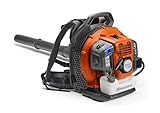
- 1. Husqvarna 150BT Gas Backpack Leaf Blower — Best overall
- 2. Greenworks 80V Backpack Leaf Blower — Best premium
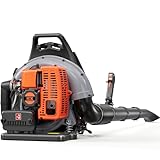
- 3. HTK Gas Backpack Leaf Blower — Best for heavy use
- 4. Thalorus 52cc Backpack Leaf Blower — Most versatile
- 5. Greenworks 60V Backpack Leaf Blower — Best lightweight
- 6. PROYAMA 72CC Gas Backpack Leaf Blower — Best for families
- 7. VEVOR 63CC Backpack Leaf Blower Gas Powered — Best budget pick
- Gas or battery: which suits your yard?
- How much CFM do you actually need?
- Husqvarna 150BT vs Greenworks 80V: which wins?
- What the listings leave out
- The verdict
- FAQ
The best quiet backpack leaf blower here is the Husqvarna 150BT, because its 51-cc engine puts 765 CFM behind a 22 lb harness and that combination clears wet leaves in fewer passes, which is the only reliable way to shorten how long you make noise. If low sound is your actual priority rather than a preference, the battery-powered Greenworks 80V at 9.48 lb is the better buy. What splits this field of seven is not airflow. It's the power source, and everything that follows from it: weight, runtime, and how the machine sounds from three houses away.
Best quiet backpack leaf blower at a glance
| Pick | Airflow | Weight | Price |
|---|---|---|---|
Best overall Husqvarna 150BT Gas Backpack Leaf Blower |
765 CFM claim | 22 lb | Check Price |
Best premium Greenworks 80V Backpack Leaf Blower |
750 CFM claim | 9.48 lb | Check Price |
Best for heavy use HTK Gas Backpack Leaf Blower |
665 CFM claim | 21 lb | Check Price |
Most versatile Thalorus 52cc Backpack Leaf Blower |
550 CFM claim | 17 lb | Check Price |
Best lightweight Greenworks 60V Backpack Leaf Blower |
550 CFM claim | 9.48 lb | Check Price |
Best for families PROYAMA 72CC Gas Backpack Leaf Blower |
72CC engine | 21 lb | Check Price |
Best budget pick VEVOR 63CC Backpack Leaf Blower Gas Powered |
1110 CFM claim | 26.5 lb | Check Price |



How I screened these seven and what the weights told me
I set three criteria before looking at a single listing, and I weighted them in this order.
- Published, comparable numbers carry the most weight. Weight in pounds and dimensions in inches are standardised. Airflow claims are not, because CFM can be measured at the housing or at the nozzle tip and no listing here says which. So a 22 lb figure counts for more in my ranking than a 1110 CFM figure.
- Power source comes second, because it decides noise, refuelling and runtime in one stroke.
- Published warranty comes third. Only three of the seven state a term: Husqvarna, HTK and Thalorus all list two years. The other four say nothing about coverage, and that gap matters more on a two-stroke engine than on almost any other yard tool.
Those criteria are ordered that way because a spec you can compare across seven listings is worth more than a spec that appears on one. The weights alone reorganised the field. Two picks land at 9.48 lb. Three cluster at 21 to 22 lb. One sits at 26.5 lb.
That's a 17-pound spread across machines that all strap to your back. Nothing else in the data separates them so cleanly, and nothing else you'll feel so immediately in the first ten minutes.
Why can't anyone promise you a quiet backpack leaf blower?
Here's the honest position. Only one listing in this set publishes a sound figure at all: HTK states 71 dB for its blower. Greenworks describes its 80V unit as producing less noise than gas, which is a comparison, not a measurement. Nobody else says anything.
So a genuine best quiet backpack leaf blower ranking, built on decibel data, cannot be assembled from what these seven listings publish. I'm not going to pretend otherwise. What I can do is tell you what the data does support:
- Battery units run quieter than two-stroke gas engines. That's a property of the drive, not a claim about any specific model. Both Greenworks picks are battery.
- A single stated dB number is not a standard. Sound is measured at a distance, and at an operator position or a bystander position, and 71 dB means nothing without that context.
- More airflow means fewer passes. Total noise made is duration times loudness. A blower that finishes in twelve minutes instead of twenty-five is doing your neighbours a real favour even if it's louder per second.
That third point is why the Husqvarna leads. It's the practical route to less noise in a category where the manufacturers won't give you the numbers.
1. Husqvarna 150BT Gas Backpack Leaf Blower — Best overall
The most complete package here: high published airflow, a named engine technology, a two-year warranty, and 22 lb that sits lower than the biggest gas unit in this group.
Best for: half-acre-plus properties where wet leaves are the norm Skip it if: you need to work early mornings near neighbours
What sets the 150BT apart in this set is that its numbers hang together. Husqvarna states 765 CFM, 270 MPH and 22 N of blowing force from a 51-cc, 2.16-HP two-cycle engine. That's the only pick here quoting force in newtons alongside volume and speed, and force is the figure that actually moves a matted, rain-soaked leaf pile.
It's also the second-smallest gas engine in the group. The HTK and VEVOR run 63CC, the PROYAMA 72CC, yet the Husqvarna's stated airflow beats the HTK's 665 CFM. That gap tells you engineering matters more than displacement, and it's why I don't rank by cc.
The chassis is the most compact of the gas picks at 14 x 18 x 11 in, which matters for garage shelf space. Husqvarna describes a padded harness, hip belt and weight-levelling load management system, plus its X-TORQUE engine. Two years of stated warranty backs it, matching the best coverage published here.
The trade-off is direct. This is the second most expensive pick in the set and it's a two-stroke, so you're mixing fuel and accepting engine noise. It's also 12.5 lb heavier than either Greenworks.
Pros:
- Highest published blowing force in the set at 22 N
- 765 CFM claim beats larger 63CC rivals
- Most compact gas chassis at 14 x 18 x 11 in
- Two-year stated warranty
- The gas pick buyers choose most often here
Cons:
- Second-highest price position of the seven
- Two-stroke engine means fuel mixing and real noise
- 22 lb is 12.5 lb over the battery picks
- No published sound figure
2. Greenworks 80V Backpack Leaf Blower — Best premium
The quietest realistic option here, delivering 750 CFM from a brushless 80V motor at 9.48 lb, which is less than half the weight of the Husqvarna.

Best for: suburban lots where emissions and engine noise are the constraint Skip it if: you clear more than a battery charge will cover
This is the pick that resolves the tension in the whole category. Greenworks states 750 CFM from an 80V brushless motor, which puts it 15 CFM behind the Husqvarna's claim while weighing 12.52 lb less. Greenworks describes it as a green alternative to gas that produces less noise and no harmful emissions. That's the brand's own framing, not a measured dB comparison, but the underlying physics of a brushless motor versus a two-stroke is not in dispute.
It ships with a 4.0 Ah battery and charger, released in 2024, and it's the fastest seller of these seven. The 11.3 x 22.6 x 22.6 in body is squat rather than long, unlike the 58-inch-plus box the 60V version ships in.
Brushless motors also change the maintenance picture. No carburettor, no fuel stabiliser, no winter draining.
The honest problems are runtime and price. It's the most expensive pick in the set, and 4.0 Ah is the smaller of the two Greenworks batteries here despite the higher voltage and airflow. Push 750 CFM hard and you'll find the limit of that pack faster than you'd like. There's also no stated warranty term in the listing, which is a real gap at this price position.
Pros:
- 750 CFM claim from just 9.48 lb
- Brushless motor, no fuel or carburettor upkeep
- No emissions and lower noise than two-stroke by design
- The fastest seller of all seven picks
Cons:
- Highest price position in the set
- 4.0 Ah battery limits continuous heavy work
- No published warranty term
- Only one seller lists it
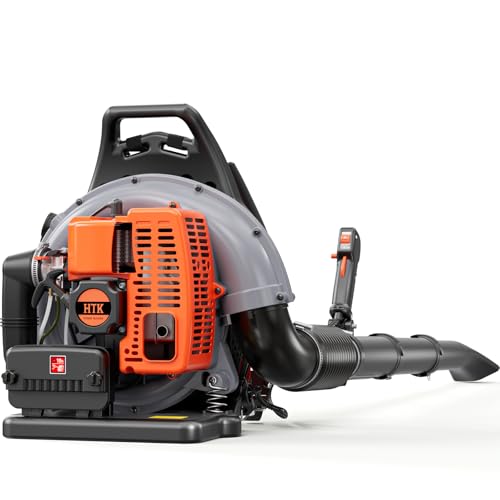
3. HTK Gas Backpack Leaf Blower — Best for heavy use
The only blower in this group that publishes a sound figure, stated at 71 dB, paired with cruise control and a 21 lb frame.
Best for: long cleanup sessions where cruise control saves your hand Skip it if: you want a published airflow figure you can trust as measured
HTK is doing something none of the other six do: putting a number on noise. The listing states a 71 dB sound level as part of a low-noise design. Treat that as the manufacturer's claim, because no measurement distance or position is given, but at least the claim exists and can be held against the product.
Beyond that, HTK states 63CC of two-stroke power, 665 CFM and up to 205 MPH. Note the shape of those numbers against the Husqvarna: more displacement, less airflow, less speed. The interesting spec is the pairing of variable-speed throttle with cruise control, which HTK says holds a steady setting without constant trigger pressure. On a long driveway-and-lawn session, that's the feature that keeps your hand from cramping. An air-purge system is described as simplifying startup.
At 21 lb it undercuts the Husqvarna by a pound, and it's the third-cheapest pick here with a stated two-year warranty. That's an unusual combination in this set: cheap picks rarely publish coverage.
The costs are visible. 665 CFM is the second-lowest gas figure among these seven, the 21.5 x 18.5 x 14 in body is bulkier than the Husqvarna's, and only one seller lists it, so you have no fallback if that seller goes quiet.
Pros:
- Only pick here with a stated dB figure
- Cruise control holds throttle without hand strain
- Two-year warranty at the third-cheapest position
- Air-purge system for easier starts
Cons:
- 665 CFM is low for a 63CC engine
- Bulkiest of the three 21 lb gas units
- Only one seller lists it
- Two-stroke fuel mixing still required
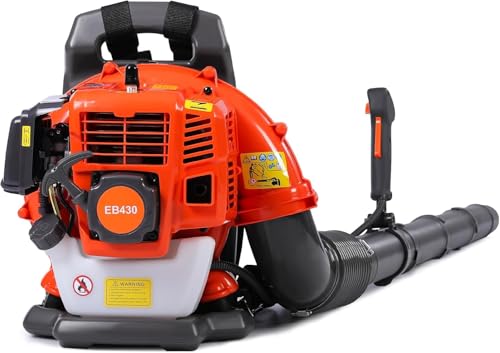
4. Thalorus 52cc Backpack Leaf Blower — Most versatile
The lightest gas pick at 17 lb, rated for work from 14°F to 104°F, which makes it the one machine here you'd genuinely use in three seasons.
Best for: mixed-season work from leaves to light snow Skip it if: contradictory weight claims in a listing bother you
Thalorus solves the weight problem without leaving gas behind. At 17 lb it's four pounds under the next-lightest gas unit and 9.5 lb under the VEVOR, and it's the second-cheapest pick in the set. Thalorus states 550 CFM and 230 MPH from a 52cc engine, so airflow drops but nozzle speed is the second-highest published figure here.
The temperature range is the genuinely distinguishing claim. Thalorus says the rugged housing and sealed engine perform from 14°F to 104°F, covering autumn leaves, summer clippings and light winter snow. The brand also states a 1-litre tank giving up to 45 minutes of uninterrupted power, a thumb throttle with cruise control, and ignition in two pulls. A two-year manufacturer warranty is listed.
One thing to flag plainly. The listing's own copy claims 13.6 lbs while the specification field says 17 lb. I've used 17 lb throughout because that's the structured specification, but a contradiction that size in a single listing is worth knowing about before you buy.
The other trade-offs: 550 CFM ties for the lowest volume in this comparison, and the 68.9-inch shipping dimension means a long box and a long tube assembly to store.
Pros:
- Lightest gas pick at 17 lb
- 230 MPH is the second-highest speed claim here
- Stated 14°F to 104°F operating range
- Two-year manufacturer warranty
- Second-cheapest of the seven
Cons:
- Listing copy contradicts its own weight spec
- 550 CFM ties for lowest volume in the set
- 68.9 in shipping length is awkward to store
- No published sound figure
5. Greenworks 60V Backpack Leaf Blower — Best lightweight
Same 9.48 lb frame as the 80V and a larger 5.0 Ah battery, trading 200 CFM for runtime and a lower price position.

Best for: smaller yards and anyone who dreads a 20-pound harness Skip it if: you need 700 CFM or more
The 60V is the sensible battery entry point, and the battery is the reason. It ships with 5.0 Ah against the 80V's 4.0 Ah, so despite the lower voltage you get the largest cell capacity in this group of seven. On a patio-and-driveway routine, that's more useful than peak airflow you never reach.
Greenworks states 550 CFM and 160 MPH with variable speed, described as dialling down to a gentle breeze for flower beds or maxing out for heavy wet leaf piles. That range is the real argument for a battery blower: a two-stroke idles noisily at its floor, while an electric motor genuinely goes quiet at low throttle. Weight is identical to the 80V at 9.48 lb.
It's also the cheaper of the two Greenworks units and it sells faster than four of the five gas picks here.
Where it loses is raw capability. 160 MPH is the lowest nozzle speed published in this set by a wide margin, and 550 CFM ties Thalorus at the bottom. Against a compacted, frozen pile at the end of a wet November, you'll be making more passes than any gas owner. The 58.1-inch box is unwieldy, and like the 80V there's no stated warranty term.
Pros:
- Largest battery in the set at 5.0 Ah
- 9.48 lb ties for lightest overall
- True low-speed control for beds and corners
- Cheaper than the 80V Greenworks
Cons:
- 160 MPH is the lowest speed claim here
- 550 CFM ties for lowest volume
- No published warranty term
- 58.1 in shipping length
6. PROYAMA 72CC Gas Backpack Leaf Blower — Best for families
The largest engine here at 72CC in a 21 lb frame, with a dual-tube nozzle set and a self-throttle lock that suits several people sharing one machine.

Best for: households sharing one blower between several users Skip it if: you want a stated warranty term
PROYAMA brings the biggest displacement in this comparison. 72CC of two-cycle power beats the two 63CC units and the Husqvarna's 51-cc, and it does it at 21 lb, which ties the lightest of the big gas machines.
The dual-tube design is the feature that earns the family label. PROYAMA supplies both a flat and a round nozzle, described as adapting to tight spaces or wide-open terrain. If three people in a household use one blower for different jobs, that swap matters more than a spec sheet suggests: flat for a narrow path, round for the back lawn. A self-throttle lock holds consistent RPM, and variable-speed throttle with cruise control rounds out the controls. Shock-absorbing straps handle the load.
Here's the problem, and it's the reason this sits sixth rather than third. PROYAMA publishes no CFM and no MPH figure in this listing. The engine displacement is the only performance number you get, and as the Husqvarna-versus-HTK comparison already showed, displacement doesn't predict airflow. You're buying 72CC on faith.
No warranty term is stated either, and only one seller lists it. It's also the slowest seller of all seven picks here.
Pros:
- Largest engine in the set at 72CC
- Flat and round nozzles both included
- 21 lb ties the lightest big gas unit
- Self-throttle lock plus cruise control
Cons:
- No published CFM or MPH figure at all
- No stated warranty term
- Slowest seller of the seven
- Only one seller lists it
7. VEVOR 63CC Backpack Leaf Blower Gas Powered — Best budget pick
The cheapest pick here and the only one arriving with earmuffs, tubes, nozzles and a full tool kit, at the cost of being the heaviest by 4.5 lb.

Best for: spending the least while still getting a full accessory kit Skip it if: you'll be carrying it uphill for an hour
VEVOR is the cheapest of these seven and the box is the fullest. The listed kit includes noise-reducing earmuffs, a corrugated tube, main air tube, extension tube, flat nozzle, two clamps, a socket wrench, an open wrench and a Philips driver. Earmuffs in the box is a small thing that says something: this is the only pick that acknowledges hearing protection at all, and any two-stroke blower needs it.
VEVOR states 1110 CFM and 220 MPH from a 63CC engine with a 1.89L tank, which is the largest fuel capacity in this set. Treat the 1110 CFM figure with real caution. It's 345 CFM above the Husqvarna's claim from a similar engine, and the same 63CC displacement in the HTK listing is rated at 665 CFM. Two brands, one displacement, a 445 CFM gap. That tells you the measurement methods differ, not that VEVOR moves 67% more air.
The build details are a shock-absorption system, ergonomic straps and high-strength nylon described as tear-resistant, with adjustable hose angles.
Then the weight. 26.5 lb makes it the heaviest here by 4.5 lb and 17 lb heavier than either Greenworks. That's the whole argument against it. No warranty term is stated, and only one seller lists it.
Pros:
- Cheapest of all seven picks
- Only pick shipping with earmuffs
- Largest fuel tank at 1.89L
- Full tool and nozzle kit included
Cons:
- Heaviest in the set at 26.5 lb
- 1110 CFM claim is implausible against rivals
- No stated warranty term
- Only one seller lists it
Gas or battery: which suits your yard?
This is the fork that decides everything else. Work through it honestly.
- Under a quarter acre, mostly hard surfaces. Battery. The 60V Greenworks at 9.48 lb with a 5.0 Ah pack will finish before the charge does, and you'll actually use it for a five-minute patio tidy instead of leaving it in the garage.
- A quarter to half an acre with mature trees. Either works. The 80V's 750 CFM claim is within 15 CFM of the Husqvarna, so the real question is whether one battery covers your yard.
- Half an acre or more, or wet leaves as the default. Gas. The Husqvarna's 22 N of stated force and 765 CFM will do in one pass what 550 CFM does in three.
- Neighbours close, restrictive hours, or you hate small-engine maintenance. Battery, without hesitation. No fuel mixing, no carburettor, no winter draining.
- You already own 60V or 80V Greenworks tools. Battery, obviously. The pack you have is worth more than any spec on this page.
One more filter. Three picks state a two-year warranty, and all three are gas: Husqvarna, HTK and Thalorus. Neither battery unit publishes a term. That's an odd inversion of what you'd expect and it belongs in your decision.
How much CFM do you actually need?
CFM is cubic feet per minute of air volume, and it's the number every listing leads with. It's also the number that misleads most in this category, for two reasons.
First, the claims aren't comparable. Two 63CC engines in this set are rated 445 CFM apart. Same displacement, wildly different numbers, which means the brands are measuring at different points or under different conditions. Airflow at the housing is always higher than airflow at the nozzle tip.
Second, volume without speed doesn't move debris. Speed in MPH is what lifts a stuck leaf. The published figures spread from 160 MPH on the 60V Greenworks to 270 MPH on the Husqvarna, and that's a 110 MPH gap that you'll feel more than any CFM difference.
Rough guidance from what's published here:
- 550 CFM class (Thalorus, 60V Greenworks): dry leaves, clippings, hard surfaces, small to medium yards.
- 665 to 765 CFM class (HTK, 80V Greenworks, Husqvarna): wet leaves, larger lots, matted piles.
- Anything above 1000 CFM: verify how it was measured before you pay for it.
Husqvarna 150BT vs Greenworks 80V: which wins?
These two are 15 CFM apart on paper and worlds apart in practice, so it's worth putting them head to head properly.
The Husqvarna wins on force and endurance. It publishes 22 N of blowing force and 270 MPH against the Greenworks' 750 CFM with no force figure given. It runs as long as you keep feeding it fuel, so a four-hour autumn Saturday is one continuous job rather than a series of charge cycles. And it states a two-year warranty where the Greenworks states none.
The Greenworks wins on weight, noise and upkeep. 9.48 lb against 22 lb is a 12.52 lb difference you notice inside five minutes and resent inside thirty. There's no fuel to mix, no carburettor to gum up over winter, and the brushless motor is described as low-maintenance by design. Greenworks positions it as producing less noise than gas.
The cutoff is runtime against your property. If you can finish your yard inside one 4.0 Ah charge, take the Greenworks and enjoy the lighter harness and the quieter morning. If you can't, the Husqvarna's tank is not a luxury, it's the whole point.
What the listings leave out
Four gaps run through this entire set, and knowing them beats any spec sheet.
Sound data, almost entirely. One listing of seven gives a dB number, and it gives it without a measurement distance. If your municipality has a noise ordinance with a numeric limit, none of these listings lets you check compliance before you buy.
Battery runtime in minutes. Both Greenworks picks state amp-hours but neither states how long that lasts at full throttle. 5.0 Ah at 60V and 4.0 Ah at 80V are different amounts of stored energy, and neither converts to a runtime you can plan around.
Airflow methodology. No listing here says where its CFM was measured. That single omission is why displacement and CFM contradict each other across these seven products.
Warranty on four of seven. Greenworks 60V, Greenworks 80V, PROYAMA and VEVOR publish no term. On a two-stroke engine that's a real risk; on a brushless motor, less so, but it's still an unknown you're accepting.
Serviceability. Nothing tells you whether parts are stocked in five years. Husqvarna and Greenworks are established names in outdoor power equipment, which is not the same as a guarantee, but it's more than nothing.
The verdict
The Husqvarna 150BT is the best quiet backpack leaf blower for most buyers with a real yard, and the reasoning is uncomfortable but sound: no listing here gives you verified sound data, so the reliable route to less noise is finishing faster. 765 CFM, 270 MPH and 22 N of stated force from a 51-cc engine, carried on a 22 lb load-levelling harness with a two-year warranty, is the package that does that.
Two conditions flip it. If actual quiet matters more than capability, because your neighbours are close or your local hours are tight, the Greenworks 80V is the better choice. Same airflow class at 750 CFM, 12.52 lb lighter, brushless, no emissions. It's the most expensive pick here and its 4.0 Ah battery is the constraint you'll hit, but nothing else in this set gets closer to genuinely low noise.
And if the harness weight is your limiting factor rather than the sound, the Thalorus at 17 lb is the lightest gas unit here at the second-cheapest position, with a stated 14°F to 104°F range and a two-year warranty. Just go in knowing its listing contradicts its own weight figure.
Skip the picks with no published airflow or no published warranty unless price is your only criterion.
FAQ
Is a quiet backpack leaf blower worth paying more for?
Whether a quiet backpack leaf blower is worth more depends on where you use it. Battery units occupy the top two price positions in this set, and you're paying for a brushless motor, a 9.48 lb frame and no fuel mixing. If your yard borders neighbours or your town restricts hours, that premium buys you usable time. On a rural acre, gas gives you more capability for less.
How do I compare CFM claims between these blowers?
Comparing CFM claims across these blowers is harder than it looks, because no listing states where the measurement was taken. Two 63CC engines here are rated 665 CFM and 1110 CFM, a 445 CFM gap on identical displacement. Use CFM to sort products into rough tiers, then weigh MPH and, where given, blowing force in newtons. The Husqvarna is the only pick publishing force at 22 N.
Does any pick here publish an actual decibel rating?
Only one pick here publishes an actual decibel rating: HTK states 71 dB as part of a low-noise design. No measurement distance or operator position is given, so treat it as the brand's claim rather than a standardised figure. Greenworks describes its 80V unit as producing less noise than gas without quoting a number. The remaining five listings say nothing at all about sound.
Greenworks 60V or 80V: which battery blower should I buy?
Between the Greenworks 60V and 80V, the split is airflow against battery capacity. The 80V claims 750 CFM and 160 more MPH but ships with a 4.0 Ah pack. The 60V claims 550 CFM with a larger 5.0 Ah pack and costs less. Both weigh 9.48 lb. Choose the 80V for wet matted leaves, the 60V for routine patio and driveway work.
What mistake do first-time backpack blower buyers make?
The mistake first-time backpack blower buyers make is chasing engine displacement. This set proves the problem: a 51-cc Husqvarna claims 765 CFM while a 63CC HTK claims 665 CFM, and a 72CC PROYAMA publishes no airflow figure whatsoever. Displacement is not output. Compare weight, which is standardised, then airflow and speed together, then check whether a warranty term is actually stated.
Start with the question you can answer without any spec sheet: can you finish your yard on one battery charge? If yes, the Greenworks 80V at 9.48 lb ends the search, and you'll never mix two-stroke fuel again. If no, the Husqvarna 150BT is the machine that turns a long noisy afternoon into a short noisy one, which is the closest thing to consideration this category offers. Everything else here is a variation on price, weight or missing data. Check the two-year warranty status before you commit, because four of these seven don't publish one.