Best Drought Tolerant Grass Seed for Raised Beds

Five drought-tolerant grass seed blends compared on root depth, coverage, grass type and sun tolerance, with a clear winner and three conditions that flip the pick.

By Taylor MontgomeryUpdated 15 min read
On this page
- How I screened the field down to five
- Best drought tolerant grass seed for raised beds at a glance
- Do raised beds change the seed you need?
- 1. Jonathan Green Black Beauty Heat & Drought Resistant Grass Seed — Best overall
- 2. Pennington Kentucky 31 Tall Fescue Grass Seed — Best for families
- 3. Scotts Grass Seed Drought Tolerant Mix — Best premium
- 4. Majesty Green Easycare Low-Maintenance Grass Seeds — Most versatile
- 5. Scotts Turf Builder Grass Seed Bermudagrass — Best budget pick
- Cool-season vs warm-season: which wins in dry heat?
- How much seed does a raised bed actually take?
- What the listings do not tell you
- Top pick vs runner-up: Jonathan Green or Pennington?
- The verdict
- FAQ
The best drought tolerant grass seed for raised beds is Jonathan Green Black Beauty Heat & Drought Resistant Grass Seed, a 3 lb tall fescue and Texas bluegrass blend that the brand says grows roots up to 4 feet deep and covers 750 sq ft of new lawn. If you have kids, dogs and heavy foot traffic, Pennington Kentucky 31 Tall Fescue is the better pick, with a 7 LB bag and thick blades built to take a beating.
How I screened the field down to five
I started with the raised-bed angle, and I want to be honest about it. Amazon returns grass seed for this query, not seed marketed specifically for planters or raised soil boxes. Any of these bags will germinate in a raised bed the same way it germinates in open ground, but none of the five listings is engineered around raised-bed conditions. Treat "raised bed" as your growing environment, not as a product category.
With that established, I compared the five listings on the specifications that actually decide a drought-tolerant lawn: grass type, coverage, published root depth, sun tolerance and bag weight. Two are cool-season fescue-based blends. One is bermudagrass, a warm-season grass for the South. One is a proprietary low-maintenance blend that does not publish its species mix. One is a straight Kentucky 31 tall fescue.
Three specifications did most of the sorting work:
- Grass type, which decides whether the seed suits your climate at all.
- Coverage per bag, which tells you how many raised beds a single purchase actually fills.
- Root depth, published by only one brand here but genuinely useful when it is.
Everything else, including price position and germination time, sits under those three.
Best drought tolerant grass seed for raised beds at a glance
| Pick | Grass type | Coverage (new lawn) | Price |
|---|---|---|---|
| Tall fescue + Texas bluegrass | 750 sq ft (3 lb) | Check Price | |
Best for families Pennington Kentucky 31 Tall Fescue Grass Seed |
Kentucky 31 tall fescue | 7 LB bag, not published as sq ft | Check Price |
Best premium Scotts Grass Seed Drought Tolerant Mix |
Tall fescue + Kentucky bluegrass | 665 sq ft (4 lb) | Check Price |
Most versatile Majesty Green Easycare Low-Maintenance Grass Seeds |
Not specified on listing | Not published | Check Price |
Best budget pick Scotts Turf Builder Grass Seed Bermudagrass |
Bermudagrass (warm-season) | 330 sq ft (1 lb) | Check Price |


Do raised beds change the seed you need?
Raised beds change how seed behaves, not which seed you buy. A raised bed drains faster than open ground, which means the top inch dries out sooner, so watering frequency matters more than variety choice. Any drought-tolerant blend still needs consistent moisture during germination, which for most of these seeds runs about a week to three weeks.
The other thing raised beds do is warm up faster in spring and cool off faster in autumn. That favours seeds with a wider temperature window. Scotts' drought-tolerant mix, for example, is stated to be applied when air temperatures sit between 65°F and 85°F, which is a narrower band than the mid-March to mid-May or mid-August to mid-October window Jonathan Green publishes for Black Beauty.
If your raised bed is shallow, root depth matters more than coverage. Jonathan Green claims Black Beauty roots reach up to 4 feet deep in open ground, so a shallow bed effectively caps the drought resilience the seed can express. That is not a fault of the seed; it is a fact about growing grass in a box.
1. Jonathan Green Black Beauty Heat & Drought Resistant Grass Seed — Best overall
Jonathan Green Black Beauty is the pick when you want the deepest published root system in this set paired with genuine dual-climate versatility.
Best for: sunny to lightly shaded yards that swing from hot summers to cool springs Skip it if: you need a warm-season lawn that survives on almost no water
This is a 3 lb bag of cool-season seed that Jonathan Green describes as a mix of tall fescue and Texas bluegrass, sized at 3 x 14 x 9 in. The brand's core claim is a waxy leaf coating that limits evaporation, plus roots that can grow up to 4 feet deep. Neither claim is one I can measure, but they are stated on the listing, and the root depth figure is unusual: none of the other four listings publishes one. Coverage is 750 sq ft for new lawns and up to 1,500 sq ft for overseeding, which lands it in the middle of the field for coverage per bag. The recommended application windows, mid-August to mid-October or mid-March through mid-May, cover both a spring and a fall planting. Against the rest of the set it is priced in the middle, sells faster than the Scotts drought mix and the Majesty Green blend, and pairs the deepest published root claim with the widest sun tolerance. The trade-off is climate: cool-season fescue is not what you plant in Phoenix.
Pros:
- Published root depth up to 4 ft
- Waxy leaf coating claim for reduced evaporation
- Works in full sun to light shade
- Two planting windows per year
- 1,500 sq ft overseeding coverage
Cons:
- Cool-season only, wrong for deep South
- Bag is bulkier than the Scotts drought mix
- Mid-range price, not the cheapest option
2. Pennington Kentucky 31 Tall Fescue Grass Seed — Best for families
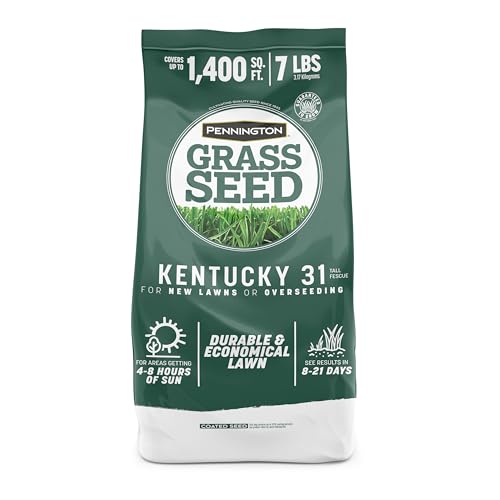
Pennington Kentucky 31 is the pick when your grass has to survive kids, dogs and a summer of sports on top of the drought.
Best for: yards with kids, dogs and constant foot traffic Skip it if: you want a fine-bladed, ornamental finish
Kentucky 31 is a straight tall fescue, and Pennington sells it in a 7 LB bag measuring 16.5 x 3.55 x 7.5 in. That is more than twice the bag weight of Jonathan Green Black Beauty, and roughly the same by weight as buying two 4 lb bags of the Scotts drought mix. The brand says the blades stand up to hot summers, heavy rains and foot traffic, and germination lands in 8 to 21 days. This is the fastest-selling listing in the set by a wide margin, so buyers are clearly reaching for it, and it is the second-cheapest of the five. The trade-off is coverage transparency: the listing does not publish a square-foot figure, which makes head-to-head cost comparison harder. It also lacks the Texas bluegrass component that gives Black Beauty its sun-and-shade flexibility. Kentucky 31 prefers full sun. For a large family lawn that has to take a beating and dry down between waterings, that is a reasonable trade.
Pros:
- Largest bag weight in this set at 7 LB
- Blades built for foot traffic
- Germination in 8 to 21 days
- The fastest seller of the five listings here
- Second-cheapest of the set
Cons:
- Coverage in square feet is not published
- No shade-tolerance claim on the listing
- Single-species blend, less genetic diversity
3. Scotts Grass Seed Drought Tolerant Mix — Best premium
Scotts Drought Tolerant Mix earns the premium slot on overseeding coverage and a self-repair claim, at the cost of the highest price position here.

Best for: overseeders covering large bare patches in a cool-season lawn Skip it if: you want the cheapest cost per square foot in this set
This is a 4 lb bag of tall fescue plus Kentucky bluegrass, sized 8.25 x 6 x 4 in. Scotts publishes 665 sq ft of new lawn coverage and up to 2,000 sq ft of overseeding coverage, which is the largest overseeding figure in the field. The listing claims 99.99% weed-free seed and a self-repair characteristic that fills in bare spots as roots deepen. Application is stated for spring or fall when air temperatures sit between 65°F and 85°F, which is a tighter window than the Jonathan Green pick offers. This is the most expensive pick here and the slower-moving Scotts listing of the two, which is worth noting: buyers are choosing the bermudagrass Scotts bag far more often. The reason to pay up for this one is coverage on overseeding jobs, not a broader growing window. Against Black Beauty, it gives up the 4-ft root claim; against Kentucky 31, it gives up bag weight; what it wins on is that 2,000 sq ft overseeding number.
Pros:
- 2,000 sq ft overseeding coverage claim
- Tall fescue plus Kentucky bluegrass blend
- 99.99% weed-free purity claim on the listing
- Self-repair characteristic stated by Scotts
- Compact 8.25 x 6 x 4 in bag
Cons:
- The most expensive pick here
- Narrow 65°F to 85°F application window
- No published root-depth figure
- Slower seller than the other Scotts listing
4. Majesty Green Easycare Low-Maintenance Grass Seeds — Most versatile
Majesty Green Easycare is the versatile pick when you want low mowing effort and fast establishment, with the caveat that the listing publishes fewer specifications than the others.

Best for: shoppers who want a low-mow, self-repairing blend and germination in about a week Skip it if: you need a published bag weight before you buy
The Majesty Green listing is the thinnest of the five for hard specifications. The pack is described as 3 lb, the dimensions are 13.4 x 3.54 x 9.84 in, and the brand says germination happens in 7 to 10 days with a full lawn in 14 to 21 days. The species mix is not disclosed on the listing, only that it is a low-maintenance drought-resistant blend with a self-repairing growth claim and long-lasting colour under dry conditions. This is the slowest seller of the five by a wide margin, which is worth weighing against a hotter listing like the Pennington. It is also priced in the premium tier of this set, which is a hard sell without a published species mix or coverage figure. What it offers, on the brand's word, is faster germination than the Pennington's 8 to 21 day window and a lower-mow promise the others do not make. Take that on trust or move to a pick with more disclosure.
Pros:
- 7 to 10 day germination claim
- Self-repairing growth claim
- Reduced mowing frequency promised
- Compact pack dimensions
- Long-lasting colour claim in dry weather
Cons:
- Grass species not disclosed on the listing
- No square-foot coverage figure published
- Weight not stated in the specifications
- The slowest seller in this set
- Premium price position for less transparent data
5. Scotts Turf Builder Grass Seed Bermudagrass — Best budget pick
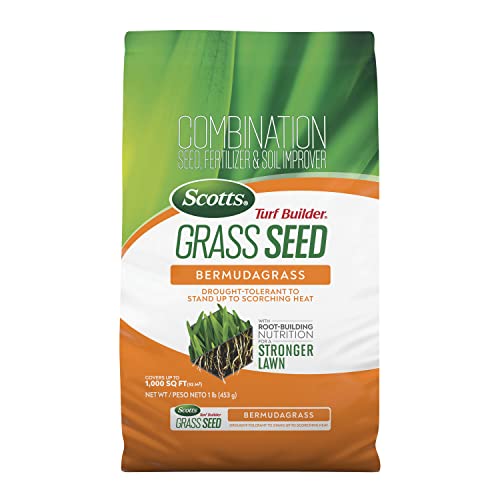
Scotts Turf Builder Bermudagrass is the budget pick for warm-climate lawns that need to survive scorching sun on very little water.
Best for: full-sun southern lawns and small patch repairs Skip it if: your yard sits in shade or you live somewhere with cold winters
Bermudagrass is a warm-season grass, and this 1 lb bag is the cheapest of the six by price rank. The pack measures 7.25 x 2.75 x 5.25 in and weighs 0.75 lb, and Scotts publishes coverage of 330 sq ft for new lawns and 1,000 sq ft for overseeding. The listing points to full sun as the required condition and pairs the seed with the brand's Root-Building Nutrition formula, which combines seed, fertiliser and a soil improver. Timing is late spring or early summer. In the context of raised beds, this pick has a specific job: small, sunny beds in the South where the goal is a tough, drought-hardy patch. It is the wrong pick almost anywhere the ground freezes for weeks each winter, and it is the wrong pick in shade at any latitude. Against Black Beauty and Kentucky 31, it trades climate range for durability under heat and dryness in the climates it does suit.
Pros:
- The cheapest of the five listings
- Warm-season grass built for full sun
- Seed, fertiliser and soil improver combined
- Compact 7.25 x 2.75 x 5.25 in pack
- Clear coverage figures on the listing
Cons:
- Only 1 lb of product in the bag
- Wrong choice for shaded raised beds
- Poor fit for cool-winter climates
- Narrow late-spring to early-summer application window
Cool-season vs warm-season: which wins in dry heat?
Both can win, at different latitudes. The best drought tolerant grass seed for raised beds in your yard depends on where the yard is more than which brand's claims sound strongest.
Cool-season grasses like tall fescue, Kentucky bluegrass and Texas bluegrass go dormant in extreme summer heat and green up again when nights cool. Their drought tolerance is largely about root depth. Jonathan Green's 4-ft root claim for Black Beauty is a cool-season strategy: send roots down where the moisture stays, and ride out the surface dryness. Three of the five picks here are in this camp, which is why Black Beauty, Pennington Kentucky 31 and the Scotts drought mix are the sensible defaults for most of the country.
Warm-season grasses like bermudagrass do the opposite. They grow hardest when the surface is hot and the days are long, and they simply do not do well in shade or through a long cold winter. If you are in the Deep South, on the Gulf Coast, or in the low desert, warm-season is the honest answer. Scotts Turf Builder Bermudagrass covers that use case in this set.
How much seed does a raised bed actually take?
Coverage figures on grass seed bags assume open ground. Raised beds are smaller and easier to measure, so cost per square foot becomes the sensible unit to compare.
Here is what the listings publish:
- Jonathan Green Black Beauty, 3 lb: 750 sq ft new, 1,500 sq ft overseeding.
- Scotts Drought Tolerant Mix, 4 lb: 665 sq ft new, 2,000 sq ft overseeding.
- Scotts Turf Builder Bermudagrass, 1 lb: 330 sq ft new, 1,000 sq ft overseeding.
- Pennington Kentucky 31, 7 LB: coverage not stated on the listing.
- Majesty Green Easycare: coverage not stated on the listing.
For a 4 ft by 8 ft raised bed, you need enough seed for 32 sq ft. Every listing that publishes coverage supplies far more than a single bed needs, so the practical question is how many beds one bag serves. On the Jonathan Green figures, one 3 lb bag reseeds more than twenty 4x8 beds. Buy the smallest bag your climate and species preference allow, or split a bag with a neighbour.
What the listings do not tell you
A grass seed listing on Amazon is written to move a bag, not to answer every reasonable question. Three things you will not find on any of these five product pages:
- Seed lot dates. Germination rates decline with age, and no listing publishes when the seed was packaged. If germination looks poor, the age of the bag is a plausible cause.
- Regional suitability at the zip-code level. Cool-season and warm-season is the coarse split; within each, some cultivars handle humidity better and some handle cold better. The bag will not tell you that.
- Water requirements during establishment. Every one of these picks needs consistent moisture in the first two to three weeks, but exact watering schedules are not on the listings. Plan on daily watering until germination, then taper.
The other thing worth knowing: "drought-tolerant" is a claim about mature grass. During germination, no seed is drought-tolerant. Raised beds dry out fast, so establishment is the hard part, not year-two survival.
Top pick vs runner-up: Jonathan Green or Pennington?
If you cannot choose between the top two, here is the split.
Pick Jonathan Green Black Beauty when your priority is drought resilience itself. The 4-ft root claim, the waxy leaf coating and the tall fescue plus Texas bluegrass mix all point in one direction: a lawn that keeps moisture longer and keeps looking green when the tap slows down. It also handles light shade, which matters if trees or fences shadow the bed for part of the day.
Pick Pennington Kentucky 31 when your priority is durability. A 7 LB bag is more than twice the Jonathan Green bag weight, and Kentucky 31 tall fescue is the classic choice for lawns that get walked on hard. It sells the fastest of the five listings here for a reason. The trade-off is that Kentucky 31 prefers full sun, and the listing does not publish a root depth or a shade rating.
The cutoff is roughly this: if drought is the harder problem in your yard, take Black Beauty; if traffic is, take Kentucky 31.
The verdict
If drought resilience is your problem, Jonathan Green Black Beauty Heat & Drought Resistant Grass Seed is the best drought tolerant grass seed for raised beds in this set. The 4-ft root claim is unique here, the tall fescue plus Texas bluegrass mix handles sun and light shade, and 750 sq ft of new-lawn coverage is enough for many beds from one 3 lb bag.
If durability under family use is your problem, Pennington Kentucky 31 Tall Fescue is the better buy. A 7 LB bag, thick foot-traffic-ready blades, and germination in 8 to 21 days at the second-cheapest price in this field make it the most sensible high-use choice. It is the fastest-selling listing of the five, which reflects that broad usefulness.
The cutoff between the two is straightforward: below the threshold of heavy foot traffic, Black Beauty wins on drought resilience and shade tolerance; above it, Kentucky 31 wins on toughness. Buyers in warm-season climates should look at the Scotts bermudagrass instead, and buyers overseeding large lawns should look at the Scotts drought mix for its 2,000 sq ft overseeding number.
FAQ
Is the best drought tolerant grass seed for raised beds the same as for open ground?
Drought tolerant grass seed for raised beds is the same seed you would buy for open ground; there is no separate product category on Amazon. What changes is behaviour. Raised beds drain faster and warm up sooner, so you water more often during germination. Species choice, root depth and sun tolerance all matter the same way they do on open lawn.
Is Jonathan Green Black Beauty worth it over cheaper options?
Jonathan Green Black Beauty is worth the mid-range price for two specific reasons: it is the only pick here with a published root depth, stated at up to 4 feet, and it is the only one blending tall fescue with Texas bluegrass to handle both sun and light shade. If your yard is deep-South warm-season country, a cheaper bermudagrass is the smarter buy instead.
How much square footage does each bag cover?
How much square footage each bag covers is published on three of the five listings. Jonathan Green Black Beauty covers 750 sq ft new or 1,500 sq ft overseeding. Scotts Drought Tolerant Mix covers 665 sq ft new or 2,000 sq ft overseeding. Scotts Turf Builder Bermudagrass covers 330 sq ft new or 1,000 sq ft overseeding. Pennington and Majesty Green do not publish coverage.
Should I choose Jonathan Green Black Beauty or Scotts Drought Tolerant Mix?
Choose Jonathan Green Black Beauty for the deepest published root claim and the widest planting window. Choose Scotts Drought Tolerant Mix for the biggest overseeding coverage figure in this field at 2,000 sq ft and the 99.99% weed-free claim. Black Beauty is mid-priced and Scotts is the most expensive pick here, so the Scotts premium buys overseeding reach, not raw drought resilience.
What is the biggest mistake buyers make with drought tolerant grass seed?
The biggest mistake buyers make with drought tolerant grass seed is under-watering during germination. Drought tolerance is a mature-grass characteristic, not a germination one. Every seed on this list needs consistent surface moisture for the first two to three weeks, and raised beds dry out faster than open ground. Plan on daily watering until you see green, then taper as roots deepen.
Grass seed is one of those products where the right choice is set by climate first, use pattern second, and brand third. Once you know whether your bed sits in a cool-season or warm-season zone, and whether it takes daily foot traffic, the shortlist collapses to one or two names. Jonathan Green Black Beauty is the default because it wins on the specification that matters most for a raised bed, which is how deep the roots can reach when the surface goes dry. Measure your bed, count your beds, and buy the smallest bag that covers the area with a little spare for touch-ups next season.