Best Broadcast Lawn Spreader for Even Coverage

Seven spreaders lined up by capacity, spread width and setup. The Scotts EdgeGuard DLX leads, with a pull-behind Agri-Fab and a hand-crank Scotts Whirl for the edges of the field.

By Taylor MontgomeryUpdated 17 min read
On this page
- Best broadcast lawn spreader at a glance
- How I narrowed seven spreaders down
- What actually decides even coverage?
- 1. Scotts Turf Builder EdgeGuard DLX Broadcast Spreader — Best overall
- 2. Agri-Fab Pull Behind Broadcast Spreader — Best premium
- 3. Scotts Whirl Hand-Powered Spreader — Best budget pick
- 4. VEVOR Walk Behind Spreader 60 lbs — Most versatile
- 5. Amazon Basics Fertilizer Spreader — Best minimal setup
- 6. ZORYX 50LB Walk-Behind Broadcast Spreader — Best upgrade
- 7. Garvee 100LBS Push Lawn Spreader — Best for pros
- Push, pull or hand: which type fits your yard?
- What the listings leave out
- Which spreader matches your lawn size?
- The verdict
- FAQ
The best broadcast lawn spreader is the Scotts Turf Builder EdgeGuard DLX, a push model that holds enough product for 15,000 sq ft and ships pre-calibrated. If your property runs past half an acre, the Agri-Fab pull-behind with its 130 lb hopper and 12 ft spread width is the better buy. Get the pick wrong and you buy the real cost: fertilizer burn stripes and bare seed rows that take a full season to grow out.
Best broadcast lawn spreader at a glance
| Pick | Capacity | Spread width | Price |
|---|---|---|---|
Best overall Scotts EdgeGuard DLX |
15,000 sq ft product | Not stated | Check Price |
Best premium Agri-Fab Pull Behind |
130 lb hopper | 10–12 ft claim | Check Price |
Best budget pick Scotts Whirl |
1,500 sq ft product | Hand-thrown | Check Price |
Most versatile VEVOR 60 lb Push |
60 lb hopper | 0–9.8 ft claim | Check Price |
Best minimal setup Amazon Basics Spreader |
5,000 sq ft per load | Not stated | Check Price |
Best upgrade ZORYX 50 lb Push |
50 lb hopper | 3 flow settings | Check Price |
Best for pros Garvee 100 lb Push |
100 lb hopper | 12 ft claim | Check Price |


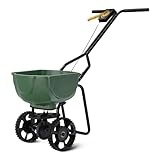


A broadcast spreader flings product from a spinning disc in a wide arc. That is different from a drop spreader, which lays a narrow band straight down. The seven picks here split into three body types: hand-crank, push, and pull-behind. Your lawn size decides which one you need, so read the size section before you commit.
How I narrowed seven spreaders down
I started with the listings and cut on three hard reasons before I ranked anything.
First cut: no usable capacity figure paired with no body-type clarity. A spreader you cannot size to your lawn is a guess. Every pick here states either a hopper weight or a square-foot rating, so you can match it to your yard.
Second cut: throw type. This is a broadcast spreader roundup, so drop spreaders were out from the start. All seven fling product from a disc.
Third cut: obvious mismatch between price position and published capability. The ZORYX sits at the top of the price ladder here yet lists only two specs, colour and dimensions, with no weight and no warranty. It survived because its rain cover and enclosed gearbox claims answer a real problem, but it drops in the ranking for that thin sheet.
What survived is a spread from a hand-thrown Scotts Whirl up to the 130 lb Agri-Fab. Here is how they screen out:
- Kept: clear capacity, broadcast throw, a stated setup story
- Ranked down: thin spec sheets, no published weight, no warranty
- Cut entirely: any drop-only design or missing size data
The best broadcast lawn spreader for you is the one whose capacity matches how much lawn you cover in a session. That is the number I ranked on first.
What actually decides even coverage?
Most spreader guides compare hopper size. Bigger hopper, fewer refills, done. That is real, but it is not what decides whether your lawn looks striped in three weeks. Coverage evenness does, and two things drive it.
The first is your walking pace held steady against the flow setting. A broadcast disc throws more product when you walk slower, less when you rush. The second is overlap discipline: broadcast patterns fade at the edges, so each pass has to overlap the last.
The specs that matter here are flow control and spread width. The Garvee lists 25 adjustable settings and a 12 ft throw. The VEVOR lists 18 settings. The ZORYX lists only 3 flow settings. More settings mean finer matching of flow to your product and pace.
- Fine flow steps: easier to dial in a new fertilizer without a test strip
- Known spread width: lets you plan overlap distance before you start
- Edge control: the Scotts EdgeGuard shield blocks the right-side throw near beds
The trap is buying width you cannot walk straight. A 12 ft throw is only even if you keep your lines parallel and overlapped. On a small yard, a hand spreader that throws a few feet is easier to control than a wide push unit you cannot line up.
1. Scotts Turf Builder EdgeGuard DLX Broadcast Spreader — Best overall
The Scotts EdgeGuard DLX wins because it ships pre-calibrated and blocks throw near beds, the two things that keep coverage even without practice.
Best for: midsize lawns that need clean edges near beds and paths Skip it if: your yard is over half an acre
What sets this pick apart in the group is the EdgeGuard shield. Scotts says the technology blocks the right side of the throw, keeping product off landscaping, driveways, and sidewalks. No other push spreader here lists edge blocking. That matters because the fastest way to waste fertilizer, or scorch a flower bed, is broadcasting straight into it.
Scotts states the unit arrives pre-calibrated and ready to use, holding up to 15,000 sq ft of Scotts product. At 10.9 lb it is the lightest of the wheeled picks with a published weight, easier to push up a slope than the 30 lb Garvee. The 22 x 19 x 22 in footprint stores flat against a wall.
It is the pick buyers here reach for most, sitting well ahead of the field on how fast it moves. The trade-off: no spread-width figure is published, so you plan overlap by eye. And 15,000 sq ft is plenty for a suburban lot but light for acreage, where the Agri-Fab pulls ahead.
Pros:
- Pre-calibrated out of the box, no test strip
- EdgeGuard shield blocks throw near beds
- Lightest wheeled pick with a stated weight, 10.9 lb
- Holds product for up to 15,000 sq ft
- Compact 22 x 19 x 22 in storage footprint
Cons:
- No published spread-width figure
- Capacity too small for half-acre-plus lawns
- No stated warranty
- Only two sellers list it
2. Agri-Fab Pull Behind Broadcast Spreader — Best premium
The Agri-Fab is the only pick you tow, and its 130 lb hopper turns a half-acre job into one loop instead of five.

Best for: large properties with a riding mower or tractor Skip it if: you have no tow vehicle
This is the heavy hitter of the set. Agri-Fab lists a 130 lb hopper that covers up to 1/2 acre or 25,000 sq ft, and a universal hitch that connects to most riding mowers, naming Craftsman, Husqvarna, and Cub Cadet. Nothing else here tows, so if you already own a tractor, this pick changes the whole job.
The stated spread width runs 10 ft to 12 ft, wider than any push spreader can hold straight on foot. Construction claims include 1 in steel tubing, an enclosed gear house, a poly hopper, and 13 in x 4 in pneumatic tires. It is the only pick in the set with a published warranty: 3 years limited. That paper matters when a spreader lives outside and takes a beating.
At the top of the price ladder here, it earns the position with real, unique capability. The trade-off is plain: without a riding mower it is dead weight. The stated unit weight is 29.4 lb empty, so you are not pushing this one by hand across a small yard.
Pros:
- 130 lb hopper covers up to 25,000 sq ft per fill
- Only pick with a published 3-year warranty
- Universal hitch fits most riding mowers
- Stated 10–12 ft spread width, widest here
- Pneumatic 13 in x 4 in tires for rough ground
Cons:
- Useless without a tow vehicle
- Highest price position in the set
- Empty weight of 29.4 lb is hard to move by hand
- Overkill for a typical suburban lot
3. Scotts Whirl Hand-Powered Spreader — Best budget pick
The Scotts Whirl is the cheapest of the seven and the only one you crank by hand, made for the strips a wheeled spreader cannot reach.

Best for: small yards and tight spots between plantings Skip it if: you have more than a couple thousand square feet to cover
The Whirl is a different animal from the wheeled picks. You hold it, turn a crank, and the disc throws product in an arc. Scotts says it holds up to 1,500 sq ft of product and includes adjustable arm support for comfort. That capacity is a tenth of the EdgeGuard's, so this is a small-yard tool, not a whole-lawn tool.
Its real strength is reach. A push spreader cannot squeeze between shrubs or dress a narrow parkway strip. The Whirl can. At 8.5 x 13 x 8.7 in it is the most compact pick here and hangs on a nail. It is also the fastest seller of the group, which fits its low price and grab-and-go role.
The trade-off is stamina and evenness. Hand-cranking a large yard is slow, and coverage depends entirely on a steady crank speed you have to learn. Buy it as a second spreader for edges and touch-ups, not as your only one on anything bigger than a small lot.
Pros:
- Cheapest pick in the set
- Reaches tight spots wheels cannot
- Most compact body, 8.5 x 13 x 8.7 in
- Adjustable arm support per the listing
- Doubles as a salt and ice-melt thrower
Cons:
- Only 1,500 sq ft of product per fill
- Even coverage depends on steady cranking
- Tiring across a large lawn
- No wheels, so no rolling straight-line control
4. VEVOR Walk Behind Spreader 60 lbs — Most versatile
The VEVOR pairs a 60 lb hopper with 18 flow settings, giving you fine control at an entry price.

Best for: buyers who want fine flow control on a budget Skip it if: you need a published weight before you buy
This is the flexible middle of the range. VEVOR lists an 18-setting flow control with a disc pellet controller, more steps than the ZORYX's 3 and enough to dial in different products without a test run. The 60 lb hopper sits between the small Scotts push unit and the big Garvee, a sensible size for a medium lawn.
VEVOR states a powder-coated steel frame, an impact-resistant plastic hopper, and 8 in all-terrain pneumatic tires. It also claims no-tools assembly, which the brand frames as easy for a wider range of users. The listed spread runs 0 to 9.8 ft, so you can throttle it right down for slow-release granules near a bed.
The gap here is data. The listing gives colour, size, and dimensions but no unit weight and no warranty, so you cannot compare its heft against the Scotts or judge how it will hold up over years. It earns its spot on flow flexibility and price, not on a full spec sheet. If a paper warranty matters to you, look at the Agri-Fab instead.
Pros:
- 18 flow settings, finer than most here
- Entry price for a 60 lb push spreader
- 8 in pneumatic tires for uneven ground
- Adjustable 0–9.8 ft spread width
- No-tools assembly per the listing
Cons:
- No published weight
- No stated warranty
- Only one seller lists it
- Steel-frame claims not independently confirmable
5. Amazon Basics Fertilizer Spreader — Best minimal setup
The Amazon Basics spreader is the lightest push unit here at 8.86 lb, with a release cable pre-installed to cut assembly.

Best for: first-time owners who want the lightest push spreader Skip it if: you cover more than 5,000 sq ft per fill
If you have never owned a spreader, this is the gentlest entry. The listing states the release cable comes pre-installed and calls assembly easy, which removes the step most people get wrong on a new spreader. It covers up to 5,000 sq ft per load and uses a multi-gear system for flow control.
At 8.86 lb it is the lightest wheeled pick with a stated weight, edging the Scotts EdgeGuard's 10.9 lb. That makes it simple to lift into a car or hang in a garage. The frame is steel with a plastic bin, rated by Amazon Basics for all-season weather. It is one of the newest designs in the group, released in 2025.
The catch is coverage per fill. 5,000 sq ft is a third of the EdgeGuard's rated product capacity, so a bigger lawn means more trips to the bag. It also lacks the Scotts edge shield, so you manage bed spillover yourself. Buy it for a small-to-medium lawn where light weight and quick setup beat capacity.
Pros:
- Lightest wheeled pick with a stated weight, 8.86 lb
- Release cable pre-installed for fast setup
- Multi-gear flow control
- Steel frame with all-season plastic bin
- Newest design here, released 2025
Cons:
- Only 5,000 sq ft per load
- No edge-blocking shield
- No stated warranty
- No published spread-width figure
6. ZORYX 50LB Walk-Behind Broadcast Spreader — Best upgrade
The ZORYX is the one built to live outdoors, with a rain cover and enclosed gearbox that keep salt and moisture off the gears.

Best for: owners who leave the spreader outside between uses Skip it if: you want a manufacturer warranty on paper
The ZORYX answers a specific problem: spreaders that rust because they never make it back into the shed. ZORYX lists a rain cover that keeps contents dry and an enclosed gearbox that protects the gears from moisture. If you spread rock salt in winter and store the unit under an eave, that sealing is worth real money.
Other stated features include a 50 lb steel-frame hopper, an anti-clog removable grate that breaks up clumps, and 13 in pneumatic tires. The grate matters most for damp salt or caked seed that jams a bare hopper. Flow control lists 3 settings, fewer than the VEVOR's 18, so you get coarser adjustment.
Here is the honest problem. This pick sits near the top of the price ladder yet publishes only two specs, colour and dimensions, with no weight and no warranty. You pay a premium position for weatherproofing claims you cannot verify against a full sheet. Only one seller lists it. Buy it for the rain cover and enclosed gears, and go in knowing the paper is thin.
Pros:
- Rain cover and enclosed gearbox for outdoor storage
- Anti-clog grate breaks up clumps
- 13 in pneumatic tires
- 50 lb steel-frame hopper
- All-season salt and seed use
Cons:
- Only two published specs, no weight
- Premium price position for a thin sheet
- Just 3 flow settings
- No stated warranty and one seller only
7. Garvee 100LBS Push Lawn Spreader — Best for pros
The Garvee throws the widest and adjusts the finest of the push spreaders, with a 12 ft spread and 25 settings.

Best for: crews wanting the widest throw and finest settings Skip it if: you store the spreader in a compact shed
For someone covering a lot of ground on foot, this is the workhorse. Garvee lists a 12 ft spreading width with 25 adjustable settings, the most granular flow control in the group. That combination lets a crew cover big areas fast while still dialing in the exact rate a job calls for.
Construction claims include a powder-coated steel frame and an impact-resistant poly hopper. The listing states tool-free assembly in under five minutes, with key parts pre-assembled. The stated capacity reads 100 lb in the name, though one feature line references an 80 lb hopper, so confirm the working fill before you rely on a full 100.
At 30.2 lb empty this is the heaviest push pick here, and its 32.7 x 45.1 x 21.5 in footprint is the bulkiest, so a small shed is a squeeze. It slots below the Scotts overall because its spec sheet mixes capacity figures and it carries no warranty. Buy it for the wide throw and fine settings if you have the storage room.
Pros:
- 25 adjustable settings, finest in the group
- Stated 12 ft spread width for fast passes
- Large hopper, listed at 100 lb
- Tool-free assembly under five minutes
- Powder-coated steel frame per the listing
Cons:
- Capacity figures conflict, 100 lb vs 80 lb
- Bulkiest footprint, 32.7 x 45.1 x 21.5 in
- Heaviest push pick, 30.2 lb empty
- No stated warranty, one seller only
Push, pull or hand: which type fits your yard?
The body type decides the tool before any spec does. The seven picks fall into three groups, and each suits a different job.
- Hand-crank. The Scotts Whirl only. You carry it and turn a crank. Best for strips, beds, and yards under a couple thousand square feet.
- Push. The Scotts EdgeGuard, VEVOR, Amazon Basics, ZORYX, and Garvee. You walk behind and the wheels drive the disc. Best for most suburban lawns.
- Pull-behind. The Agri-Fab only. It hitches to a riding mower. Best for half-acre and up.
Push spreaders cover the widest range of buyers, which is why five of seven picks land there. Within that group, weight and capacity split them: the 8.86 lb Amazon Basics for easy handling, the 30.2 lb Garvee for wide fast passes.
- Under 2,000 sq ft: hand-crank Whirl
- 2,000 to 15,000 sq ft: a push spreader
- Half an acre and up, with a tractor: the Agri-Fab
Match the type to your lawn first. Only then compare flow settings and capacity inside that group.
What the listings leave out
Even a full spec sheet skips things that change how a spreader works in your hands. Watch for these gaps.
Calibration is the big one. Only the Scotts EdgeGuard states it arrives pre-calibrated. For the rest, the setting numbers are the maker's own scale, not a universal one, so a "6" on the VEVOR is not a "6" on the Garvee. You still test on a hard surface before your first real pass.
Spread width is inconsistent. Some listings give a figure, the Scotts EdgeGuard and Amazon Basics do not. Where a width is stated, treat it as a claim, not a measured guarantee.
- Not stated for most picks: actual granule rate per setting
- Maker-specific: every flow-setting number
- Claim, not test: the wide spread widths on the pull and pro units
- Missing on several: unit weight and any warranty
The quiet lesson: a spreader with fewer published specs asks you to trust more. That is why the Agri-Fab's stated 3-year warranty and the Scotts pre-calibration carry weight the thinner sheets cannot.
Which spreader matches your lawn size?
Lawn size is the cleanest way to pick. Here is the map, described by what each fill clears.
- Small yard, under 2,000 sq ft: the Scotts Whirl handles it with a hand crank and reaches spots wheels miss.
- Standard suburban lawn, up to 5,000 sq ft: the Amazon Basics clears it in one load with the lightest push body here.
- Larger suburban lot, up to 15,000 sq ft: the Scotts EdgeGuard is the default, pre-calibrated with the bed-guarding shield.
- Big lawn on foot, wide areas: the Garvee's 12 ft throw and 100 lb hopper cut passes, if you have storage room.
- Half an acre and up, with a tractor: the Agri-Fab's 130 lb hopper clears up to 25,000 sq ft per fill.
The VEVOR and ZORYX slot into the mid range too, the VEVOR when you want 18 flow steps at an entry price, the ZORYX when the spreader stays outside. Buy the smallest unit that clears your lawn in one or two fills. A hopper too big for your yard is weight you push for nothing.
The verdict
If you have a standard suburban lawn, the Scotts Turf Builder EdgeGuard DLX is the buy. It ships pre-calibrated, holds product for 15,000 sq ft, and its EdgeGuard shield keeps fertilizer off beds and paths, the one feature no other push pick here offers. At 10.9 lb it is easy to push and store.
If your property runs past half an acre and you own a riding mower, the Agri-Fab Pull Behind is the better broadcast lawn spreader. Its 130 lb hopper clears up to 25,000 sq ft per fill, its stated 10 to 12 ft spread cuts passes, and it is the only pick with a published warranty, 3 years limited.
The cutoff is roughly half an acre and whether you own a tow vehicle. Below that line, or without a tractor, the EdgeGuard wins on control and simplicity. Above it, with a mower, the Agri-Fab wins on capacity and fewer refills.
For a small yard or edge work, keep the hand-crank Scotts Whirl in the shed. It reaches what wheels cannot, at the lowest price here.
FAQ
Is a broadcast lawn spreader worth it over a drop spreader?
A broadcast lawn spreader is worth it for most yards because it covers ground faster, throwing product in a wide arc from a spinning disc. A drop spreader lays a narrow band and needs many more passes. The broadcast trade-off is edge control near beds, which the Scotts EdgeGuard's shield addresses directly.
What size broadcast lawn spreader do I need for my lawn?
The size broadcast lawn spreader you need matches your fills. Under 2,000 sq ft, the hand-crank Scotts Whirl works. Up to 15,000 sq ft, the Scotts EdgeGuard clears it in one push. Half an acre and up, the Agri-Fab's 130 lb hopper covers up to 25,000 sq ft. Buy the smallest unit that clears your yard in one or two loads.
How much does the best broadcast lawn spreader cost to run?
The best broadcast lawn spreader costs little to run beyond the product you spread. There are no motors or batteries in these picks, all human-powered or towed. Your real spend is fertilizer, seed, or salt. A well-calibrated spreader saves money by cutting waste, since even coverage means you buy less product to green up the same lawn.
EdgeGuard DLX or Agri-Fab: which spreader should I pick?
EdgeGuard DLX or Agri-Fab comes down to lawn size and equipment. The Scotts EdgeGuard is a push spreader for lawns up to 15,000 sq ft, pre-calibrated with a bed-guarding shield. The Agri-Fab is a pull-behind with a 130 lb hopper for half an acre and up, needing a riding mower. No tractor means the Scotts.
What is the most common broadcast spreader mistake?
The most common broadcast spreader mistake is walking at an uneven pace, which throws heavy in slow spots and light in fast ones, leaving stripes. The fix is a steady walk and overlapping each pass, since the throw fades at the edges. Test the flow setting on pavement first, since setting numbers differ between every brand here.
Start by measuring your lawn and counting how many fills each pick would need to cover it, then match that to the size map above. For most readers that points to the Scotts EdgeGuard DLX: it is light, it stores flat, it arrives ready to spread, and its shield stops the one mistake that ruins a fresh application. Bigger properties with a tractor should skip straight to the Agri-Fab. Either way, test your flow setting on the driveway before your first real pass, and walk it slow and steady.