Best Gas Broadcast Lawn Spreader Picks for Big Yards

Gas-engine spreaders barely exist in the consumer aisle, so Amazon returns push and tow-behind models instead. Here's which of the seven actually suits your yard size, and where the tow-behind hoppers earn their keep.

By Taylor MontgomeryUpdated 19 min read
On this page
- Best gas broadcast lawn spreader at a glance
- Is a gas broadcast lawn spreader even a real product?
- How I screened the listings down to seven
- 1. Scotts Turf Builder EdgeGuard DLX — Best overall
- 2. Agri-Fab Pull Behind Broadcast Spreader — Best premium
- 3. VEVOR Walk Behind Spreader — Best for beginners
- 4. Amazon Basics Fertilizer Spreader for Lawn — Best for families
- 5. Garvee 100LBS Push Lawn Spreader — Best for heavy use
- 6. HVDI Pull Behind Broadcast Spreader — Best compact
- 7. Scotts Whirl Hand-Powered Spreader — Best budget pick
- Push, tow-behind or handheld: which one fits your yard?
- How hopper capacity changes your afternoon
- What the listings do not tell you
- When a different pick wins
- The verdict
- FAQ
The best gas broadcast lawn spreader you'll actually find on Amazon is the Scotts Turf Builder EdgeGuard DLX, a push model that holds enough product for 15,000 sq ft and arrives pre-calibrated. If your lot runs past half an acre and you own a riding mower, the Agri-Fab 45-0463 and its 130 lb hopper is the smarter buy. Neither runs on gasoline, and that matters.
Here's who should stop reading. If you specifically need an engine-driven spreader for commercial acreage, this isn't your aisle. Those live at dealer counters under names like Lesco and Z-Spray, they cost several times what anything here does, and they aren't sold as consumer Amazon listings. What Amazon returns for this search is push spreaders and tow-behinds. Good ones, but powered by your legs or your tractor.
Best gas broadcast lawn spreader at a glance
| Pick | Capacity | Spread width | Price |
|---|---|---|---|
Best overall Scotts Turf Builder EdgeGuard DLX |
15,000 sq ft of product | EdgeGuard side shield | Check Price |
Best premium Agri-Fab Pull Behind Broadcast Spreader |
130 lb hopper | 10–12 ft claim | Check Price |
Best for beginners VEVOR Walk Behind Spreader |
60 lb hopper | 0–9.8 ft claim | Check Price |
Best for families Amazon Basics Fertilizer Spreader |
5,000 sq ft per load | multi-gear claim | Check Price |
Best for heavy use Garvee 100LBS Push Lawn Spreader |
100 lb size rating | 12 ft claim | Check Price |
Best compact HVDI Pull Behind Broadcast Spreader |
130 lb hopper | 12 ft claim | Check Price |
Best budget pick Scotts Whirl Hand-Powered Spreader |
1,500 sq ft of product | hand crank | Check Price |


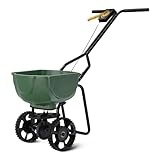


Is a gas broadcast lawn spreader even a real product?
Short answer: yes, but not here.
Engine-driven broadcast spreaders exist. They're ride-on or self-propelled machines used by lawn treatment crews covering many properties a day, and they're bought through equipment dealers rather than online retail. When you search for the best gas broadcast lawn spreader on Amazon, the engine part of that phrase gets quietly ignored. What comes back is the consumer category: push spreaders you walk behind, and tow-behinds you hitch to a mower.
None of the seven picks in this guide has a motor. I'm not going to pretend otherwise, and you should treat any listing that hints at one with suspicion.
So what do you do with that? Two options, depending on your property:
- Under about half an acre. A push spreader is genuinely the right tool. Walking speed is what sets your application rate, and a motor adds nothing except weight and maintenance.
- Half an acre to a few acres. A tow-behind hopper hitched to a riding mower gives you the coverage a self-propelled machine would, and the engine you're paying for is already in the mower.
That's the honest version. The rest of this guide ranks what's actually purchasable.
How I screened the listings down to seven
I started from the specifications, because that's the only data on a spreader listing that's standardised enough to compare. Capacity, spread width, hopper material, frame material, published weight, warranty.
Three things got cut immediately:
- Listings with no capacity figure at all. A spreader that won't tell you what it holds is asking you to guess how many refills your lawn takes.
- Duplicate rebrands. Several no-name push spreaders share the same hopper mould and the same photograph. I kept one representative from that shape.
- Anything sold only as an accessory. Replacement hoppers and hitch kits are not spreaders.
What survived splits neatly into three mechanisms. Two Scotts units, one push and one handheld, both pre-calibrated to Scotts product numbers. Three walk-behind push spreaders from VEVOR, Garvee and Amazon Basics, all steel frame with poly hoppers. Two tow-behinds, from Agri-Fab and HVDI, both rated at 130 lb.
Only one of the seven publishes a warranty: the Agri-Fab at 3 years limited. That single data point did a lot of work in the ranking, because a spreader is a gearbox, and gearboxes are the part that fails.
1. Scotts Turf Builder EdgeGuard DLX — Best overall
The pre-calibrated hopper and side shield make this the lowest-effort way to put fertilizer down accurately on a normal suburban lot.
Best for: suburban lawns up to 15,000 sq ft that get treated four times a year Skip it if: your property runs past half an acre
Two things separate this from the other push spreaders here. First, Scotts says it ships pre-calibrated, so the setting numbers printed on your bag of Turf Builder match the numbers on the dial. Every other push spreader in this set gives you a numbered scale and leaves you to work out what it means. Second, the EdgeGuard shield blocks the right-hand side of the spread pattern, which Scotts says keeps product off driveways and beds.
At 10.9 lb it's the lightest of the three walk-behinds by a wide margin. The Garvee weighs 30.2 lb empty, nearly three times as much. Folded footprint is 22 x 19 x 22 in, small enough for a shelf rather than a corner of the garage floor.
Capacity is where it stops. It holds enough product for 15,000 sq ft, which sounds enormous until you compare it to a 130 lb tow-behind rated for 25,000 sq ft. It also sells faster than anything else in this set apart from the handheld Whirl, so parts and settings advice are easy to find. The trade-off against the tow-behinds is simple: you supply the legs.
Pros:
- Ships pre-calibrated, no setting guesswork
- Lightest walk-behind here at 10.9 lb
- EdgeGuard side shield keeps product off hardscape
- Compact 22 x 19 x 22 in storage footprint
- The one buyers choose most often among the push models
Cons:
- No published warranty, unlike the Agri-Fab
- Capacity well below the 130 lb tow-behinds
- Calibration numbers assume Scotts-brand product
- Plastic-heavy build compared with the steel-framed VEVOR
2. Agri-Fab Pull Behind Broadcast Spreader — Best premium
The only pick with a published warranty and an enclosed gear house, which is exactly where a spreader dies.

Best for: half-acre and larger lots with a riding mower already in the shed Skip it if: you have no tractor or ATV to pull it
This is the most expensive pick here, and it's the only one that puts a number on how long it's meant to last: 3 years limited. Agri-Fab also lists the parts that matter individually, which no other brand in this set bothers to do. The frame is 1 in steel tubing, the gear house is enclosed, and the tires are 13 x 4 in pneumatic. An enclosed gear house is the detail I'd pay for. Fertilizer dust is abrasive and hygroscopic, and an open gearset packed with damp prill is the classic failure.
Agri-Fab rates the 130 lb hopper for half an acre, or 25,000 sq ft, and claims a 10 to 12 ft spread width. That combination is the whole argument for a tow-behind. Fewer passes, fewer refills, and the mower does the walking.
At 29.4 lb empty it's roughly the same weight as the Garvee push spreader, but you never carry it. The HVDI matches its 130 lb rating for less money, and that's the real competition. What Agri-Fab has that HVDI doesn't is the warranty and a specification sheet that names materials rather than adjectives. It's also the slowest seller here, which is what happens when a product needs a tractor before it needs a buyer.
Pros:
- Only pick with a published warranty, 3 years limited
- Enclosed gear house protects the drive from fertilizer dust
- 130 lb hopper rated for 25,000 sq ft
- 1 in steel tubing frame and 13 x 4 in pneumatic tires
- Universal hitch listed for Craftsman, Husqvarna and Cub Cadet
Cons:
- Highest price position in this set
- Useless without a riding mower, ATV or tractor
- Slowest seller of the seven, so less shopper chatter to lean on
- 29.4 lb empty makes moving it around the shed awkward
3. VEVOR Walk Behind Spreader — Best for beginners
Eighteen settings and 8 in pneumatic tires at the second-lowest price position among the push models, with tool-free assembly.

Best for: first-time spreader owners with a mid-size lawn Skip it if: you want a pre-calibrated hopper with brand-matched settings
The 60 lb hopper sits usefully between the Scotts push spreader and the 100 lb Garvee. VEVOR lists 18 adjustable settings and a disc pellet controller, plus 8 in pneumatic tires. Air-filled tires matter more than the spec sheet suggests. Solid plastic wheels skitter and bounce on rough turf, and a bouncing spreader lays product in stripes.
VEVOR also claims a 0 to 9.8 ft spread width and says assembly needs no tools. Both of those read as beginner-friendly, and the 29.5 x 31.5 x 17.7 in footprint is the smallest of the three push spreaders once assembled.
The catch is calibration. Where the Scotts dial matches the numbers on a Scotts bag, this gives you 1 through 18 and no translation table. That means a slow first application, half-open, walking a measured strip and checking coverage before you commit a full bag. Nothing hard, but it's an afternoon of learning the Scotts owner skips entirely. VEVOR publishes no warranty and only one seller lists it, so support runs through the brand alone.
Pros:
- 60 lb hopper, a sensible middle capacity here
- 8 in pneumatic tires handle uneven turf
- 18 settings plus disc pellet control claimed
- Powder-coated steel frame with poly hopper
- Smallest assembled footprint of the push spreaders
Cons:
- Numbered settings with no product-matched calibration
- No published warranty
- Only one seller lists it
- Spread width claim starts at 0 ft, so the useful range is narrower than 9.8 ft suggests
4. Amazon Basics Fertilizer Spreader for Lawn — Best for families
At 8.86 lb it's the lightest spreader here that still rolls on wheels, which matters when more than one person pushes it.

Best for: shared use where the lightest push spreader wins Skip it if: you refill from 40 lb bags and hate stopping
Weight is the story. Empty, this is 8.86 lb against 30.2 lb for the Garvee. A teenager can wheel it out, tip it, rinse it and put it away without help, and that's the difference between a lawn that gets fed and a lawn that waits for whoever owns the heavy tool.
Amazon Basics rates one load at 5,000 square feet and lists 0.53 cubic feet of hopper volume, a 33 lb figure, a steel frame with a plastic bin, and a multi-gear drive with the release cable pre-installed. Released in 2025, it's the newest listing in this set.
The 5,000 sq ft load is the constraint. On a 12,000 sq ft lawn that's three fills per application, and each stop is a chance to lose your place in the pattern. It sells slowly compared with the Scotts models, and there's no warranty on the listing. Assembled dimensions run 28.7 x 35.8 x 20 in, so it's wider in storage than the VEVOR despite weighing a third as much. The trade-off against the Scotts EdgeGuard DLX is capacity and calibration for lightness and a lower price position.
Pros:
- Lightest wheeled spreader here at 8.86 lb
- Release cable pre-installed, minimal assembly
- Steel frame with poly bin
- Second-cheapest of the seven
- 0.53 cubic feet of stated hopper volume
Cons:
- 5,000 sq ft per load means frequent refills
- No published warranty
- Wider stored footprint than the VEVOR
- No side shield to protect beds and driveways
5. Garvee 100LBS Push Lawn Spreader — Best for heavy use
A 100 lb rating and 25 settings make this the push spreader for people who'd rather fill once and walk further.

Best for: long seeding sessions on rough, uneven ground Skip it if: storage space is tight
This is the biggest walk-behind in the set by a clear margin. The size rating is 100 lb, roughly 40 lb more than the VEVOR, and Garvee claims a 12 ft spread width with 25 adjustable settings. Twenty-five steps is finer control than any other push spreader here offers, which helps when you're switching between a coarse ice melt and a fine starter fertilizer.
Construction is powder-coated steel with a poly hopper Garvee describes as explosion-proof and UV resistant. The company says key parts arrive pre-assembled and setup takes under five minutes.
Watch the numbers on the listing though. The heading says 100 lb, and one feature bullet then refers to an 80 lb hopper. That inconsistency is exactly why I treat capacity claims as claims. Physically it's the bulkiest pick: 32.7 x 45.1 x 21.5 in and 30.2 lb empty, so a full hopper is a serious push on a slope. It's also the second-slowest seller of the seven. Against the Agri-Fab, it gives you similar hopper volume without needing a tractor, and loses the warranty and enclosed gearbox in exchange.
Pros:
- Largest push hopper here, rated 100 lb
- 25 adjustable settings, the finest control in the set
- 12 ft spread width claim
- Powder-coated steel frame and UV-resistant poly hopper
- Tool-free setup claimed under five minutes
Cons:
- Listing quotes both 100 lb and 80 lb capacity
- Bulkiest footprint of all seven at 32.7 x 45.1 x 21.5 in
- 30.2 lb empty, heavy going uphill when loaded
- No published warranty, and only one seller lists it
6. HVDI Pull Behind Broadcast Spreader — Best compact
A 130 lb tow-behind that matches the Agri-Fab's capacity and adds five discharge ports, at a lower price position.

Best for: ATV and UTV owners who need a 130 lb hopper that stores flat Skip it if: you want a published warranty in writing
HVDI takes a different approach to spread pattern. Instead of one opening feeding a spinner, it lists 5 adjustable discharge ports with a trapezoidal hopper shape, which the company says produces even distribution across a claimed 12 ft. More ports feeding the disc means product lands on the spinner in more places, which in principle smooths out the pattern at the edges.
Capacity is 130 lb, the same as the Agri-Fab. HVDI lists a powder-coated steel frame with a sealed gearbox, and says the universal hitch fits most lawn tractors plus ATVs and UTVs. The ATV mention is worth noting, since the Agri-Fab listing names only mowers and tractors.
The specification sheet is thin, and that's the honest weakness. The listed dimensions of 5 x 18.2 x 8 in describe a shipping carton rather than an assembled spreader, and there's no published weight, no warranty and no material grade for the tubing. Only one seller lists it. Set against the Agri-Fab, you get the same hopper rating for less, and give up the 3 year warranty plus a spec sheet that names its own steel.
Pros:
- 130 lb hopper, matching the priciest pick here
- 5 adjustable discharge ports for pattern control
- Sealed gearbox on a powder-coated steel frame
- Hitch listed for ATVs and UTVs as well as mowers
- Lower price position than the Agri-Fab at equal capacity
Cons:
- No published warranty
- No stated assembled weight or assembled dimensions
- Thinnest specification list of the seven
- Only one seller lists it
7. Scotts Whirl Hand-Powered Spreader — Best budget pick
The cheapest pick here and the only one you carry, sized for 1,500 sq ft of product and patch work.

Best for: patch repairs and strips of lawn under 1,500 sq ft Skip it if: you treat a full lawn in one session
Every other pick in this guide rolls. This one hangs off your arm and you turn a crank. Scotts rates it for 1,500 sq ft of product, which is one tenth of the EdgeGuard DLX, and lists an adjustable arm support for comfort. At 8.5 x 13 x 8.7 in it's small enough to hang on a nail.
There's a real job for this. Reseeding a bare patch by the gate, salting a set of front steps, feeding a narrow side strip a wheeled spreader can't turn in. Doing any of those with a 100 lb push spreader is more setup than the task deserves. It's also the fastest-selling item in this set, which tells you how many people want a small tool for small jobs.
What it can't do is a lawn. Hand-cranked spread pattern varies with how fast you turn, so consistency depends entirely on you, and 1,500 sq ft per fill means a 10,000 sq ft yard becomes seven refills and a sore shoulder. Scotts publishes no weight and no warranty for it. Honestly, buy it alongside a wheeled spreader rather than instead of one.
Pros:
- Cheapest of the seven by price position
- The one buyers choose most often in this set
- Reaches strips and steps no wheeled spreader can
- Adjustable arm support claimed for comfort
- Tiny 8.5 x 13 x 8.7 in storage size
Cons:
- 1,500 sq ft per fill, one tenth of the EdgeGuard DLX
- Even coverage depends on your crank speed
- No published weight or warranty
- Not a substitute for a wheeled spreader on a full lawn
Push, tow-behind or handheld: which one fits your yard?
Mechanism decides this purchase, not the brand. Everything else is detail.
Handheld. One tool, one job: small areas and awkward strips. The Scotts Whirl covers 1,500 sq ft of product per fill. That's a patch, not a property.
Push. The default for most homes. You walk, the wheels drive the spinner, and your pace controls the rate. The four push spreaders here range from 5,000 sq ft per load on the Amazon Basics up to a 100 lb rating on the Garvee. Above roughly 15,000 sq ft the refills and the walking start to add up.
Tow-behind. Both 130 lb picks, the Agri-Fab and the HVDI, are rated to cover ground a push spreader can't in one session. Agri-Fab puts that at 25,000 sq ft, or half an acre. The condition is absolute: you need a mower, tractor, ATV or UTV with a hitch. No hitch, no spreader.
There's a middle case worth naming. If your lawn is around 15,000 sq ft and you already have a riding mower, either mechanism works, and the tow-behind wins on time while the push spreader wins on storage and precision near beds.
How hopper capacity changes your afternoon
Capacity is really a count of interruptions. Here's the arithmetic on a 20,000 sq ft lawn:
- Scotts Whirl, 1,500 sq ft per fill. Fourteen fills. Not a serious plan.
- Amazon Basics, 5,000 sq ft per load. Four fills, four chances to lose your line.
- Scotts EdgeGuard DLX, up to 15,000 sq ft of product. Two fills. Manageable.
- Agri-Fab or HVDI, 130 lb. One fill, with the Agri-Fab rated to 25,000 sq ft.
Every refill costs more than the minute it takes. You set the bag down, reset the hopper, then guess where your last pass ended. Overlap that guess and you get a dark green stripe. Miss it and you get a pale one. Fertilizer burn from a doubled pass shows up for weeks.
That's why a bigger hopper on a big lawn is worth more than a finer settings dial. Below about 8,000 sq ft, though, capacity stops mattering and weight takes over, because you'll be lifting and rinsing the thing more often than you'll fill it.
What the listings do not tell you
Three gaps run through this whole set, and it's better to know them before you order.
Warranty is mostly absent. Only the Agri-Fab publishes one, at 3 years limited. Six of seven listings say nothing. That doesn't mean no coverage exists, but it means you're buying on the strength of the return window rather than a stated term.
Spread width is a claim, not a measurement. VEVOR says 0 to 9.8 ft, Garvee and HVDI both say 12 ft, Agri-Fab says 10 to 12 ft. Actual width depends on material density, how full the hopper is and how fast you move. Prill fertilizer throws further than seed. Treat these as ceilings.
Calibration is your problem on five of seven. Only the two Scotts units come pre-calibrated to a product's printed settings. On the VEVOR, Garvee, Amazon Basics, Agri-Fab and HVDI, the numbers are relative. Do a test strip on a driveway, sweep it up, and you'll learn more in ten minutes than the manual tells you.
One more thing worth checking. Neither tow-behind states which hitch pin size it ships with, and hitch plates vary between mower brands even where the listing says universal.
When a different pick wins
Three conditions flip the recommendation, and each one is something you can check in your own garage in under a minute.
- You own a riding mower and treat more than half an acre. The Agri-Fab wins outright. 130 lb, 25,000 sq ft rated coverage, enclosed gear house, 3 year limited warranty.
- You have a hitch on an ATV rather than a mower. HVDI names ATVs and UTVs where Agri-Fab names mowers and tractors. Same 130 lb rating, lower price position.
- More than one person in the house will use it. Amazon Basics at 8.86 lb is the one nobody complains about wheeling out. Capacity drops to 5,000 sq ft per load, so this only holds under about 10,000 sq ft.
Two smaller flips. If most of your product is coarse ice melt in winter, the Garvee's 25 settings give you finer adjustment than the Scotts dial's Scotts-specific numbers. And if your total treated area is a front strip and two patches, buy the Whirl and stop there.
The verdict
If you're feeding a normal suburban lawn on foot, the best gas broadcast lawn spreader available to you is the Scotts Turf Builder EdgeGuard DLX, and the reason is calibration. It arrives matched to the numbers printed on Scotts bags, it holds enough product for 15,000 sq ft, it weighs 10.9 lb, and the EdgeGuard shield keeps fertilizer off your driveway. Nothing else here removes as much guesswork.
If you're covering half an acre or more and there's a riding mower in the shed, the Agri-Fab 45-0463 is the buy. The cutoff is 15,000 sq ft of treated area. Below it, the Scotts saves you storage space and setup time. Above it, the Agri-Fab's 130 lb hopper and 25,000 sq ft rating turn a two-hour job into a lap of the yard, and the enclosed gear house plus 3 year limited warranty are the only durability commitments anyone in this set makes in writing.
The runner-up's exact advantage over the winner is refills. One fill against two, on the same lawn, with the mower doing the walking. Its exact disadvantage is that it's inert without a hitch. Check for one before you order.
FAQ
Is a gas broadcast lawn spreader worth it for a home lawn?
A gas broadcast lawn spreader is worth it only if you're treating multiple acres commercially, and those machines are sold through equipment dealers rather than Amazon. For a home lawn, a push spreader like the Scotts EdgeGuard DLX applies product just as accurately, since your walking pace sets the rate. An engine adds weight, fuel and maintenance for no accuracy gain.
What does more money buy in a broadcast spreader?
More money buys capacity and a documented gearbox. Moving from the entry picks to the Agri-Fab takes you from a 5,000 sq ft load to a 130 lb hopper rated for 25,000 sq ft, adds 1 in steel tubing, an enclosed gear house and 13 x 4 in pneumatic tires, and brings the only published warranty in this set at 3 years limited.
Which hopper capacity should I look for?
The hopper capacity you should look for tracks your treated area. Under 5,000 sq ft, the Amazon Basics single load handles it. Between 5,000 and 15,000 sq ft, the Scotts EdgeGuard DLX or the 60 lb VEVOR keeps refills to one or two. Above 15,000 sq ft, go to a 130 lb tow-behind and refill once.
Scotts EdgeGuard DLX or Agri-Fab 45-0463?
Choose the Scotts EdgeGuard DLX if you walk your lawn and it's under 15,000 sq ft, because pre-calibration and the side shield remove the guesswork near beds and driveways. Choose the Agri-Fab if you have a riding mower and more ground: 130 lb hopper, 25,000 sq ft rated, 3 year limited warranty. Without a hitch, the Agri-Fab does nothing.
What mistake do first-time spreader buyers make?
The mistake first-time spreader buyers make is trusting the settings dial without a test pass. Only the two Scotts units here are pre-calibrated to a product's printed numbers. On the VEVOR, Garvee, Amazon Basics and both tow-behinds, the scale is relative. Run a strip on pavement, sweep it up, then adjust. Doubled passes burn grass.
Pick your mechanism first, then your capacity, and the choice makes itself. For most people reading this, that lands on the Scotts EdgeGuard DLX: 10.9 lb, pre-calibrated, 15,000 sq ft of product per fill, and a side shield that stops you scattering fertilizer across the sidewalk. It's the pick that turns lawn feeding into a twenty-minute chore rather than a project you keep postponing. If you already own a riding mower and your lot runs past half an acre, spend up for the Agri-Fab and its 130 lb hopper instead. Check your hitch, then order.