Best Rose Pruning Shears: Gonicc GPPS-1003 Leads
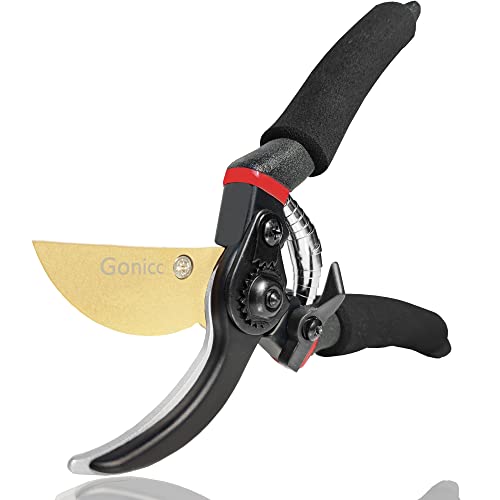
A ranked shortlist of six bypass pruners for rose care, sorted by cut capacity, weight, warranty and grip. The gonicc GPPS-1003 leads, with a Fiskars runner-up for lifetime backing.

By Taylor MontgomeryUpdated 16 min read
On this page
- Best rose pruning shears at a glance
- How I narrowed six pruners down for rose work
- Why bypass beats anvil on rose canes
- 1. gonicc 8" Bypass Titanium GPPS-1003 — Best overall
- 2. Fiskars Bypass Pruning Shears — Best warranty
- 3. DECERK 8.5" Professional Pruning Shears — Best upgrade
- 4. Haus & Garten ClassicPRO 8.5" — Best premium
- 5. Kimura 8" Pro Bypass Pruning Shears — Best minimal setup
- 6. Craft911 2-Pack Stainless Steel Scissors — Best budget pick
- What the cut capacity number really means
- How to keep a rose pruner sharp and clean
- Who should skip this shortlist?
- The verdict
- FAQ
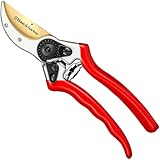
The best rose pruning shears are the gonicc 8" Professional Premium Bypass Titanium Pruning Shears, a 5.29 oz drop-forged bypass pruner rated by the maker for branches up to 3/4 inch. If you would rather trade a slightly smaller 5/8" cut capacity for a lifetime warranty, the Fiskars Bypass Pruning Shears are the safer buy. Both are bypass designs, which is the blade geometry that matters most on green rose canes.
Best rose pruning shears at a glance
| Pick | Cut capacity | Weight | Price |
|---|---|---|---|
Best overall gonicc 8" Bypass Titanium GPPS-1003 |
3/4 in claim | 5.29 oz | Check Price |
Best warranty Fiskars Bypass Pruning Shears |
5/8 in | 0.65 lb | Check Price |
Best upgrade DECERK 8.5" Professional Pruning Shears |
3/4 in claim | 0.55 lb | Check Price |
Best premium Haus & Garten ClassicPRO 8.5" |
Not listed | 0.56 lb | Check Price |
Best minimal setup Kimura 8" Pro Bypass |
1 in claim | 0.51 lb | Check Price |
Best budget pick Craft911 2-Pack Stainless Steel Scissors |
Not listed | 5.93 oz | Check Price |


How I narrowed six pruners down for rose work
I did not test these in a garden. What I did was line up the published specifications side by side and cut the field on three criteria that matter for rose canes.
First, blade geometry. A rose cane is living tissue, so the pruner has to slice, not crush. Every pick on the shortlist is a bypass design, where two curved edges pass each other like scissors. Anvil pruners, which push a single blade onto a flat plate, were excluded on principle.
Second, stated cut capacity. Mature hybrid tea and shrub roses regularly throw canes in the 1/2 to 3/4 inch range, and any pruner claiming less will bind on old wood. Two picks here list 3/4 inch, one lists 1 inch, one lists 5/8 inch, and two do not publish a figure at all.
Third, weight and grip. Rose pruning is repetitive, and a heavy tool is a sore wrist by lunchtime. Five of the six weigh between 0.51 lb and 0.65 lb. The Craft911 pack is the outlier because it is two tools rather than one.
The keyword here is "for roses". Amazon's category paths for these picks include Bonsai Cutters, Hedge Clippers and general Scissors, so the results are not rose-specific. Treat that as your job as the buyer: judge each pick against the rose criteria above rather than trusting the search page.
Why bypass beats anvil on rose canes
Rose stems bleed when they are crushed. A clean, angled cut heals; a mashed cut invites dieback, and dieback runs down the cane toward the graft. Bypass shears keep the cut clean because both edges are sharpened and they slide past each other in the same plane.
Every pruner on this list is bypass. That is not an accident. It is the only geometry worth buying for roses, and if you see an anvil pruner marketed for rose work, walk past it. Three picks call out the bypass design explicitly in their listings: the gonicc GPPS-1003, the Fiskars, and the DECERK. The Kimura and Haus & Garten shears are bypass by construction. Bypass is the baseline, not a feature.
A few things follow from bypass geometry that shape the rest of the buying decision:
- The blade only cuts on one side. The other side is a hook that holds the cane in place. Look at product images to see which hand the tool favours; most of these are right-handed.
- Sap groove matters. Rose sap is sticky. A blade with a channel to shed it stays cleaner between cuts. The gonicc and the Fiskars both call out a sap groove.
- Coatings help but do not replace sharpening. Titanium, PTFE and anodised finishes reduce friction and slow rust. None of them substitute for a stone and a cloth at the end of the season.
1. gonicc 8" Bypass Titanium GPPS-1003 — Best overall
A 5.29 oz drop-forged bypass pruner claiming a 3/4-inch cut, and the second-fastest seller of the six.
Best for: regular rose maintenance on canes up to 3/4 inch Skip it if: you want a written lifetime warranty in the box
At 5.29 oz, the gonicc is the lightest single pruner here by a hair, edging the 0.51 lb Kimura and the 0.55 lb DECERK once you convert the units. gonicc says the blade is SK-5 steel with a titanium coating and an ultra-fine polish, that the frame is drop-forged, and that the sap groove channels sticky residue away from the pivot. Those are manufacturer claims, but drop-forged construction is the kind of detail the cheaper picks in this set do not mention at all.
The 3/4-inch cut capacity is the right number for rose work. That covers everything from thin water shoots on a floribunda to the older canes you take out at the base during winter pruning. What the listing does not include is a written warranty, and that is the specific reason it does not walk away with every category. Compared with the Fiskars, you gain a bigger cut and a lighter body, and you give up the paperwork.
Pros:
- Drop-forged frame, uncommon at this price position
- Manufacturer's 3/4-inch cut claim covers mature canes
- Lightest single pruner in the set at 5.29 oz
- SK-5 blade with titanium coating and sap groove
- Second-fastest seller of the six here
Cons:
- No published warranty
- Category path is Bonsai, not rose-specific
- Only one seller stocks it
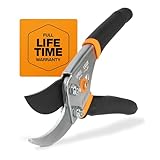
2. Fiskars Bypass Pruning Shears — Best warranty
The only pruner here with a stated lifetime warranty, at 0.65 lb and a 5/8-inch cut.
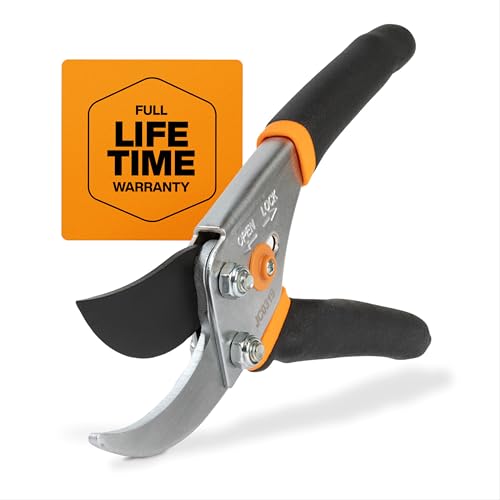
Best for: gardeners who want a lifetime-backed everyday pruner Skip it if: you routinely cut canes thicker than 5/8 inch
The Fiskars is the only pick in this set that publishes a warranty, and the warranty is a lifetime one. That is not a small detail on a hand tool you plan to use for decades. Fiskars lists a 5/8-inch cut capacity, precision-ground steel blades, a low-friction coating, a sap groove and a one-hand safety lock. The published weight is 0.65 lb, which makes it the heaviest single pruner here, and the dimensions are 0.1 x 9.07 x 2.47 in.
The trade against the gonicc is straightforward. You give up an eighth of an inch of cut capacity and 0.32 oz of hand weight, and you gain a written promise that the tool gets replaced if the frame fails. For a rose garden of hybrid teas, floribundas and modest shrub roses, 5/8 inch handles nearly everything you meet in a normal season. It is the fastest-selling pick of the six.
Pros:
- Stated lifetime warranty, unique in this shortlist
- Sap groove, low-friction coating and one-hand lock
- The fastest seller of the six here
- Entry-tier price position for a warranty-backed tool
- Precision-ground all-steel blade construction
Cons:
- 5/8-inch cut is the smallest published here
- Heaviest single pruner at 0.65 lb
- No titanium blade coating
3. DECERK 8.5" Professional Pruning Shears — Best upgrade
An 8.5-inch pruner with a four-times lever claim and rubber-cushioned handles for tired hands.

Best for: arthritic hands cutting thicker, older rose wood Skip it if: you prefer a slimmer, lighter-feeling pruner
The DECERK is the pruner to reach for when the wood is old. Decerk describes a Japanese SK5 bypass blade with a three-layer titanium coating, a lever-action geometry the brand rates at 4x cutting force, and a one-hand safety lock. The published weight is 0.55 lb across an 8.5-inch length, so the balance sits a bit further from the pivot than on the 8-inch gonicc. Decerk also markets the rubber handle cushioning as arthritis-friendly, and the grip is the reason to consider it over the Fiskars.
The blade is quoted as tested through 5,000 cuts. Treat that as the maker's number, not an independent test. What is checkable is what you get in the hand: the second-longest tool in the shortlist, a lever mechanism the other picks do not claim, and two sellers stocking the listing rather than the usual one.
The trade against the gonicc is size. The DECERK is half an inch longer, and that is the sort of thing you feel in a shirt pocket after an hour. If your rose garden is small, the shorter gonicc suits it better.
Pros:
- Lever-action design claimed at 4x force
- Cushioned rubber handles for repetitive cuts
- Three-layer titanium coating on the SK5 blade
- Two sellers stock the listing
- 8.5-inch length gives reach on tall canes
Cons:
- Longer than most one-handed pruners at 8.5 in
- No published warranty
- Bulkier feel than the 8-inch gonicc
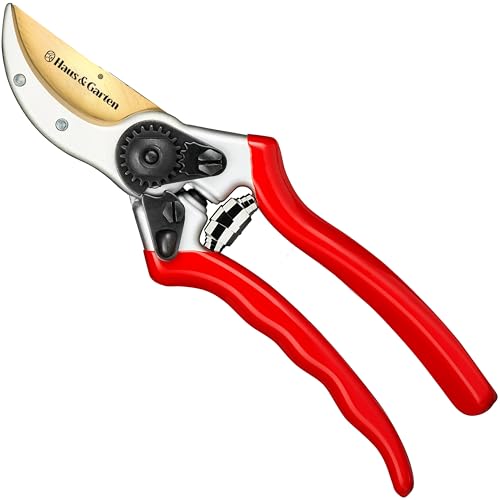
4. Haus & Garten ClassicPRO 8.5" — Best premium
The most expensive pick here, sized for medium-to-large hands and built around Japanese high-carbon steel.
Best for: medium-to-large hands who prune roses weekly in season Skip it if: you have small hands or a tight budget
The ClassicPRO is the only pruner in this set whose size specification is a hand size rather than a blade dimension. Haus & Garten publishes "Medium-Large Hands" as the sizing, which is a useful admission that a pruner has to fit the person before it fits the plant. The frame is anodised aluminium with titanium-coated blades, and the maker describes shock-absorbing pads under the grips. Weight is 0.56 lb across an 8.5-inch length, so it lands within a hair of the DECERK on the scale.
Haus & Garten does not publish a maximum cut capacity in the specifications, which is the awkward gap in an otherwise thorough listing. The feature bullets describe general bypass work on live plants without committing to a diameter. That is not disqualifying, but it is the reason this pick sits at fourth rather than higher: with cut capacity unstated, you cannot line it up cleanly against the 3/4-inch gonicc or the 1-inch Kimura.
It is also the slowest single-pruner seller in the set except the Kimura, which is a signal about how the market has voted rather than a statement about the tool.
Pros:
- Sizing published for medium-to-large hands
- Japanese high-carbon steel with titanium coating
- Anodised aluminium frame and shock pads
- 8.5-inch length for reach on established shrubs
- Rust and corrosion resistant build claims
Cons:
- Highest price position in this shortlist
- No published cut capacity figure
- No stated warranty
- Sized against larger hands only
5. Kimura 8" Pro Bypass Pruning Shears — Best minimal setup
The lightest pruner in the shortlist at 0.51 lb, with the largest published cut capacity at 1 inch.

Best for: a light one-pruner kit with a 1-inch cut claim Skip it if: you want a stated warranty or a second tool included
The Kimura is the featherweight of the group. At 0.51 lb over an 8-inch length, it is the lightest single tool here, and Kimura lists the largest cut capacity of any pick, at 1 inch. The blade is described as Japanese SK5 steel, heat-treated to 60 HRC, with a PTFE coating for low friction and sap release. Handles are aluminium with a non-slip PVC wrap.
The awkward part is that this pick sits in a premium price position and sells slower than every other pruner in the shortlist. That is not a fault of the tool, but it is a signal that the market rates the cheaper Fiskars and the gonicc more highly for the same work. Choose the Kimura when you want the largest cut number on a light body and are willing to give up the Fiskars warranty and the DECERK lever assist.
It is a "minimal setup" pick because everything a rose gardener needs is in one tool: a 1-inch cut claim, a sap-shedding coating, and a light grip. Nothing extra in the box.
Pros:
- Lightest single pruner at 0.51 lb
- Largest published cut capacity at 1 in
- PTFE-coated SK5 blade for sap release
- Heat-treated to 60 HRC per the maker
- Aluminium frame with riveted handles
Cons:
- Slowest seller in the shortlist
- No stated warranty
- Premium price position for a spec-only sell
- Dimensions not fully published
6. Craft911 2-Pack Stainless Steel Scissors — Best budget pick
Two tools in one pack: a pair of pruning shears and a snip for deadheading, at the cheapest position in the set.

Best for: beginners who want a pruner plus a snip for deadheading Skip it if: you need drop-forged blades for thick, woody canes
The Craft911 pack is the only entry here that is not a single pruner, and that is the reason to consider it. You get two tools: a pair of bypass pruning shears and a pruning snip. Roses need both. The pruner handles canes and structural cuts, and a snip is what you actually want in your hand for deadheading spent blooms, where a full-size pruner is heavier than the job requires.
Craft911 lists stainless steel blades on both tools, safety locks on both, and cushioned handles the brand markets as arthritis-friendly. The published weight for the pack is 5.93 oz, and the size is 7 x 7 in for the pruner. Cut capacity is not published, and that is the honest limit of the pick: without a diameter figure you cannot promise the pruner will tackle a mature cane. For starter roses, potted patio varieties or deadheading duty on any garden, the pack earns its place.
Two-for-one pricing is what makes this the budget entry. Do not expect the drop-forged frame of the gonicc or the lifetime backing of the Fiskars.
Pros:
- Two tools in one pack, pruner and snip
- Cheapest price position in this set
- Stainless steel blades on both tools
- Safety locks on both tools
- Snip is ideal for deadheading
Cons:
- No cut capacity published
- Not drop-forged
- No stated warranty
- Blade steel spec less detailed than the SK5 picks
What the cut capacity number really means
Cut capacity is the single spec buyers get most wrong. The number on the listing is the maximum green-wood diameter the maker will stand behind, cut cleanly, on a fresh blade. It is not a promise about dead wood, and it is not a promise about the tenth cut of an afternoon after the edge has dulled.
For rose work, use the number as a ceiling and prune well under it. A pruner rated for 3/4 inch will spend most of its life cutting 1/4 to 1/2 inch canes and thanks you for the headroom. Push it to the ceiling on every cut and the pivot loosens, the blade rolls at the tip, and the tool retires early.
Three practical rules follow:
- Match the pruner to your thickest routine cane, not your thickest annual cut. If you take out one 1-inch old cane a year, use a lopper for that one and a bypass pruner for the rest.
- Discount unlisted numbers. The Haus & Garten and the Craft911 do not publish a diameter, so treat both as unknown for the biggest canes and reach for the gonicc, the Fiskars or the DECERK when the wood is thick.
- Believe the number less on old, dry wood. Dead rose canes are woody and stringy, and a bypass pruner rated for 3/4 inch of green cane will struggle with 1/2 inch of dead cane. That is normal.
How to keep a rose pruner sharp and clean
A rose pruner earns its keep on the second season, not the first. Here is the trick with keeping one alive:
- Wipe the blade every session. Rose sap sets like glue. A cloth and a splash of isopropyl alcohol at the end of the afternoon prevent the pivot from stiffening.
- Sharpen with a diamond file, not a stone. Bypass blades have a bevelled edge on one side only. A flat diamond file lets you follow the bevel without rolling it.
- Oil the pivot twice a season. A drop of light machine oil, worked through the joint by opening and closing the shears, keeps the action clean. The sap grooves on the gonicc and the Fiskars help, but they are not a substitute.
- Disinfect between diseased plants. If you cut a canker or a black-spotted cane, wipe the blade with alcohol before the next plant. Rose diseases travel on tools.
- Store closed and locked. Every pick here has a one-hand safety lock. Use it. Blades left open in a shed rust at the tip first, and a rusty tip is the part of the blade that does the finish work on a cane.
None of this is exotic. A pruner that gets ten minutes of care a month outlasts the same tool that gets none by a decade.
Who should skip this shortlist?
Not every rose grower needs a new pruner. Skip this list if any of the following describe you:
- You already own bypass shears with a working sap groove and a sharp edge. A tune-up beats a purchase.
- Your roses are miniatures in pots. A pruning snip is the correct tool, and the Craft911 pack is the only pick here that includes one.
- You are pruning climbers over head height. Long-reach bypass loppers or a pole pruner are the right buy, and none of the picks here are those.
- You need left-handed shears. None of these picks are marketed as left-handed, and forcing a right-handed bypass in a left hand makes crushed cuts and blisters.
- You want a ratchet mechanism. The DECERK claims a 4x lever, but no pick here is a true ratchet pruner. If ratcheting is a hard requirement, look outside this shortlist.
The verdict
If you are pruning roses and you want one tool, buy the gonicc 8" Professional Premium Bypass Titanium Pruning Shears. The 3/4-inch cut claim covers real rose work, the 5.29 oz weight is easy on the wrist, the drop-forged frame is the kind of construction detail the cheaper picks skip, and it is the second-fastest seller of the six here.
Two conditions flip the recommendation. If a written lifetime warranty matters more to you than an eighth of an inch of cut capacity, buy the Fiskars Bypass Pruning Shears. The Fiskars is the only pick in the set with a published warranty, and 5/8 inch handles most rose work. If your hands hurt after an hour of pruning, buy the DECERK 8.5" Professional Pruning Shears. The lever-action claim and the cushioned rubber grips are aimed squarely at that problem, and the 0.55 lb frame keeps the tool light.
The Haus & Garten is the buy for medium-to-large hands who want a premium body, the Kimura is the pick when 1 inch of cut capacity matters more than a warranty, and the Craft911 pack is the right starter kit because it includes the snip a rose garden actually needs.
FAQ
Are bypass or anvil pruners better for rose pruning?
Bypass pruners are better for rose pruning, and it is not close. Bypass blades slice past each other like scissors, leaving a clean angled cut that heals cleanly on a living cane. Anvil pruners crush the stem against a flat plate, which invites dieback down the cane. Every pick in this shortlist is a bypass design for that reason.
What cut capacity do I need for rose pruning shears?
The cut capacity you need for rose pruning shears is around 3/4 inch for most gardens. Hybrid teas, floribundas and modest shrub roses throw canes in the 1/4 to 3/4 inch range through a normal season. The gonicc GPPS-1003 and the DECERK both claim 3/4 inch; the Kimura claims 1 inch; the Fiskars lists 5/8 inch, which suits younger plants.
Is the Fiskars worth it over the gonicc for roses?
Is the Fiskars worth it over the gonicc depends on how you weigh the warranty. The Fiskars is the only pruner here with a published lifetime warranty, and it is the fastest-selling pick of the six. You give up 1/8 inch of cut capacity and gain the paperwork. Choose the gonicc if the bigger cut and lighter body matter more to you.
How do I sharpen bypass rose pruning shears?
To sharpen bypass rose pruning shears, use a flat diamond file and follow the existing bevel on the cutting blade only. The hook side stays flat. Two or three passes at the original angle restore the edge without rolling it. Wipe the blade clean of sap first, and finish with a drop of light machine oil on the pivot before closing and locking the tool.
Do any of these best rose pruning shears fit left-handed gardeners?
None of these best rose pruning shears are marketed as left-handed in their listings. Bypass geometry is handed: the blade cuts on one side and the hook holds the cane on the other, so a right-handed pruner used in a left hand tends to crush rather than slice. If you need a left-handed tool, look outside this shortlist for a model that specifies it.
Rose canes forgive a good tool and punish a bad one, and the difference shows up two seasons later in how the plant grows. The gonicc GPPS-1003 is the right default because it does the job the plant needs: a clean bypass cut, a diameter figure that matches real rose work, and a light enough body to still be enjoyable at the end of a Saturday afternoon. Buy it, wipe the sap off after every session, sharpen it once a year, and lock it closed in the shed. Then let the roses tell you whether you chose well next June.