Best Lawn Spreader for Large Yards by Capacity

Five spreaders compared by hopper capacity, pass width and setup. The Scotts EdgeGuard DLX wins on coverage, with a hand-powered runner-up for edges.

By Taylor MontgomeryUpdated 16 min read
On this page
- Best lawn spreader for large yards at a glance
- How I narrowed five spreaders down
- 1. Scotts Turf Builder EdgeGuard DLX Broadcast Spreader — Best overall
- 2. Scotts Whirl Hand-Powered Spreader — Best upgrade
- 3. VEVOR Compost Spreader — Best minimal setup
- 4. CHAPIN 8740A 64 oz All-Season Hand Shaker Spreader — Best budget pick
- 5. Best Choice Products Compost Spreader — Best for pros
- Broadcast, drop or shaker: which fits a large yard?
- What hopper capacity actually buys you
- How do you calibrate a spreader you bought online?
- What the listings do not tell you
- The verdict
- FAQ
The best lawn spreader for large yards is the Scotts Turf Builder EdgeGuard DLX Broadcast Spreader, which the listing says holds up to 15,000 sq. ft. of product and arrives pre-calibrated. If your yard is broken up by beds, paths and tight corners, the Scotts Whirl Hand-Powered Spreader is the better second tool at 8.5 x 13 x 8.7 in, sized for spot work the wheeled unit cannot reach cleanly.
Best lawn spreader for large yards at a glance
| Pick | Capacity or width | Setup | Price |
|---|---|---|---|
Best overall Scotts Turf Builder EdgeGuard DLX |
Up to 15,000 sq. ft. claim | Pre-calibrated, no assembly | Check Price |
Best upgrade Scotts Whirl Hand-Powered Spreader |
Up to 1,500 sq. ft. claim | Adjustable arm support | Check Price |
Best minimal setup VEVOR Compost Spreader |
24 in drum width | Two-height handle, 22.3 lb | Check Price |
Best budget pick CHAPIN 8740A Hand Shaker |
64 oz bottle | Three lid openings | Check Price |
Best for pros Best Choice Products Compost Spreader |
24 in mesh drum | T-handle, quick assembly | Check Price |



How I narrowed five spreaders down
I started with the criteria a large-yard buyer actually uses, then weighted them: hopper or drum capacity first, effective pass width second, setup and calibration third, and comfort over long sessions fourth. Every pick had to publish enough specifications to compare against the others on at least two of those four axes.
That order matters. On an open half-acre, a bigger hopper means fewer walks back to the driveway to refill, which is the single biggest time sink in a fertiliser or seed application. Pass width comes next because it decides how many strips you walk. Setup and calibration only matter once, on day one. Comfort matters after the first hour.
Two categories of tool made the shortlist despite not being broadcast fertiliser spreaders: compost rollers and hand shakers. The rollers are here because topdressing is a real large-yard job that a broadcast hopper cannot do at all. The shakers are here because every large yard has strips, edges and shaded patches where a 22-inch broadcast unit throws product where you do not want it. A best lawn spreader for large yards guide that ignored those jobs would push you toward a single tool that does 80% of the work well and the last 20% badly.
Cuts included spreaders that published no weight or dimension figures, and any listing whose only capacity claim was "large".
1. Scotts Turf Builder EdgeGuard DLX Broadcast Spreader — Best overall
The EdgeGuard DLX is the pick because it publishes the largest coverage figure in this set and ships ready to use.
Best for: homeowners fertilising open turf who want fewer refill trips Skip it if: your lawn is mostly narrow strips near flowerbeds
Scotts says the hopper holds up to 15,000 sq. ft. of their lawn products, which is the headline figure that puts this spreader ahead of everything else here on a large yard. The unit is 22 x 19 x 22 in and weighs 10.9 lb empty, so it fits in a standard garage bay and one adult can lift it loaded onto a step or into a truck bed. It is a 2022 model, catalogue number 76232.
The feature that earns the "DLX" is EdgeGuard, a side shield Scotts says blocks the spread pattern on one side so product stays off driveways, sidewalks and beds. On a large yard with a perimeter driveway or edging, that shield is what lets you walk the border without hand-sweeping afterwards. The listing also states the spreader is pre-calibrated, so you set the rate dial to the number on your Scotts product bag and start walking.
The trade-off is honest: this is the most expensive pick here, and everything about it is optimised for open turf. On a yard cut up by beds, a hand tool still earns its keep.
Pros:
- Up to 15,000 sq. ft. hopper claim, the largest here
- EdgeGuard side shield for driveway and bed edges
- Pre-calibrated for Scotts products, no dial guesswork
- 10.9 lb empty, manageable to lift and store
- The one buyers choose most often in this set
Cons:
- The most expensive pick here
- Calibration marks map to Scotts products, not every brand
- Not the tool for narrow strips or tight corners
2. Scotts Whirl Hand-Powered Spreader — Best upgrade
The Whirl is the pick to pair with a broadcast unit, not to replace one.

Best for: spot feeding, edges and tight corners a wheeled unit misses Skip it if: you want to cover several thousand square feet in one pass
At 8.5 x 13 x 8.7 in, the Whirl is a crank-style hand spreader you carry rather than push. Scotts positions it for lawns up to 1,500 sq. ft. of their product per fill, and describes it in the listing as engineered for smooth, even coverage. The adjustable arm support is the detail that matters over a long session: it takes the load off your wrist when the hopper is full.
On a large yard, this is not a primary tool and pretending otherwise would waste your afternoon. It is the tool you reach for after the EdgeGuard DLX has done the open turf, for the strip beside the mailbox, the shaded triangle by the fence, and the narrow run between the house and the walk. It is also the pick to keep in the shed for reseeding a bare patch in October without pulling the big unit out.
The trade-offs are the mirror of the DLX: no wheels, no pre-calibrated dial referenced to a specific product, and no side shield. What you get is a tool sized for the places the big spreader physically cannot go, and priced in the entry band.
Pros:
- Compact 8.5 x 13 x 8.7 in body reaches tight spots
- Adjustable arm support for longer sessions
- Second-cheapest of the six
- Rated by Scotts for year-round use including salt
- Sells faster than most of this set
Cons:
- Up to 1,500 sq. ft. per fill, so many refills on a large yard
- No side shield for hard edges
- Crank fatigue on very long runs
3. VEVOR Compost Spreader — Best minimal setup
The VEVOR is here because topdressing a large yard is a job the broadcast units simply cannot do.

Best for: topdressing compost or peat moss on established turf Skip it if: you need to apply granular fertiliser or grass seed
This is a 24-inch mesh drum on a two-height handle, sized 28.3 x 24 x 15.7 in and weighing 22.3 lb. VEVOR describes it as a peat moss roller for compost, manure and topsoil, with powder-coated steel construction and two side latches to keep the drum closed while you roll. The handle adjusts between two positions the listing gives as 41.1" and 43", which matters if more than one person in the household uses it.
On a large yard, topdressing with a thin layer of compost or peat is how you improve soil over time without tearing anything up. A wheelbarrow and rake will do it, but slowly and unevenly. A 24-inch drum walks a strip roughly two feet wide per pass and meters the material through the mesh as you go. That is the entire pitch: one job, done in a fraction of the time.
Against the Best Choice Products roller below, the VEVOR is lighter at 22.3 lb versus 21.3 lb (they are close) and sits in the mid price band rather than premium. The compromise is that the shorter overall body means less leverage on heavy loads, and only one seller lists it.
Pros:
- 24 in drum for wide topdressing passes
- Two-height handle for shared use
- Side latches to keep the drum closed under load
- Mid-price positioning in this set
- Powder-coated steel per the listing
Cons:
- Only spreads bulk media, not granules
- Only one seller lists it
- Fewer published specifications than the Best Choice unit
4. CHAPIN 8740A 64 oz All-Season Hand Shaker Spreader — Best budget pick
The Chapin shaker is the touch-up tool every large-yard shed should own.

Best for: steps, paths and touch-up work between larger applications Skip it if: a broadcast spreader is your primary tool
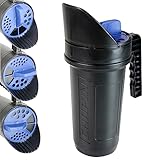
The 8740A is a 64 oz poly bottle, model 8740A, weighing 0.7 lb empty at 13 x 17 x 12 in. The lid twists to select one of three openings the listing describes as sized for ice melt, salt, fertiliser, grass seed, sand and pelletised products. Chapin lists a warranty in the specifications, and it is the cheapest of the six.
For a large yard, treat this as a companion rather than the main event. It is what you keep by the back door in December to shake ice melt across the steps and the path to the driveway. It is what you grab in April to reseed the patch the dog killed, and again in July to hand-feed the strip under the tree the mower shades. None of those jobs justifies rolling out a 15,000 sq. ft. hopper.
The concession is scope. The bottle holds 64 oz, and 64 oz of grass seed will not carry you across a half acre. Buying this instead of a broadcast unit is buying the wrong tool. Buying it alongside one costs very little and saves a lot of wear on the bigger machine.
Pros:
- Cheapest of the six
- Three lid openings for different particle sizes
- 0.7 lb empty and easy to store
- Published warranty
- Handle designed for gloved use per the listing
Cons:
- 64 oz limits it to small jobs
- Slowest seller of the six
- Manual shaking is tiring on long runs
5. Best Choice Products Compost Spreader — Best for pros
The Best Choice roller is the heavier-built topdresser for people who use one often.

Best for: landscapers topdressing multiple properties with sand or mulch Skip it if: storage space is tight or you only spread granules
This is another 24-inch mesh drum, but on a longer 16 x 46 x 28 in frame with an adjustable T-handle. It weighs 21.3 lb. The listing calls out a reinforced triangle bracket for balance, a heavier steel mesh drum to resist deformation under load, and a secure clasp to keep the drum from opening mid-pass. Best Choice describes the mesh gauge as thicker than a standard spreader's.
For a homeowner topdressing once a year, the VEVOR does the same job for less. This pick earns its place on a truck that visits several yards a week, where the reinforced drum and the longer handle both pay back over hundreds of loads. The T-handle also gives two hands more leverage on wet compost, which matters when the drum is full.
Trade-offs: it is a premium price position, only one seller lists it, and the 46-inch length means it takes more shed wall than the VEVOR. Sales rank is the lowest of the five, which reflects the narrower audience rather than the build.
Pros:
- Reinforced steel mesh drum per the listing
- T-handle for two-handed leverage
- 46 in frame for a longer stride
- Adjustable handle height
- Secure clasp on the drum
Cons:
- Premium price position in this set
- Only one seller lists it
- Longest footprint of the six to store
Broadcast, drop or shaker: which fits a large yard?
Every pick in this guide is either a broadcast unit, a compost roller or a hand shaker. There is a fourth category, the drop spreader, that meters product straight down through a slot the width of the hopper. None of the five here is a drop spreader, so this section is for you to judge whether that gap matters.
- Broadcast throws product in a fan pattern several feet wide. It is the fastest way to cover a large open lawn and the reason the EdgeGuard DLX is the winner. Its weakness is that the pattern is imprecise near beds and drives, which is what the EdgeGuard shield is designed to blunt.
- Drop places product only where the wheels roll. It is slower and it needs perfect overlap between passes to avoid stripes, but it wastes nothing on the flowerbed. If your yard is mostly narrow strips beside beds, look at drop spreaders as well as this list.
- Hand shaker is broadcast at a small scale. Fine for steps and touch-ups, wrong for open acreage.
- Compost roller is a different job entirely. It meters bulk material through a mesh drum. Do not try to spread granular fertiliser or seed through one.
The best lawn spreader for large yards is almost always a broadcast unit with a hand tool alongside for edges.
What hopper capacity actually buys you
Capacity figures on spreader listings mean the volume of a specific product the hopper holds, not the square footage the unit can cover before you stop to breathe. Scotts says the EdgeGuard DLX holds up to 15,000 sq. ft. of their lawn products per fill. The Whirl is rated up to 1,500 sq. ft. per fill. That is a factor of ten.
On a 20,000 sq. ft. yard, that means:
- The DLX asks for two fills to cover the whole lawn.
- The Whirl asks for roughly fourteen.
- The Chapin shaker, at 64 oz, is not measured in square feet at all: it is a touch-up tool.
Each fill is a walk back to the bag, a scoop, a moment to reset the dial. Two fills is a coffee. Fourteen fills is an afternoon. The best lawn spreader for large yards is, in practice, the one whose hopper matches your yard closely enough that refills are not the story of the day.
Capacity also affects weight when full. The DLX weighs 10.9 lb empty. A hopper of fertiliser adds real weight on top of that, so wheel diameter and handle grip matter more the bigger the hopper.
How do you calibrate a spreader you bought online?
You calibrate a spreader you bought online by matching the dial on the hopper to the number printed on the bag of product you are applying. Scotts pre-calibrates the EdgeGuard DLX for their own products, so if you buy their fertiliser the number is already on the bag and you set the dial to it. For any other brand, or any other tool in this guide, you set the dial to the manufacturer's recommendation for the closest product type and do a test strip on the driveway to check the pattern.
What is the best lawn spreader for large yards?
The best lawn spreader for large yards in this set is the Scotts Turf Builder EdgeGuard DLX Broadcast Spreader. The listing states it holds up to 15,000 sq. ft. of Scotts lawn products per fill, the largest capacity claim of the five. It also ships pre-calibrated for Scotts products and includes the EdgeGuard side shield for driveways, sidewalks and bed edges, which is the feature large yards with hard boundaries need most.
Is a broadcast spreader worth it over a drop spreader on a big lawn?
A broadcast spreader is worth it on a big lawn because it covers a wider strip per pass, so you walk fewer strips to finish the yard. The EdgeGuard DLX addresses the classic broadcast weakness with its side shield, which the listing says keeps product off driveways, sidewalks and landscaping. If your yard is mostly narrow strips between beds, a drop spreader still has a case, but on open turf broadcast wins on time.
Will the Scotts EdgeGuard DLX fit fertiliser brands other than Scotts?
The Scotts EdgeGuard DLX will fit fertiliser brands other than Scotts, because the hopper is a general broadcast unit and the dial is a numbered scale. The catch is that the pre-calibration Scotts advertises maps their dial numbers to their bag numbers. For any other brand, you set the dial to that manufacturer's recommendation and confirm on a small test strip before covering the whole yard.
EdgeGuard DLX or Scotts Whirl for a half-acre yard?
EdgeGuard DLX or Scotts Whirl depends on whether it is your only tool. On a half-acre yard the DLX is the primary spreader because the listing rates the hopper at up to 15,000 sq. ft. per fill, versus 1,500 sq. ft. for the Whirl. The Whirl at 8.5 x 13 x 8.7 in earns its keep as the second tool for edges, shaded patches and the strip beside the mailbox where the wheeled unit oversprays.
What is the biggest mistake first-time spreader buyers make?
The biggest mistake first-time spreader buyers make is picking one tool and expecting it to do every job. A broadcast unit like the EdgeGuard DLX handles open turf quickly, but it cannot topdress compost the way a mesh drum does, and it cannot reach the strip by the steps the way a 0.7 lb shaker does. Buying the primary broadcast spreader plus one hand tool covers a large yard properly.
What the listings do not tell you
Three things worth knowing that you will not find in the specifications on any of these five listings.
- Assembly time. Scotts says the EdgeGuard DLX arrives with no assembly required. The two compost rollers publish handle-height figures without stating a specific assembly time, so leave a few minutes on the box.
- Cleaning. Fertiliser and salt residue corrodes hoppers if left in overnight. None of the listings walks you through cleaning. Empty the hopper into a sealed container, rinse with plain water, dry the parts before storing.
- Storage footprint. The Best Choice Products unit is 46 in long. The DLX is 22 in on its longest dimension. Measure your shed wall before you buy the roller.
None of these are dealbreakers. All of them are the sort of thing you would rather know before the box arrives than after.
The verdict
If your yard is open turf and you want the fastest way to feed it, the Scotts Turf Builder EdgeGuard DLX Broadcast Spreader is the pick. The listing rates the hopper at up to 15,000 sq. ft. per fill, it ships pre-calibrated for Scotts products, and the EdgeGuard side shield handles the hard edges most large yards have along a driveway or a path. It is the most expensive pick here, and it earns that position on capacity alone.
If your yard is broken up by beds, or if you already have a broadcast unit and want the second tool that fills its gaps, the Scotts Whirl Hand-Powered Spreader is the runner-up. At 8.5 x 13 x 8.7 in it reaches the edges the wheeled unit cannot, and Scotts rates it up to 1,500 sq. ft. per fill for exactly that kind of spot work.
The cutoff between them is not the size of your yard, it is the shape. A rectangular half acre wants the DLX alone. A half acre carved into six planting zones wants both.
FAQ
How much lawn can one fill of the Scotts EdgeGuard DLX actually cover?
How much lawn one fill covers depends on the product going in the hopper, because the 15,000 sq. ft. figure Scotts publishes is for their lawn products at their recommended rate. Denser or heavier products fill the same hopper at fewer square feet. Use the number on the bag as the truth and treat 15,000 sq. ft. as the ceiling, not the guarantee for every product type.
Is the Best Choice Products compost spreader worth the price over the VEVOR?
Is the Best Choice Products spreader worth it over the VEVOR depends on how often you topdress. Both drums are 24 in wide. The Best Choice unit is 46 in long with a reinforced mesh and a T-handle, at a premium price position. The VEVOR is 28.3 x 24 x 15.7 in with side latches, in the mid band. For once-a-year homeowner use the VEVOR is enough; for weekly professional use the Best Choice pays back.
Can the Scotts Whirl handle salt and ice melt in winter?
Can the Scotts Whirl handle salt and ice melt, yes: the listing describes it as a seed, salt and fertiliser spreader engineered for year-round use including ice melt. The 8.5 x 13 x 8.7 in body carries enough for a driveway approach or a set of steps, but for a long path a broadcast unit or a bag of ice melt with a scoop covers more ground faster.
EdgeGuard DLX versus VEVOR compost spreader: which do I buy first?
EdgeGuard DLX versus VEVOR is a question about which job comes first. The DLX applies granular fertiliser, seed and ice melt across open turf. The VEVOR rolls compost, peat and topsoil to improve the soil underneath the grass. Most homeowners buy the DLX first because feeding and seeding is a monthly job, and add a roller later when they start caring about the soil profile.
What is the pitfall buyers overpay for in lawn spreaders?
What is the pitfall buyers overpay for is buying a bigger broadcast hopper than the yard needs, and then reaching for a hand shaker anyway when the beds and edges come up. A well-matched broadcast unit plus a 0.7 lb Chapin-style shaker covers more ground with less money than one oversize hopper alone. Match hopper size to open turf area, then add a hand tool.
Start with the broadcast unit that fits your open turf, then add the hand tool that reaches the places it cannot. The Scotts Turf Builder EdgeGuard DLX Broadcast Spreader is the default answer for a large yard because its published 15,000 sq. ft. capacity and pre-calibrated dial remove two of the friction points that make people stop halfway through a fertiliser application. Pair it with the Scotts Whirl for edges and touch-ups, and you have covered the two jobs a large yard actually asks of a spreader across the year. The compost rollers wait for the season you decide the soil itself needs work.