Best Electric Greenhouse Heater: BioGreen Palma Wins

Six 1500W heaters, one clear winner for keeping a hobby greenhouse above freezing. The BioGreen Palma leads on airflow and thermostat precision, but three cheaper picks earn their spot for specific rooms.

By Taylor MontgomeryUpdated 15 min read
On this page
- Best electric greenhouse heater at a glance
- How I cut 30 listings down to six
- What actually decides a greenhouse heater
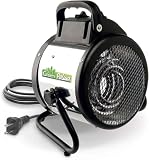
- 1. BioGreen Palma Digital — Best overall
- 2. VEVOR BG-E2A-15 — Best for pros
- 3. Joylight GHH — Runner-up
- 4. BioGreen Palma Manual — Best for beginners
- 5. RuoKid GHT-BK-1500W — Best for heavy use
- 6. VEVOR BGP1506-150 — Best budget pick
- How much space will 1500W really hold?
- What to look for if you shop beyond this list
- Is a greenhouse-labelled heater worth it over a space heater?
- The verdict
- FAQ
The best electric greenhouse heater is the BioGreen Palma with digital thermostat, a 1500W stainless-steel unit that moves 5800 ft³/h of air and holds a set temperature between 32°F and 185°F. For a smaller grow tent or a seedling bench indoors, the VEVOR BGP1506-150 at 4.54 lb is the better call: it is the lightest and cheapest of the six, and the only one small enough to tuck under a shelf.
Best electric greenhouse heater at a glance
| Pick | Power / airflow | Water rating | Price |
|---|---|---|---|
Best overall BioGreen Palma Digital |
1500W 5800 ft³/h |
IPX4 splash | Check Price |
Best for pros VEVOR BG-E2A-15 |
1500W 25° tilt outlet |
IPX4 claim | Check Price |
Runner-up Joylight GHH |
20 / 750 / 1500W | IPX5 claim | Check Price |
Best for beginners BioGreen Palma Manual |
5120 BTU 4317 ft³/h |
IPX4 splash | Check Price |
Best for heavy use RuoKid GHT-BK-1500W |
1500W 120 ft² claim |
Not listed | Check Price |
Best budget pick VEVOR BGP1506-150 |
1500W 6800 BTU claim |
IP20 dust only | Check Price |




How I cut 30 listings down to six
I started with three cuts and ended with the six above. The first cut was output: anything under 1500W was gone, because five of the six shortlisted units land at exactly 1500W and that has become the floor for a heater sold under a greenhouse label. The one exception is the BioGreen Palma manual model, which is specified in BTUs at 5120 BTU on its top setting rather than in watts. That's the same output class in different units.
The second cut was the water rating. A greenhouse has irrigation, condensation and occasional splashback. Four of the six publish an IP figure: two IPX4, one IPX5, and one IP20 that only covers dust. The RuoKid does not publish an IP figure at all. I kept it because the listing states overheat and tip-over protection, but note the gap in the section below.
The third cut was airflow. Any heater sold for a greenhouse needs a fan mode, because the air needs to move even when the room is already warm. All six offer a fan-only mode. Only the two BioGreen units publish an actual airflow figure in ft³/h, which is why they lead this list.
What actually decides a greenhouse heater
Most guides compare wattage. That is not what decides it in this set. Five of the six draw the same 1500W. What separates them is three things the wattage number hides.
The first is airflow. A heater in a greenhouse is really a fan with a heating element behind it. Warm air needs to reach the far corner of the bench or you get a cold pocket where seedlings damp off. Only the two BioGreen units publish a ft³/h figure, and the digital Palma at 5800 ft³/h moves noticeably more air than the manual version at 4317 ft³/h.
The second is water resistance. IPX4 means protected against splashing water from any direction, and both BioGreen models plus the VEVOR pro pick carry that. The Joylight goes further with an IPX5 claim, meaning protection against a low-pressure jet. The VEVOR budget pick is IP20: fine for a dry indoor tent, wrong for a wet greenhouse floor.
The third is thermostat quality. A digital thermostat that starts and stops the heater at a set number in °F is a different tool from a dial that reads "Low / Medium / High". Four of the six list a digital thermostat. The manual Palma uses a stepless dial. The Joylight advertises three fixed steps at 20W, 750W and 1500W, which is coarser than continuous digital control.
Get those three right and the wattage takes care of itself.
1. BioGreen Palma Digital — Best overall
The BioGreen Palma digital is the best electric greenhouse heater in this set because it pairs the highest published airflow with the widest thermostat range and a stainless-steel, IPX4 body built for a wet floor.
Best for: a hobby greenhouse up to 120 ft² that sees damp, near-freezing nights Skip it if: you only need frost protection in a 4x4 grow tent
Two things separate this from every other pick here. The first is the airflow figure of 5800 ft³/h, which is roughly a third more than its own manual sibling at 4317 ft³/h and the only quantified airflow claim in this set. The second is the digital thermostat range published as -58 to 210.2°F on the listing, with a working range from 32°F to 185°F. That is a real number you can dial in, not a Low-Medium-High dial. BioGreen states two heating steps at 750W and 1500W, so you can drop to half output on a mild night and let the fan handle circulation.
The trade-offs are real. It is the heaviest of the six at 11 lb, the most expensive pick here, and only two sellers list it, so availability can wobble. If you already have a small tent and just want to keep the chill off a shelf of chilli seedlings, that weight is wasted on you.
Pros:
- Highest published airflow in the set at 5800 ft³/h
- Digital thermostat with a wide working range
- Stainless-steel body rated IPX4 for splashing
- Two output steps at 750W and 1500W
- Fan-only mode for warm days
Cons:
- The heaviest pick here at 11 lb
- The most expensive of the six
- Only two sellers list it
2. VEVOR BG-E2A-15 — Best for pros
The VEVOR BG-E2A-15 earns the pro pick because it is the only heater in this set with a 25° adjustable outlet angle, letting you aim heat at a specific bench instead of the ceiling.

Best for: growers who want an angled outlet to direct heat at a specific bench Skip it if: you need a published waterproof rating stronger than splash
If you run a taller greenhouse with staged benches, hot air ends up in the roof and cold air pools around your propagator trays. VEVOR's answer is a 25° tilt on the outlet, which lets you push warm air down at a low tray rather than out at chest height. That is a small design choice with a big effect on how evenly a 10x12 ft space heats.
It is also the second-lightest of the six at 7.12 lb, with a portable handle, and it lists overheat shutoff plus an IPX4 splash claim. VEVOR says the heater has two modes, heating and fan, so summer circulation is covered. The listing category sits under space heaters rather than greenhouse parts, which is honest: this is a well-specified space heater aimed at growers, not a purpose-built horticultural product like the Palma.
The trade-off is popularity. It sells more slowly than most of the set, and only one seller lists it, so if it goes out of stock you wait. For a working grower who values aim over airflow figures, that is a wait worth taking.
Pros:
- Only pick with a 25° adjustable outlet angle
- Second-lightest at 7.12 lb
- Listed IPX4 splash claim and overheat shutoff
- Heating and fan modes for year-round use
- Portable handle and grippy base
Cons:
- Slowest-selling of the set with a listing on space heaters
- Only one seller stocks it
- No published airflow figure
3. Joylight GHH — Runner-up
The Joylight GHH is the runner-up because it is the only pick with an IPX5 waterproof claim and a genuine low-power setting at 20W.

Best for: a damp propagation room where a stronger water rating matters Skip it if: you want a published weight or heated-area figure before buying
Joylight is the only one of the six advertising IPX5, which on paper means protection against a low-pressure jet of water rather than just splashes. In a room where you hose the floor or overhead misters occasionally drip, that upgrade earns its place. Joylight also lists three power steps at 20W, 750W and 1500W. The 20W setting is unusual: it is really a heated-fan mode for keeping air moving and stripping condensation off leaves without adding meaningful heat.
The heating element is described as PTC ceramic, which self-limits its own temperature and is the standard choice for a modern greenhouse heater. The digital thermostat runs the on-off cycle automatically to a set °F target. The size is listed as "Large" without an explicit weight, and the dimensions come to 7.3 x 9.4 x 12.2 in, so it is roughly the same footprint as the Palma.
The reason it lands third rather than first is the paperwork. There is no weight figure, no airflow figure and no heated-area claim, so you cannot compare it head-on with the BioGreen units even when it seems to match them.
Pros:
- IPX5 claim is the strongest water rating here
- 20W fan-plus-trickle setting for humidity control
- PTC ceramic element self-limits temperature
- Digital thermostat with auto on and off
- Flame-retardant housing claim
Cons:
- No published weight
- No published airflow figure
- No stated heated-area figure
4. BioGreen Palma Manual — Best for beginners
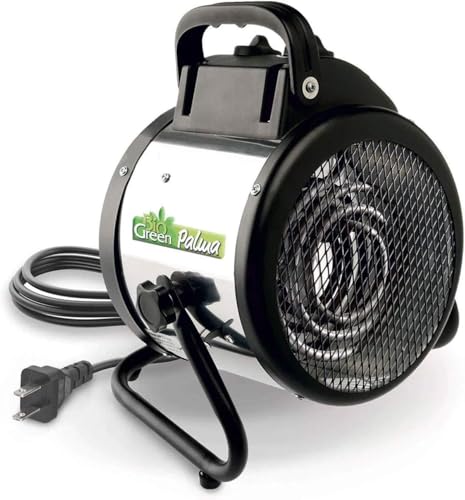
The BioGreen Palma with manual thermostat gets the beginner pick because a stepless dial is easier to learn than a menu, and the build quality still gets you a stainless-steel IPX4 body.
Best for: first-time greenhouse owners who want a dial, not a menu Skip it if: you want to program setpoints down to the degree
This is the same physical heater as the winner, minus the digital control head. BioGreen publishes the output in BTUs at 5120 BTU on the top setting and 2560 BTU on the lower one. The airflow figure is 4317 ft³/h, which is quieter than the digital Palma but still the second-highest quantified airflow in this list. Weight comes down slightly to 9.75 lb, and the stainless-steel body carries the same IPX4 rating.
For a first winter running a greenhouse, a stepless dial is the friendlier interface. You turn it up until the heater kicks in, mark the spot with a pencil, and leave it alone. There is no display to misread at 6 a.m. in the cold, and no menu tree between you and a warmer bench.
The trade-off is precision. You cannot set "38°F" and know the heater will hold to that number the way the digital version does. In a big greenhouse with expensive plants, the digital model is worth the extra outlay. In a lean-to at the back of the house, the dial gets the job done. This is the slowest-selling pick in the set, so shortlist it deliberately rather than by accident.
Pros:
- Same stainless-steel build as the winner
- IPX4 splash-proof rating
- Stepless dial is easy to learn
- 4317 ft³/h published airflow
- Two output steps at 2560 and 5120 BTU
Cons:
- No exact °F setpoint like the digital version
- The slowest-selling pick here
- Second-most expensive of the six
5. RuoKid GHT-BK-1500W — Best for heavy use
The RuoKid GHT-BK-1500W earns the heavy-use pick because RuoKid states the 1500W element heats up in 3 seconds and warms spaces up to 120 sq ft, and it is the second-cheapest heater in the set.

Best for: a 120 ft² space that runs the heater most nights all winter Skip it if: you need a stated weight or IP rating before you buy
RuoKid puts numbers next to two of the questions buyers actually ask. The heated-area claim is 120 sq ft, which is the same figure BioGreen quotes for the Palma with 6.6 ft ceilings. The startup claim is 3 seconds to heat, which is standard for a PTC ceramic element but nice to see stated. The dual-mode design gives you a 1500W winter setting and a fan-only setting for summer or shoulder-season circulation. Tip-over protection is listed, and so is automatic shutoff.
The reason it slots at fifth rather than higher is what is missing. There is no published IP rating, so I cannot tell you whether it survives a splash from a watering can. There is no published weight. The category listing sits under patio heaters. On price it is the second-cheapest of the six, and two sellers stock it, so replacement is easy if a season of hard use kills one.
Buy this if you are running a heater six or seven nights a week and would rather replace it in two years than nurse a premium unit. Do not buy it if the heater will spend time near open water.
Pros:
- Stated 120 ft² heated area at 6.6 ft ceilings
- Second-cheapest pick in the set
- Digital display and thermostat
- Tip-over and overheat protection listed
- Two sellers stock it
Cons:
- No published IP rating for water
- No published weight
- Category listing is patio heaters, not greenhouse parts
6. VEVOR BGP1506-150 — Best budget pick
The VEVOR BGP1506-150 is the budget pick because at 4.54 lb it is the lightest and cheapest heater here, and VEVOR states an output of 6800 BTU from the same 1500W element class.

Best for: a small grow tent, chick brooder or 4x4 seedling shelf indoors Skip it if: the heater will ever see splashing water or open irrigation
This is the odd one out and the reason the list has six picks instead of five. The BGP1506-150 is a small, portable 1500W unit at 8.66 x 6.29 x 6.29 in and 4.54 lb, and VEVOR lists it under greenhouse ventilation equipment. It has three power speeds, an independent thermostat, and a stated 6800 BTU heat claim. That is a lot of heater for the price band.
The catch is the IP figure. VEVOR states IP20 protection, which covers solid objects but not water. That is the correct rating for a chick brooder, a plant tent inside a garage or a seedling shelf indoors. It is the wrong rating for a working greenhouse with irrigation drips and condensation running down the walls, and the listing does not pretend otherwise.
If you want the cheapest way to keep a 4x4 tent above 60°F while starting seeds in February, this is the pick. If your greenhouse floor is ever wet, step up to one of the IPX4 units instead.
Pros:
- Lightest of the six at 4.54 lb
- Cheapest pick here
- Three power speeds
- Stated 6800 BTU output
- Compact 8.66 in footprint
Cons:
- IP20 covers dust only, not water
- Only one seller stocks it
- Small footprint means less throw across a big room
How much space will 1500W really hold?
The rough rule for a hobby greenhouse: a 1500W heater will hold a 120 ft² space with 6.6 ft ceilings above freezing on a night that hits about 20°F outside, if the greenhouse is well-glazed and reasonably tight. BioGreen states that 120 ft² figure explicitly on both Palma listings. RuoKid states the same 120 sq ft coverage. Neither claim depends on outdoor temperature, so treat them as a ceiling rather than a promise.
Three factors shrink that number fast:
- Glazing. Single-skin polyethylene loses heat two to three times faster than twin-wall polycarbonate. If your greenhouse is a plastic hoop house, halve the area figure.
- Air leaks. A door that does not seal will pull the working area down to 60 or 70 ft².
- Setpoint. Holding a room at 55°F for tomato starts costs several times more heat than holding it just above freezing for overwintering.
If your space is bigger than 120 ft², you need two heaters or a different tool. A single 1500W unit on a 15-amp circuit is at its ceiling: two of them cannot share that circuit. Split them across two breakers.
What to look for if you shop beyond this list
If you find another candidate on Amazon and want to check whether it belongs in the same class as the six above, work down this checklist:
- 1500W minimum, or the BTU equivalent around 5100 BTU.
- Published IP rating. IPX4 is the working minimum for a greenhouse. IP20 is fine only for a dry indoor tent.
- Thermostat with a °F setpoint, not just three named speeds. A dial is acceptable if you have a separate thermometer to calibrate against.
- Fan-only mode, because circulation without heat is what you want in shoulder season.
- Overheat and tip-over protection, both stated on the listing.
- A published weight, because that tells you the heat exchanger is not paper-thin.
Listings that skip two or more of the above are usually rebadged desktop space heaters. They will work indoors and fail outside in one wet season.
Is a greenhouse-labelled heater worth it over a space heater?
The honest answer is: sometimes. Two of the six here list under space heaters and one lists under patio heaters. The label is not proof of anything. What matters is the IP rating and the airflow. If a generic space heater carries IPX4 and a proper fan mode, it will survive a greenhouse. If a "greenhouse heater" only carries IP20, it will not. Read the specifications, not the product name. The keyword partial-match here is a real reminder: Amazon's search returned six units under "electric greenhouse", but only four of them publish a water rating strong enough for the job.
The verdict
The best electric greenhouse heater is the BioGreen Palma with digital thermostat. It is the only pick in this set that combines a quantified airflow figure of 5800 ft³/h, a stainless-steel IPX4 body, two output steps at 750W and 1500W, and a digital thermostat you can set in °F. For a 120 ft² hobby greenhouse that sees damp winter nights, that combination is the one to buy and forget about.
Two conditions flip the call. First, if your heater will live inside a grow tent, a shed, or an indoor shelf where water never reaches it, the VEVOR BGP1506-150 is the right buy. It is the lightest and cheapest here, and at 4.54 lb it fits places the Palma physically will not. Second, if you run a taller greenhouse with staged benches and you need to aim heat downward, the VEVOR BG-E2A-15 with its 25° adjustable outlet earns its place: it is the only pick in the set that lets you angle the airflow.
The Palma manual, Joylight and RuoKid are all real options rather than filler, but each concedes something to the digital Palma: no °F setpoint, no published airflow, or no IP rating.
FAQ
Is an electric greenhouse heater worth it in a small greenhouse?
An electric greenhouse heater is worth it whenever your greenhouse holds plants that cannot take a frost. A 1500W unit like the BioGreen Palma holds a 120 ft² space with a 6.6 ft ceiling above freezing on a cold night. Below that size, the smaller VEVOR BGP1506-150 at 4.54 lb is enough and costs less to buy and run.
How much power do these heaters actually draw?
Five of the six picks here draw 1500W on their top setting, which is the ceiling of a standard 15-amp North American outlet. The BioGreen Palma digital and Joylight both offer a lower step at 750W, and the Joylight adds a 20W fan-plus-trickle setting for humidity control. Never share a circuit between two 1500W heaters, or you will trip the breaker.
Which is better, the BioGreen Palma digital or the manual version?
Which is better between the BioGreen Palma models depends on how you set temperature. The digital Palma lets you dial a °F setpoint and moves 5800 ft³/h of air. The manual Palma uses a stepless dial, moves 4317 ft³/h and weighs 9.75 lb rather than 11 lb. For precise seed starting, buy digital. For overwintering with a wall thermometer, the manual model is enough.
What water rating do I need for an electric greenhouse heater?
The water rating you need for an electric greenhouse heater is IPX4 at a minimum, because a greenhouse has irrigation, condensation and occasional overspray. Both BioGreen Palma units and the VEVOR BG-E2A-15 list IPX4. The Joylight goes further with an IPX5 claim. The VEVOR BGP1506-150 is IP20, which covers dust only, so keep it away from water.
Can I use a greenhouse heater in a grow tent?
You can use a greenhouse heater in a grow tent, and several picks here are marketed for both. The VEVOR BGP1506-150 is the natural tent choice: it is small, light and rated IP20, which is fine inside a dry tent. For a wetter propagation tent with humidifiers running, step up to the Joylight with its IPX5 claim, which handles airborne moisture better than IP20 does.
Cold snaps do not warn you, and a single frost will end a seedling tray you have been growing for six weeks. If you are still deciding, order the BioGreen Palma digital and treat it as the default for a 120 ft² hobby greenhouse: airflow, IPX4, digital setpoint, all in one stainless housing. Keep the VEVOR BGP1506-150 in mind for a tent or a shelf. The reason the digital Palma wins is not that it is the most expensive here. It wins because it is the only pick that publishes real numbers for every question a greenhouse owner asks before buying.