Best Cordless Grass Seed Setup for a One-Person Crew

Six picks split into two groups: battery-powered handheld spreaders and the bagged seed that goes in them. The WaxPar unit leads, but coverage figures decide which seed you pair with it.

By Taylor MontgomeryUpdated 18 min read
On this page
- Best cordless grass seed for professionals at a glance
- Why this list splits into spreaders and seed
- How I cut the field down to six
- 1. WaxPar Cordless Grass Seed Spreader Compatible with Ryobi — Best overall
- 2. Generic Cordless Grass Seed Spreader — Best premium
- 3. Scotts Turf Builder Grass Seed Sun & Shade Mix — Best for heavy use
- 4. Scotts Turf Builder Rapid Grass Tall Fescue Mix — Best for families
- 5. Pennington The Rebels Tall Fescue Grass Seed Mix 7 lb — Most versatile
- 6. Pennington Smart Seed Dense Shade Mix Grass Seeds for Lawn — Best budget pick
- Which figure actually decides a cordless grass seed purchase?
- How much ground does one hopper fill cover?
- Does the professional label mean anything here?
- What the listings leave out
- The verdict
- FAQ
The best cordless grass seed for professionals is the WaxPar Cordless Grass Seed Spreader, because at 2.95 lb it stays comfortable through a full shift and the hopper is rated for 9,149 sq ft of product per fill. If you need a bigger hopper and don't mind a listing with almost no published measurements, the Generic 5.5L cordless spreader claims coverage up to 1500 m2. The deciding number in this whole category isn't hopper volume. It's coverage per fill measured against the seeding rate on the bag you're actually pouring in, and those two figures rarely line up the way the box implies.
Best cordless grass seed for professionals at a glance
| Pick | Coverage claim | Weight | Price |
|---|---|---|---|
| 9,149 sq ft per fill (claim) | 2.95 lb | Check Price | |
Best premium Generic Cordless Grass Seed Spreader |
1500 m2 per fill (claim) | Not published | Check Price |
Best for heavy use Scotts Turf Builder Grass Seed Sun & Shade Mix |
745 sq ft new 2,240 sq ft overseed |
5.6 lb | Check Price |
Best for families Scotts Turf Builder Rapid Grass Tall Fescue Mix |
615 sq ft new 1,845 sq ft overseed |
5.6 lb | Check Price |
Most versatile Pennington The Rebels Tall Fescue Grass Seed Mix 7 lb |
Rate varies by use | 7 lb | Check Price |
Best budget pick Pennington Smart Seed Dense Shade Mix Grass Seeds for Lawn |
Up to 1,750 sq ft | 3 lb | Check Price |



Why this list splits into spreaders and seed
Search for the best cordless grass seed for professionals and Amazon hands you two different things in one result page. Two of the six picks here are battery-powered handheld spreaders. Four are bags of seed. That isn't a mistake in the data, it's how the marketplace reads the phrase.
I've kept both groups because a working crew buys both. The spreader is the capital purchase you keep for years. The seed is the consumable you reorder every season.
- Spreaders: WaxPar (2.95 lb, 7.28 x 11 x 12.2 in) and the Generic 5.5L unit.
- Sun and shade seed: Scotts Sun & Shade Mix, 5.6 lb.
- Fast establishment seed: Scotts Rapid Grass Tall Fescue, 5.6 lb.
- Traffic tolerance seed: Pennington The Rebels, 7 lb.
- Deep shade seed: Pennington Smart Seed Dense Shade, 3 lb.
Read the two groups separately. Pick one spreader, then pick the seed that suits the site in front of you. The pairing matters more than either item alone, because a hopper rated for 9,149 sq ft and a bag rated for 745 sq ft at new-lawn rate means you're refilling that hopper far less often than you're opening bags.
How I cut the field down to six
Three things got listings cut before I compared anything else.
- No published coverage figure. If a bag or a hopper doesn't state square footage or square metres, there's no way to plan a route or a materials order around it. Guesswork on a paid job costs you a second trip.
- No stated battery compatibility. For a cordless spreader, the battery question decides everything downstream. A unit that doesn't name a platform is a unit you can't slot into an existing kit.
- Nothing to compare across the set. Several listings published a model number and little else. Two of my six are thin on specifications too, and I've said so in their sections, but they earned a place on published coverage claims that the cut listings didn't have.
What survived is a set where every pick states either a coverage figure or a battery platform, and usually both. The four seed bags all publish a weight: 3 lb, 5.6 lb, 5.6 lb, 7 lb. Three of the four publish a square-footage figure. Two of the four publish a written refund commitment from Pennington, which is the only warranty language in the group worth reading.
The spreaders are where the data thins. WaxPar publishes weight, dimensions and a model number. The Generic unit publishes a model number and a count, and that's it. That gap is the single biggest reason the ranking falls the way it does.
1. WaxPar Cordless Grass Seed Spreader Compatible with Ryobi — Best overall
The only spreader here that publishes its weight and its footprint, and both figures are small enough to carry all day.
Best for: a crew already standing on Ryobi 18V batteries Skip it if: you run a different battery platform
At 2.95 lb bare and 7.28 x 11 x 12.2 in, this is a genuinely one-handed unit. That matters more than it sounds. A handheld spreader is held out from your body while you walk, so every ounce is levered against your shoulder, and the difference between three pounds and six pounds is the difference between finishing a route and switching hands every twenty yards.
WaxPar lists compatibility with 18V Ryobi packs including RB18L40, P100, P102, P104 and P108, plus 12V and 14.4V batteries. Note the "Tool only" in the title. No battery is included, which is the right call if you already own packs and an expensive surprise if you don't. The listing claims five speed settings and a 125° spreading angle, and says the unit ships pre-calibrated and fully assembled with a redesigned hopper and agitator. Those are the manufacturer's words, not measured results.
The hopper claim is 850 m2, or 9,149 sq ft, of product per fill. Against the 745 sq ft new-lawn rate on a 5.6 lb Scotts bag, you're pouring in multiple bags before the hopper empties.
The trade-off is the battery lock-in. The Generic unit doesn't tie you to one brand, and it claims a larger hopper. This is also the second-priciest pick here.
Pros:
- Lightest published weight of either spreader, 2.95 lb
- Compact 7.28 x 11 x 12.2 in footprint
- Names specific 18V, 14.4V and 12V pack numbers
- Five speed settings and 125° angle claimed
- Ships pre-calibrated and assembled, per the listing
Cons:
- Tool only, no battery or charger included
- Useless to you if you don't run compatible packs
- Only one seller lists it
- Second-highest price position in this set
2. Generic Cordless Grass Seed Spreader — Best premium
The largest claimed hopper in the set, on the thinnest listing in the set.

Best for: large open acreage in one long pass Skip it if: you need published weight and size figures first
The headline claim is a 5.5L hopper covering up to 1500 m2, which is roughly 16,000 sq ft, and a dual 4.0Ah battery arrangement. If those numbers hold, this is the unit that walks a big open field with the fewest stops for refilling and the fewest stops for charging. On a large commercial site, refill stops are the hidden cost nobody budgets for.
Here's the problem. This listing publishes a count of 1 and a model number of A-1. No weight. No dimensions. No warranty. No named battery platform beyond the capacity of the packs. For a tool you'll hold at arm's length for an hour, an unpublished weight is a real gap, and it's the reason this sits second rather than first despite the bigger hopper.
The listing describes adjustable scatter width and variable flow rate, calls the unit lightweight, and mentions weather-resistant construction from premium materials. Every one of those is a claim without a figure attached. "Lightweight" next to WaxPar's stated 2.95 lb is not a comparison, it's a word.
It's also the most expensive pick here, and only one seller stocks it. If you want maximum coverage per fill and you're willing to buy on claims rather than measurements, it makes sense. If you want to know what you're carrying before it arrives, it doesn't.
Pros:
- Largest claimed coverage of either spreader, up to 1500 m2
- 5.5L hopper claim, the only stated volume in the set
- Dual 4.0Ah battery setup claimed
- Adjustable scatter width and flow rate
Cons:
- No published weight or dimensions anywhere
- Highest price position with the fewest published specifications
- No named battery platform compatibility
- Only one seller lists it, and no stated warranty
3. Scotts Turf Builder Grass Seed Sun & Shade Mix — Best for heavy use
The widest overseeding coverage of any bag here at 2,240 sq ft, on a mix built for mixed light.

Best for: mixed sun and shade repair work at scale Skip it if: the site is deep shade only
This 5.6 lb bag is the one buyers choose most often across the whole set, and the coverage figures explain why. Scotts publishes 745 sq ft at the new-lawn rate and 2,240 sq ft for overseeding. That overseeding number is the highest per-bag figure in this group, which matters when you're topping up thin turf across several properties in a week rather than building one lawn from bare soil.
The mix is described as suited to full sun and moderate shade, with medium drought resistance and medium to high durability. Scotts also says the product combines seed, fertiliser and a soil improver in one bag, and includes what it calls Root-Building Nutrition. That's marketing language for a coated seed, and it's their claim rather than a tested outcome.
The application window is narrow and specific: soil temperatures consistently between 55°F and 70°F, spring or fall. That's a cooler window than the Rapid Grass mix wants, which quietly makes this the more flexible choice in shoulder seasons. The bag measures 14.5 x 3 x 8.75 in and the listing dates the product to 2022.
Against the others, the weakness is scope. "Moderate shade" is not dense shade, and Pennington's Dense Shade mix exists precisely because that gap is real.
Pros:
- Highest overseeding coverage in the set, 2,240 sq ft
- Works across full sun and moderate shade
- Seed, fertiliser and soil improver in one bag, per Scotts
- Cooler 55°F to 70°F application window
- Sells faster than anything else here
Cons:
- No published warranty, unlike either Pennington bag
- Not rated for dense or deep shade
- Only medium drought resistance stated
- Coverage drops to 745 sq ft on bare soil
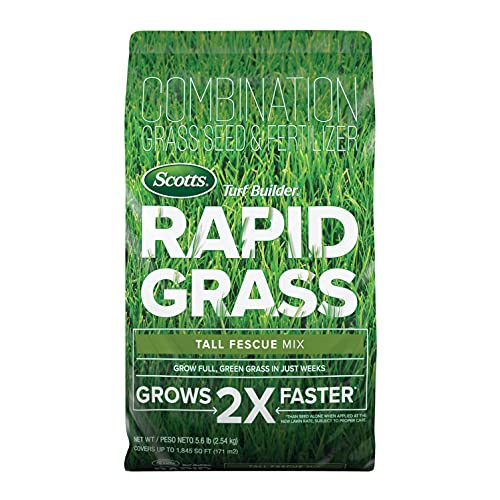
4. Scotts Turf Builder Rapid Grass Tall Fescue Mix — Best for families
Fastest claimed establishment in the set, and the only bag with an explicit warranty entry from Scotts.
Best for: jobs where the client wants visible green fast Skip it if: you seed outside the 60°F to 80°F window
Scotts claims this mix grows grass 2X faster than seed alone at the new-lawn rate, with proper care. Speed is the whole argument. On a job where a homeowner is watching bare dirt and asking questions, weeks matter more than square footage, and this is the only bag in the set making an explicit speed claim.
The coverage figures are the lowest of the two Scotts bags: 615 sq ft new lawn, 1,845 sq ft overseeding, from the same 5.6 lb weight. You're trading roughly 400 sq ft of overseeding reach against the Sun & Shade mix for the faster establishment claim. The bag is slightly larger at 15 x 4.5 x 9.5 in, and the listing carries a warranty entry where the Sun & Shade bag carries none.
Application temperature is 60°F to 80°F, warmer than the Sun & Shade window. That's a real scheduling constraint. Early spring and late fall work often runs cooler than 60°F, which pushes this bag out of the calendar exactly when repair work piles up.
Scotts positions it for overseeding large problem areas and establishing new grass, and describes it as seed and fertiliser combined. Against the rest of the set, its weakness is that narrower window plus the smaller footprint per bag.
Pros:
- 2X faster growth than seed alone claimed by Scotts
- Warranty entry published, unlike the Sun & Shade bag
- Tall fescue base with fertiliser included
- Aimed at large problem areas and new lawns
Cons:
- Lowest coverage of the two Scotts bags, 615 sq ft new
- Warmer 60°F to 80°F window narrows the season
- 1,845 sq ft overseed trails the Sun & Shade figure
- Speed claim depends on proper care, per the listing
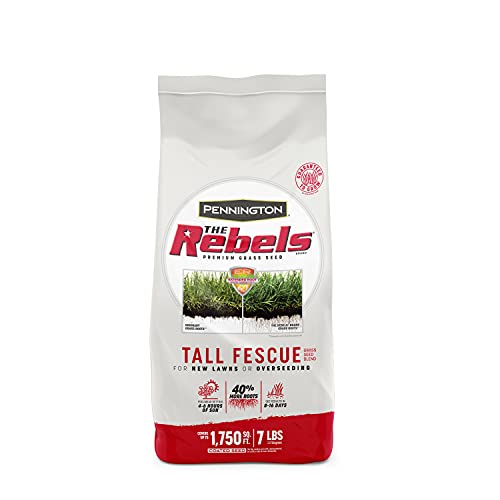
5. Pennington The Rebels Tall Fescue Grass Seed Mix 7 lb — Most versatile
The biggest bag here at 7 lb, aimed squarely at turf that gets walked on.
Best for: high-traffic turf that has to survive heat and feet Skip it if: the area gets under four hours of sun
At 7 lb, this is the largest bag in the set by a clear margin, 25% heavier than either Scotts bag. For anyone hauling material between sites, that's fewer bags to track and fewer trips to the truck. The bag runs 16.5 x 3.55 x 7.5 in, so it stacks flat.
Pennington's claims centre on toughness: thick, deep, dense roots, and turf that withstands heavy traffic, insects, heat and drought. They also state it produces a darker, greener and denser lawn than Kentucky-31 and other tall fescues. Those are the brand's comparisons against other seed, not measurements I can verify, and the "still the best Tall Fescue on the market" line in their copy is marketing rather than evidence.
The number that actually constrains you is the light requirement: 4 to 6 hours of sunlight. That's a real threshold you can check on site with a shadow at noon. Below four hours, this mix isn't the right call and Pennington's own Dense Shade bag is.
Pennington publishes a full written refund policy including a mailing address and phone line, which is stronger consumer language than either Scotts listing carries. The catch is what's missing: no square-footage coverage figure at all. You're sizing the job off the bag's back panel rather than the listing, which is the reason this sits fifth rather than higher.
Pros:
- Largest bag in the set at 7 lb
- Written money-back policy with contact details published
- Rated by Pennington for heavy traffic, heat and drought
- Clear 4 to 6 hour sunlight requirement stated
- Second-cheapest pick here
Cons:
- No coverage square footage published anywhere
- Needs 4 hours of sun minimum, so shade jobs are out
- Comparison claims against Kentucky-31 are unverified
- No fertiliser included, unlike both Scotts bags
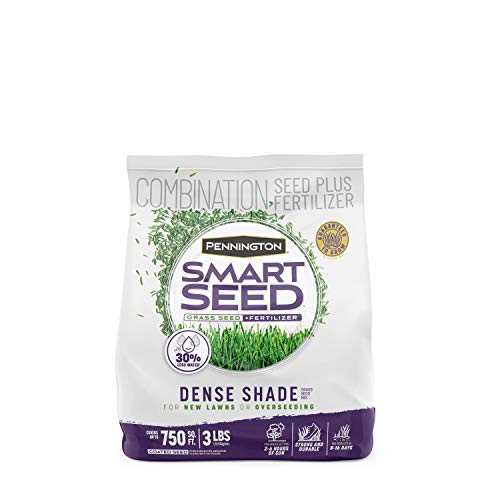
6. Pennington Smart Seed Dense Shade Mix Grass Seeds for Lawn — Best budget pick
The cheapest of the six, and the only mix in the set built specifically for dense shade.
Best for: shaded strips where other mixes thin out Skip it if: you need the largest bag per trip
Coverage per pound is the standout figure here. Pennington states this 3 lb bag covers up to 1,750 sq ft, which is a stronger ratio than the 5.6 lb Scotts Sun & Shade bag managing 2,240 sq ft on overseed and only 745 sq ft new. A lighter bag that covers nearly as much ground is a lighter bag to carry between the truck and the far corner of a property.
This is the only dense-shade formulation in the set. North-facing strips, the ground under mature maples, the side of a house that never sees midday sun: those are the places where a sun-and-shade mix goes thin and a client calls you back. Pennington also claims their Smart Seed mix saves more water year after year than ordinary Kentucky bluegrass seed, which is their comparison rather than a measured figure.
The same written refund commitment applies here as on The Rebels bag, with the address and phone line spelled out in full.
The listing is sparse. Two feature claims total, no light-hour requirement, no seeding rate breakdown between new lawn and overseeding. At 3 lb it's the smallest bag here, so a large shaded property means multiple bags. And it's a specialist: on open sun it isn't the mix you want.
Pros:
- Cheapest of the six
- Best coverage per pound, up to 1,750 sq ft from 3 lb
- Only dense-shade formulation in the set
- Written money-back policy published in full
Cons:
- Smallest bag here at 3 lb
- Only two published feature claims, the thinnest seed listing
- No new-lawn versus overseeding rates given
- Wrong choice for full-sun areas
Which figure actually decides a cordless grass seed purchase?
Most guides to the best cordless grass seed for professionals lead with hopper volume. Volume is the wrong headline number, because a hopper is refilled in thirty seconds and a badly matched seed choice costs you a return visit six weeks later.
Two figures do the real work.
Coverage per fill against seeding rate. WaxPar claims 9,149 sq ft per fill. A 5.6 lb Scotts bag covers 745 sq ft at the new-lawn rate. That means a single hopper fill outlasts several bags, so your bottleneck is material on the truck, not hopper trips. Plan bag count, not fill count.
Light hours on site. Pennington states 4 to 6 hours of sunlight for The Rebels. Scotts describes Sun & Shade as full sun to moderate shade. Pennington's Dense Shade bag exists for everything below that. Walk the property at noon, look at where the shadows fall, and let that pick the bag before price does.
Everything else is secondary. Battery platform matters, but it's a yes-or-no question rather than a spectrum: either you own compatible packs or you don't.
How much ground does one hopper fill cover?
The published figures let you do this arithmetic before you load the truck.
- WaxPar spreader: 850 m2, stated as 9,149 sq ft, per fill.
- Generic spreader: up to 1500 m2 per fill, roughly 16,000 sq ft.
- Scotts Sun & Shade: 745 sq ft new, 2,240 sq ft overseed, from 5.6 lb.
- Scotts Rapid Grass: 615 sq ft new, 1,845 sq ft overseed, from 5.6 lb.
- Pennington Dense Shade: up to 1,750 sq ft, from 3 lb.
- Pennington The Rebels: no coverage figure published.
The pattern is clear. Both spreaders out-cover any single bag by a wide margin, and the Generic unit's claim is roughly 75% higher than WaxPar's. On overseeding work, one 5.6 lb Scotts bag covers a quarter of what the WaxPar hopper is rated to handle. On new-lawn work, it covers under a tenth.
That's why I'd size the job in bags. Count the square footage, divide by the bag's stated rate, add one bag for edges and overlap, then stop thinking about the hopper entirely.
Does the professional label mean anything here?
Honestly, not much. WaxPar uses the phrase "Professional Design" in its own listing copy, and none of the six products carries a commercial certification, a duty-cycle rating or a trade warranty. That's the plain truth of what's published.
So treat "professional" as a shorthand for three practical things you can actually check:
- Does it survive daily use? The published clues are thin. Pennington's written refund policy and the warranty entry on Scotts Rapid Grass are the only formal commitments in the set.
- Does it scale? Coverage figures answer this. Pennington's 7 lb bag and the Generic unit's 1500 m2 claim scale best on paper.
- Does it fit the kit you own? WaxPar names specific Ryobi pack numbers. That's the single most useful line for a working crew in any of these six listings.
If your standard is a genuine commercial-grade tool with a stated duty rating, none of these six meets it, and I'd rather say so than dress up a consumer handheld as trade equipment. What this set offers is light weight, decent published coverage and, in one case, battery compatibility with a platform you may already own.
What the listings leave out
Three gaps run through the whole group.
Noise and vibration. Neither spreader publishes a decibel figure or any vibration data. On a handheld tool you'll hold for an hour at a stretch, that's a genuine unknown.
Runtime. The Generic listing mentions dual 4.0Ah batteries. Neither unit states minutes of runtime per charge, so you can't plan a route around a battery swap. WaxPar ships as tool only, so its runtime depends entirely on which pack you already own.
Seeding rate mechanics. Both spreaders describe adjustable flow, and WaxPar claims five speed settings and a 125° angle. Neither tells you which setting corresponds to which pounds-per-thousand-square-feet rate. You'll calibrate on a tarp with a known weight of seed, which is the standard method anyway.
Grass species breakdown. None of the four seed bags publishes a percentage split of the species in the mix. Scotts names tall fescue for Rapid Grass and Pennington names tall fescue for The Rebels. The Sun & Shade and Dense Shade mixes stay vague on composition.
The verdict
The best cordless grass seed for professionals comes down to the WaxPar Cordless Grass Seed Spreader, and the reason is weight. At 2.95 lb with a 7.28 x 11 x 12.2 in body, it's the only unit here that publishes what you'll actually be holding, and it pairs that with a claimed 9,149 sq ft per fill. Add the named Ryobi 18V, 14.4V and 12V pack compatibility and you have a tool that slots into a kit you may already own rather than starting a new battery platform.
Two conditions flip that.
If you run a different battery brand, the WaxPar's biggest asset becomes its biggest liability, and the Generic 5.5L unit is the buy. Its 1500 m2 coverage claim is roughly 75% higher than WaxPar's, which is the real advantage worth paying for on wide open ground. You accept a listing with no published weight or dimensions to get it.
If you're stocking seed rather than buying a tool, the Scotts Turf Builder Sun & Shade Mix leads on the number that matters, 2,240 sq ft of overseeding coverage from a 5.6 lb bag, the highest per-bag figure in the set. Drop below four hours of sun and Pennington's 3 lb Dense Shade bag takes over at 1,750 sq ft.
FAQ
Is a cordless grass seed spreader worth it over a push spreader?
A cordless grass seed spreader earns its place on jobs a push unit physically can't reach: narrow side yards, slopes, planting beds, ground around obstacles. The WaxPar weighs 2.95 lb, so it's carried rather than pushed. On wide open turf, a broadcast push spreader still moves material faster. Most crews end up owning both and choosing by site layout.
Which spreader gives better value for a working crew?
Better value for a working crew depends on your existing batteries. The WaxPar sits at a lower price position than the Generic unit and publishes its weight and dimensions, which makes it the safer buy. The Generic model costs more and claims a larger 5.5L hopper covering up to 1500 m2. Without a published weight, you're buying its comfort on faith.
How many square feet does one bag of grass seed cover?
Square feet per bag varies sharply by mix and by whether you're seeding bare soil or overseeding. Scotts Sun & Shade covers 745 sq ft new or 2,240 sq ft overseeding from 5.6 lb. Scotts Rapid Grass covers 615 sq ft new or 1,845 sq ft overseeding. Pennington Dense Shade states up to 1,750 sq ft from just 3 lb.
Scotts Sun & Shade or Pennington Dense Shade for a shaded yard?
Choose between Sun & Shade and Dense Shade by counting light hours. Scotts describes its Sun & Shade mix as suited to full sun and moderate shade, so it handles dappled light. Pennington's Dense Shade mix is the only pick here formulated for genuinely dark ground under mature trees or north-facing walls, and it's the cheapest of the six.
What mistake do buyers make with cordless grass seed for professionals?
The common mistake with cordless grass seed for professionals is seeding outside the stated temperature window. Scotts Sun & Shade wants soil consistently between 55°F and 70°F. Scotts Rapid Grass wants 60°F to 80°F. Seed dropped outside those ranges germinates poorly regardless of which spreader laid it down, and you'll be back on site redoing the work.
Start with the battery question, because it settles the tool in one step: if you already own Ryobi 18V packs, buy the WaxPar and be done. Then walk the property at midday and note where the shade sits. That single observation picks your bag faster than any spec sheet, sending you to Scotts Sun & Shade for mixed light, Pennington The Rebels for sunny high-traffic turf, or Pennington Dense Shade for the dark corners. The WaxPar stays the right default because 2.95 lb is the figure you'll feel every hour you're on the job.